

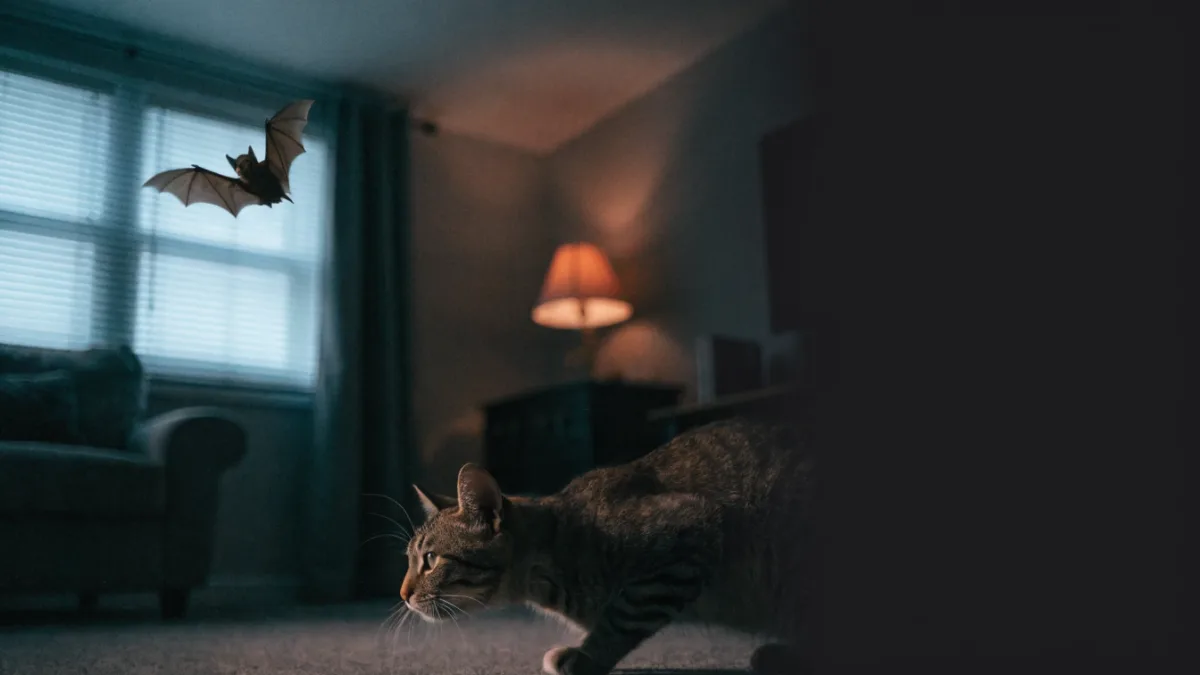
Two Octobers ago, I got one of those Monday-morning calls that rearranges a family’s whole week. A client had woken at dawn to find a bat circling her living room ceiling fan — and her four-year-old indoor tabby, Clementine, perched on the bookshelf directly beneath it, tail bottle-brushed and pupils enormous. “She never goes outside,” her owner told me, voice shaking. “I didn’t think rabies applied to us.” In one version or another, I hear that sentence every single autumn. Rabies in pets isn’t a relic from the 1800s — it’s alive and well in the bats, raccoons, and skunks that share our fences, porches, and, occasionally, our living rooms. And our pets are almost always the ones standing in the middle of that encounter.
The Real Carriers Live in Your Backyard
Here’s the statistic that surprises most of my clients: more than,[1] not in pets. The backyard culprits are predictable — bats, raccoons, skunks, and foxes. Yet when researchers tallied thousands of reported terrestrial rabies exposure incidents, dogs accounted for roughly two-thirds and cats about a quarter. That’s not because dogs and cats are walking reservoirs; it’s because:[2] between wildlife rabies and people. Your dog sticks his nose into the woodpile. Your cat patrols the fence line at dusk. They find the sick animal you’d never approach, and they investigate it with their faces.
Bo, a three-year-old Bluetick Coonhound, is my favorite example. His owner heard a commotion at the woodpile one September evening and found Bo shaking a skunk like a rag doll. Bo was current on his rabies vaccine, which is why this story ends with a booster shot and a bored dog rather than something worse. The skunk escaped — meaning it could never be tested — so Bo’s family spent 45 days keeping him home and watching him closely. Annoying? Yes. A tragedy? No. The vaccine made all the difference.
Recognizing Rabid Wildlife
People expect a rabid animal to be foaming and vicious. The reality is usually stranger and quieter:
- Aggression toward people, animals, or even inanimate objects
- Disorientation — stumbling, circling, walking odd patterns, appearing almost drunk
- Unusual tameness — a raccoon that strolls up to you, a skunk that doesn’t run off
- Drooling from progressive paralysis of the jaw and throat
- Wrong-hours activity — nocturnal species out in broad daylight (a clue, not proof)
Timing matters too. [3] young animals are dispersing, everyone is feeding hard before winter, and pets are still enjoying evenings outside in the lingering warmth. Bo and Clementine were both autumn cases, and so are most of the wildlife exposures I’ve logged over the years.
What Happens After a Wildlife Encounter
Nobody loves the paperwork and phone calls that follow a possible exposure, but these rules are built on decades of solid biology — and knowing them before you need them spares you a lot of panic later.
The 10-Day Observation Window
If a dog, cat, or ferret bites a person, the animal is observed for 10 days. That number isn’t arbitrary. Rabies virus only reaches the saliva in the final stage of illness, and by then the animal dies within days. So if your dog is alive and acting normally 10 days after a bite, he could not have been shedding the virus at the time it happened. Two caveats: this applies only to dogs, cats, and ferrets — the species whose disease timelines we know inside and out — and it’s an entirely different situation when your pet is the victim of a wild animal.
Why You Shouldn’t Throw the Bat Outside
There is no live-animal test for rabies. Diagnosis requires examining brain tissue, which means the bat, skunk, or raccoon must be captured or recovered intact. So when public health officials beg you not to shoo the bat out the window or bury the skunk, they’re not being dramatic. If a possible exposure occurred, contain the animal safely — never bare-handed; use gloves and a box or bucket — or call animal control. One lab result can be the difference between a routine booster and months of quarantine for your pet.
Quarantine Rules: Vaccinated Versus Not
Exact rules vary by jurisdiction, sometimes even between neighboring counties, but the framework is consistent:
- Vaccinated pet exposed to wildlife: a rabies booster right away, then typically 30 to 45 days of quarantine, usually at home.
- Unvaccinated pet exposed: strict quarantine of three to six months at an approved facility, at the owner’s expense — or euthanasia, depending on local law.
- Overdue for a booster: handled case by case. Some jurisdictions treat previously vaccinated animals as protected if they’re boosted promptly. Never assume — call.
I understand the temptation to skip the phone call and just watch your pet at home. But rabies is almost invariably fatal once symptoms begin, in animals and in people alike, and reporting promptly nearly always gives you more options, not fewer. When in doubt, call your veterinarian or animal control the same day. I’ve watched a family absorb a four-month facility quarantine for an unvaccinated barn cat who tangled with a skunk they couldn’t recover — the cat survived, but nearly every part of that ordeal was avoidable.
Why Indoor Cats Still Need the Rabies Vaccine
I’ll admit something: early in my career, I was soft on this. When a client with a strictly indoor cat hesitated about the rabies vaccination for cats, I didn’t push. I’ve changed my mind, and Clementine’s owner is a big part of why. Bats don’t recognize the concept of an indoor cat. They slip through gaps smaller than a couple of centimeters — around chimneys, attic vents, torn window screens, spaces where pipes enter the house. And bat teeth are so fine that a sleeping person or pet can be bitten without anyone noticing a wound. Nobody saw Clementine get bitten. Nobody could say she hadn’t been.
Because Clementine was unvaccinated, one bat in the living room set the whole machinery in motion. Fortunately, her owner had the presence of mind to trap it under a colander and call animal control before disposing of it. The bat tested negative, Clementine got her first vaccine that afternoon, and the family spent a short observation period at home instead of a months-long facility quarantine — or an unbearable decision. If that bat had tested positive, or had simply flown out the window, “she never goes outside” would have offered her no protection at all.
There’s a larger pattern here. In most recent years in the U.S., cats have actually outnumbered dogs among reported rabid domestic animals, largely because cats’ vaccination rates lag behind dogs’ — even though a cat’s hunting instincts put her squarely in contact with bats and small sick mammals. Add in the reality that “indoor-only” cats do escape, and one dart through an open door is all it takes. In many jurisdictions, the vaccine isn’t optional anyway; the law typically covers all cats past the minimum age, lifestyle notwithstanding. Your veterinarian can map out the right schedule and products for your cat’s age and health.
Living With Wildlife Without Living in Fear
The goal has never been to purge our neighborhoods of wildlife. It’s to build a buffer between wildlife and the people and pets we love:
- Vaccinate every cat and dog — indoor, outdoor, and everything in between — and keep boosters current.
- Don’t touch wildlife, including babies that look abandoned; call a licensed wildlife rehabilitator instead.
- Handle bats with a box and a phone call, never your hands — and never release a bat that shared a room with a sleeping person, child, or pet until you’ve spoken with public health.
- Bat-proof your home in late fall and winter by sealing gaps and capping chimneys, ideally with humane exclusion so you don’t trap animals inside.
- Remove the buffet: feed pets indoors, secure garbage and compost, and bring food-motivated dogs in at dusk during peak season.
There’s hopeful news on the conservation side, too. Oral rabies vaccination programs — bait drops that immunize raccoons, foxes, and coyotes where they live — have quietly contained the geographic spread of raccoon-variant rabies across large regions without harming the animals. It’s one of the best examples I know of fighting a disease while protecting the wildlife that carry it.
Here’s the takeaway I’d offer over a backyard fence: rabies is still out there, but the wall between wildlife rabies and your family isn’t a taller fence or fear of the dark — it’s a small vaccine, given on schedule, in every pet you love. And remember, the skunks and raccoons were digging in this soil before your house was built, and bats were catching mosquitoes overhead all summer — a single bat can consume hundreds of insects in a night, and several of those species are now struggling against white-nose syndrome. They’re neighbors, not enemies. Keep your pets vaccinated, keep your hands off wildlife, and keep animal control’s number handy. Do that, and you can share your backyard with wildlife for all the right reasons.
Sources
- 90 percent of reported rabies cases in animals occur in wildlife — cdc.gov
- pets are the interface — pmc.ncbi.nlm.nih.gov
- Wildlife encounters reliably spike in the fall — facebook.com