

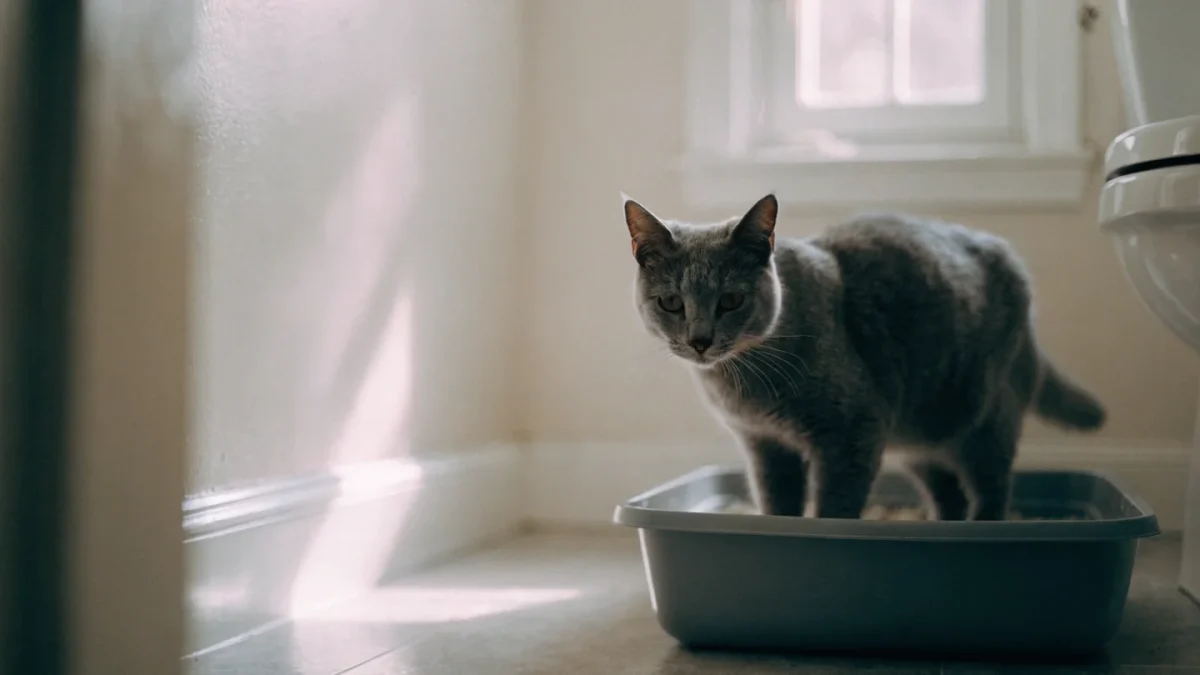
Of all the things I discuss with cat owners, litter box issues might top the list — both for frequency and for the anxiety they generate. Learn more about common cat health problems here. A cat not using the litter box, straining while trying to urinate, or vomiting repeatedly isn't just an inconvenience. It's the cat's primary way of telling you something is wrong, because the cat has no other way to tell you.
Digestive and urinary problems are among the most common reasons cats are brought in for urgent visits. Understanding what's happening — and more importantly, what can wait versus what can't — helps owners make faster, better decisions when something seems off.
Inflammatory Bowel Disease (IBD)
Inflammatory bowel disease is a chronic condition characterized by abnormal immune cell infiltration into the walls of the stomach and intestines, causing ongoing inflammation. It's one of the most common causes of chronic vomiting and diarrhea in cats, and it's frequently under-diagnosed because owners attribute the symptoms to "sensitive stomach" or the cat just being particular.
What IBD Looks Like
The clinical picture of IBD varies:
- Vomiting: Can be daily, several times a week, or intermittent. Often occurs after eating but sometimes on an empty stomach.
- Diarrhea: May be chronic, intermittent, or alternating with normal stools. Sometimes accompanied by urgency.
- Weight loss: Even in cats that appear to have reasonable appetite, chronic malabsorption leads to gradual weight loss.
- Changes in appetite: Some cats become pickier; others develop a ravenous appetite because nutrients aren't being absorbed properly.
Vomiting a hairball occasionally is normal. Vomiting consistently more than once or twice a month is not, and shouldn't be normalized.
The Diagnostic Challenge
Diagnosing IBD requires ruling out other causes of the same symptoms: parasites, hyperthyroidism, kidney disease, pancreatitis, and — critically — low-grade gastrointestinal lymphoma, which can look nearly identical to IBD both clinically and on imaging. This distinction matters because the treatment differs significantly.
A thorough workup typically includes bloodwork, fecal testing, abdominal imaging (ultrasound is more informative than radiographs for GI disease), and often intestinal biopsies — either via endoscopy or surgical biopsy. The biopsy is the definitive test.
Managing IBD
Treatment usually has two components:
-
Dietary modification: Many cats with IBD respond to hydrolyzed protein diets or novel protein diets, which reduce the antigenic load in the gut. Some cats do best with highly digestible, low-fiber diets; others with fiber-supplemented options. Finding the right diet sometimes requires trial and error over several weeks.
-
Immunosuppressive medication: For moderate to severe IBD, corticosteroids are the most commonly used treatment — they reduce intestinal inflammation effectively. Cats who can't tolerate steroids or who need long-term management may be transitioned to other immunosuppressive agents.
For more detail on symptoms and dietary approaches, see IBD in cats and its dietary management.
Urinary Tract Infections (UTIs)
True bacterial urinary tract infections are less common in cats than many owners assume — particularly in younger cats. Stress-related cystitis (inflammation without infection) is far more common in cats under ten. In older cats, especially those with dilute urine from kidney disease or diabetes, bacterial UTIs occur more frequently.
Signs of a UTI
- Frequent trips to the litter box with small or no urine output
- Crying or vocalizing while urinating
- Blood in the urine (pink or red tinge)
- Urinating outside the litter box
- Excessive licking of the genital area
Diagnosing a UTI requires a urine sample — ideally obtained by cystocentesis (a small needle through the abdominal wall directly into the bladder, which sounds alarming but is quick, safe, and gives a sterile sample). Culture and sensitivity testing identifies the specific bacteria and which antibiotics will be effective.
Treating with antibiotics based on culture results — rather than broad-spectrum empirical treatment — reduces the risk of antibiotic resistance and ensures the right drug is used.
Feline Lower Urinary Tract Disease (FLUTD)
FLUTD is an umbrella term covering several conditions affecting the bladder and urethra. Understanding it matters because it includes a spectrum from mild and self-resolving to immediately life-threatening.
Feline Idiopathic Cystitis (FIC)
This is the most common FLUTD diagnosis in cats under ten, accounting for approximately 60-70% of cases in several large clinical studies. The bladder becomes inflamed — painfully so — without a bacterial infection, crystal formation, or other identifiable cause. Stress is the primary trigger: changes in routine, new pets, construction, rehoming, and even weather changes have all been implicated.
FIC typically resolves within five to seven days even without treatment in cats who can urinate. Management focuses on addressing the underlying stressor, increasing water intake, and sometimes medication for pain and inflammation during the acute episode. Cats who have one FIC episode are prone to recurrence.
Urinary Crystals and Stones
Crystals (struvite and calcium oxalate are the two most common types) can form in the bladder, causing irritation and, in severe cases, contributing to blockages. Diet plays a significant role in crystal formation — particularly urine pH and hydration level. Veterinary urinary diets are formulated to manage specific crystal types, which is why knowing the crystal type before starting a prescription diet matters.
Urinary Blockages: The Emergency
Male cats have a significantly narrower urethra than female cats, which makes them vulnerable to urinary blockages. A plug of mucus, crystals, or tissue can block urine flow completely. What follows is a rapidly escalating emergency.
A cat with a complete urinary obstruction typically:
- Strains repeatedly in the litter box with no output (or just drops)
- Cries or vocalizes during attempts
- Returns to the litter box obsessively
- May vomit or become lethargic as toxins build up
- Will become critically ill — and can die — within 24 to 48 hours if the blockage isn't relieved
A male cat straining in the litter box without producing urine is an emergency. Not a "wait and see" situation. Not a "call us tomorrow." An emergency that needs same-day veterinary care.
Treatment involves catheterizing the urethra under sedation or anesthesia, relieving the obstruction, flushing the bladder, and hospitalization for fluid support while kidney values normalize. Cats who block once have a significantly elevated risk of blocking again — long-term management with dietary changes, stress reduction, and increased hydration is essential.
For a full breakdown of FLUTD and how to recognize a blockage early, see cat urinary blockages and FLUTD.
Pancreatitis
Feline pancreatitis — inflammation of the pancreas — deserves mention alongside GI conditions because it frequently presents with vomiting and reduced appetite, and it often occurs alongside IBD and liver disease in cats. This triple combination is common enough to have an informal name in veterinary medicine: "triaditis."
Unlike dogs, who typically show dramatic vomiting and abdominal pain with pancreatitis, cats often present with subtler signs: reduced appetite, lethargy, vague abdominal discomfort, and weight loss. This makes it easy to miss without specific testing — the fPLI (feline pancreatic lipase immunoreactivity) blood test is the most sensitive marker.
Management of pancreatitis is largely supportive: fluid therapy, anti-nausea medication, pain management, and early reinstatement of nutrition. Cats with concurrent IBD or liver disease require integrated management of all three conditions.
The Litter Box as a Health Monitor
One thing I tell every cat owner: the litter box is the most valuable health monitoring tool in your home. Checking it regularly — noting urine volume, stool consistency, frequency, and anything unusual — gives you a baseline. Deviations from that baseline are often the earliest indicator of developing disease, sometimes weeks before any other symptom appears.
The cats I catch diseases earliest in practice are almost always the ones whose owners are paying attention to the litter box.
Frequently Asked Questions
Is it normal for cats to vomit occasionally?
Occasional hairballs — typically cylindrical, composed of hair, and occurring perhaps once or twice a month — are within normal range. Vomiting food or liquid, especially more than once or twice a month consistently, is worth investigating. Chronic vomiting is not a normal part of cat ownership.
How do I know if my cat has a urinary blockage or just a UTI?
Both may involve straining in the litter box. The key indicator of a blockage is straining without producing urine — the cat appears to be trying but nothing comes out, or only drops appear. Any male cat showing this should be seen immediately. Even if it turns out to be a UTI rather than a blockage, prompt evaluation is appropriate.
Can stress cause urinary problems in cats?
Yes. Feline idiopathic cystitis, the most common cause of urinary symptoms in young to middle-aged cats, is strongly linked to stress. Environmental changes, conflict with other pets, and disruptions to routine are among the most common triggers. Managing stress is part of managing recurrent FLUTD.
Can diet prevent urinary problems in cats?
Diet plays a significant role in urinary health. Wet food increases urine volume and dilutes the urine, reducing crystal concentration and the likelihood of blockage. Cats prone to struvite crystals or calcium oxalate crystals often benefit from prescription urinary diets specifically formulated to manage urine pH and mineral balance.