

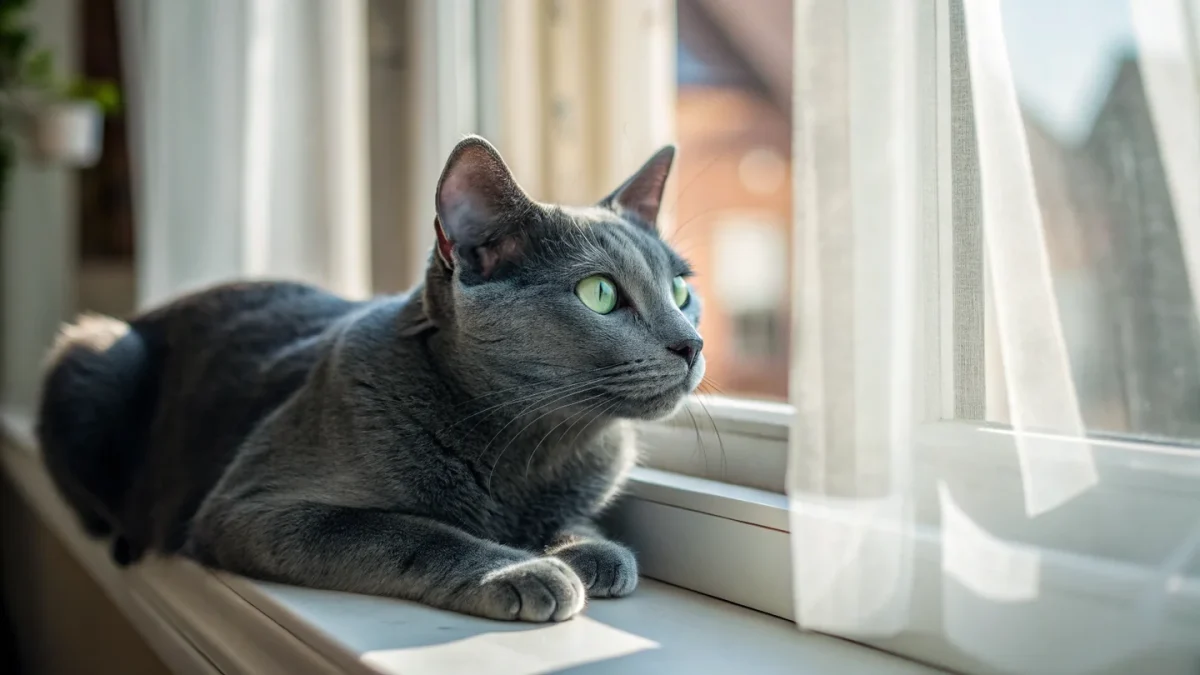
The Russian Blue's reputation as a hypoallergenic cat breed has circulated in cat communities and breed marketing for decades. It is persistent, it is widely believed, and it is — at minimum — significantly overstated. For anyone considering a Russian Blue specifically because of allergy concerns, the most responsible thing I can do is explain what the evidence actually shows.
What Cat Allergies Actually Involve
Most people who are allergic to cats react to a protein called Fel d 1. This glycoprotein is produced primarily in the salivary glands and the sebaceous (skin) glands of cats. It is deposited on the fur through grooming — when a cat licks its coat, Fel d 1 from saliva coats the fur. As fur sheds, the allergen-coated hair spreads through the environment. Dried saliva on shed fur also becomes airborne as the fine particles are disturbed.
The crucial point: the allergen is in the saliva and skin secretions, not in the fur itself. Fur is the carrier and spreader, not the source.
Secondary allergens (including Fel d 2, 3, and 4) also exist and affect some people. Individual allergy profiles vary — some people react strongly to Fel d 1 but not others; some react to multiple proteins. This is one reason "allergy sufferers" don't all respond the same way to the same cat.
Why the Russian Blue Claim Exists
Several mechanisms have been proposed to explain why some allergy sufferers report better tolerance with Russian Blues:
The dense double coat as allergen trap. The Russian Blue coat is thick, plush, and dense. The theory is that the double coat traps shed allergen-carrying particles more effectively than a thinner coat, reducing airborne spread. This is plausible but has not been rigorously quantified.
The breed's fastidious grooming habits. Russian Blues are meticulous self-groomers. More frequent grooming could mean more consistent coat management — though this also means more consistent allergen distribution on the coat, which cuts both ways.
Lower Fel d 1 production. Some sources claim Russian Blues produce less Fel d 1 than other breeds. This is the most commonly cited reason, and it's where the evidence is weakest. There is no well-established, peer-reviewed research demonstrating that Russian Blues categorically produce less Fel d 1 than comparable breeds — and the breed's own fanciers association has said as much: the Russian Blue Fanciers' Association has stated it has "no idea how the idea that the Russian Blue cat is hypoallergenic got started — but it wasn't from us." Individual cats — of any breed — vary in their Fel d 1 production by as much as 80-fold, and this individual variation is typically larger than any potential breed-level variation.
What This Means Practically
For someone with cat allergies who is interested in a Russian Blue:
-
Spend time with individual Russian Blue cats before committing. Not just one — the individual variation in Fel d 1 production means one cat cannot represent the breed's overall allergenicity for your specific sensitivity profile.
-
Know your own allergy profile. If you react to multiple cat allergens or have severe cat allergy, the potential reduction from any breed is unlikely to be sufficient.
-
Be skeptical of breeders who claim definitively that Russian Blues are hypoallergenic. This claim is not supported by reliable research, and breeders who make it are either mistaken or marketing irresponsibly.
-
Consider practical allergen-reduction measures that apply regardless of breed: regular brushing (outdoors or with a HEPA filter running), high-quality air filtration, keeping the cat out of the bedroom, and hand-washing after handling. These interventions reduce allergen load meaningfully for many allergy sufferers.
The Honest Assessment
Some Russian Blue owners with mild cat allergies do experience better tolerance than they did with previous cats. This is real experience and worth acknowledging. The explanations may include individual variation in that specific cat's Fel d 1 production, the breed's coat structure, or factors not yet fully characterized.
What it doesn't mean is that the Russian Blue is a safe choice for cat-allergic people to make without personal testing. The Russian Blue breed guide covers this in the broader context of the breed. The bottom line for allergy considerations is: test, don't assume.