

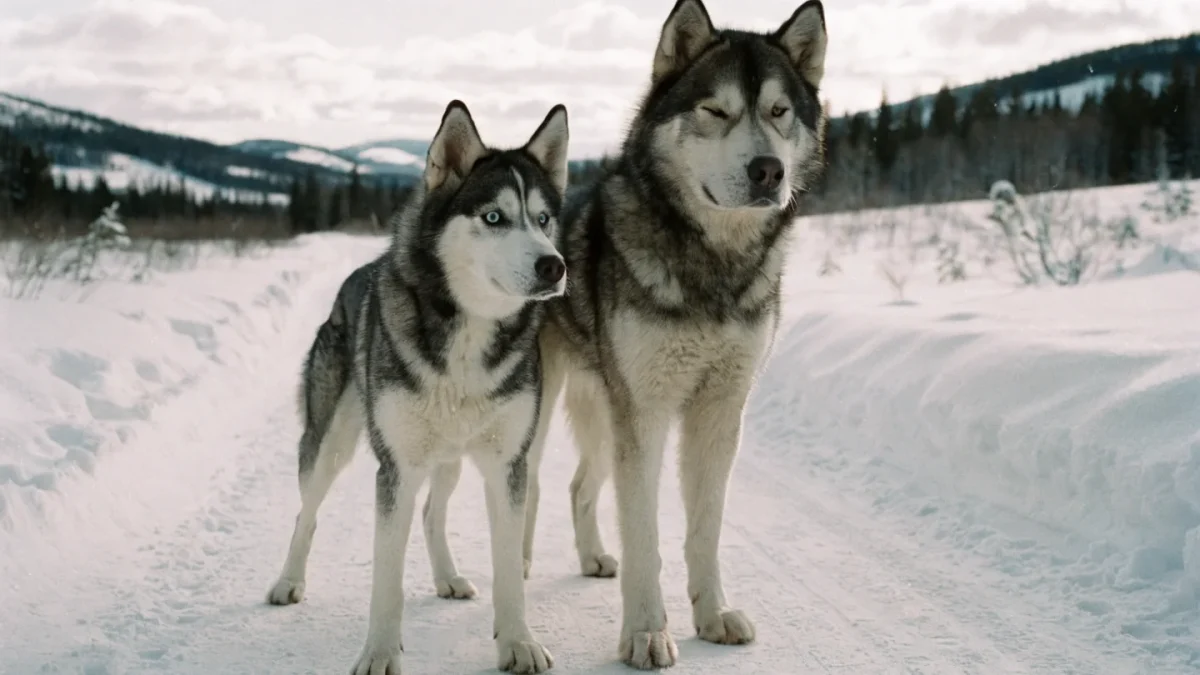
The Chukchi people of northeastern Siberia developed the Siberian Husky over thousands of years as a long-distance sled dog capable of covering vast stretches of frozen terrain at moderate speed on minimal food. The Mahlemut Inuit of western Alaska developed the Alaskan Malamute for a completely different purpose: hauling heavy freight — hundreds of kilograms of supplies — over shorter distances. Speed versus power. That functional difference defines everything about how these breeds compare.
People confuse them because both are thick-coated, wolf-like northern dogs. Beyond that surface similarity, they're built for different jobs and behave accordingly. Here's how they break down using the comparison framework.
Size and Build
| Trait | Siberian Husky | Alaskan Malamute |
|---|---|---|
| Height (male) | 53–60 cm | 63–65 cm |
| Height (female) | 51–56 cm | 58–61 cm |
| Weight (male) | 20–27 kg | 36–45 kg |
| Weight (female) | 16–23 kg | 32–38 kg |
| Build | Medium, lean, built for speed | Large, heavy-boned, built for power |
Standing side by side, there's no mistaking them. The Malamute is substantially larger — often nearly twice the Husky's weight. The Malamute's head is broader, the bone heavier, the chest deeper. The Husky is proportionally lighter and more compact, with a narrower head and a body designed to move efficiently over distance.
Temperament
Huskies are social, energetic, mischievous, and frequently described by their owners using words that are not suitable for publication. They're pack-oriented dogs that generally get along well with other dogs but have strong prey drive toward smaller animals. Huskies are not guard dogs — they'll greet a burglar with enthusiasm.
Malamutes are calmer, more dignified, and significantly more dominant. Same-sex dog aggression is a well-documented breed tendency. A Malamute may live peacefully with dogs it was raised with but react aggressively to unfamiliar dogs, particularly of the same sex. They're loyal and affectionate with their family but carry a seriousness the Husky lacks.
Both breeds are independent thinkers with low recall reliability off-leash. Neither breed is biddable in the way a Labrador or German Shepherd is. They were bred to make decisions on ice — and they still make their own decisions.
Exercise
Huskies have almost limitless endurance. They were developed to run for hours in subzero conditions and that drive persists in pet homes. A Husky without adequate exercise is an escape artist, furniture destroyer, and noise machine. They need 60 to 90+ minutes of vigorous daily activity, and a securely fenced yard is essential — Huskies are legendary escape artists who dig under, climb over, and squeeze through fencing that would contain any other breed.
Malamutes need less raw mileage but still require significant daily exercise — 60 to 90 minutes. Their exercise preference leans toward strength-based activities: pulling carts, weight pulling, loaded hiking. They overheat faster than Huskies due to their greater mass and heavier coat, so summer exercise must be carefully managed.
Grooming
Both breeds have thick double coats that blow out twice a year in spectacular fashion. During coat blows, daily brushing produces shopping bags worth of undercoat. Outside those periods, two to three brushings per week keeps things manageable.
The Malamute's coat is generally coarser and longer, requiring slightly more maintenance. Neither breed should ever be shaved — the double coat regulates temperature in both heat and cold.
Fur will be a permanent fixture in your home, your car, your food, and your lungs. This is non-negotiable with either breed.
Health
| Health Factor | Siberian Husky | Alaskan Malamute |
|---|---|---|
| Top concern | Autoimmune disorders, eye issues | Hip dysplasia, chondrodysplasia |
| Lifespan | 12–14 years | 10–12 years |
| Eye issues | Cataracts, PRA, corneal dystrophy | Day blindness (cone degeneration) |
| Hip dysplasia | Less common | Common |
| Hypothyroidism | Moderate risk | Moderate risk |
Huskies are generally one of the healthier medium-sized breeds, with fewer structural problems than many purebreds. Malamutes, being larger, face more orthopedic issues and a shorter lifespan. Chondrodysplasia (a form of dwarfism) is a known genetic condition in the Malamute — responsible breeders test for it.
Which Fits Your Life?
Choose the Siberian Husky if you're active, have secure fencing, can tolerate an independent and occasionally exasperating personality, and want a social dog that does well in multi-dog households. Be honest about whether you can meet the exercise demands — most Husky rehoming happens because owners couldn't.
Choose the Alaskan Malamute if you want a powerful, calmer northern breed, have experience with dominant dogs, can provide strength-based exercise outlets, and preferably live in a cooler climate. The Malamute is not a first-time dog owner's breed.
For another arctic breed comparison, see how the Samoyed and Siberian Husky match up. For a deep dive into the Husky's Chukchi origins, working drive, and characteristic health concerns, the Siberian Husky complete breed guide covers the breed in full.