

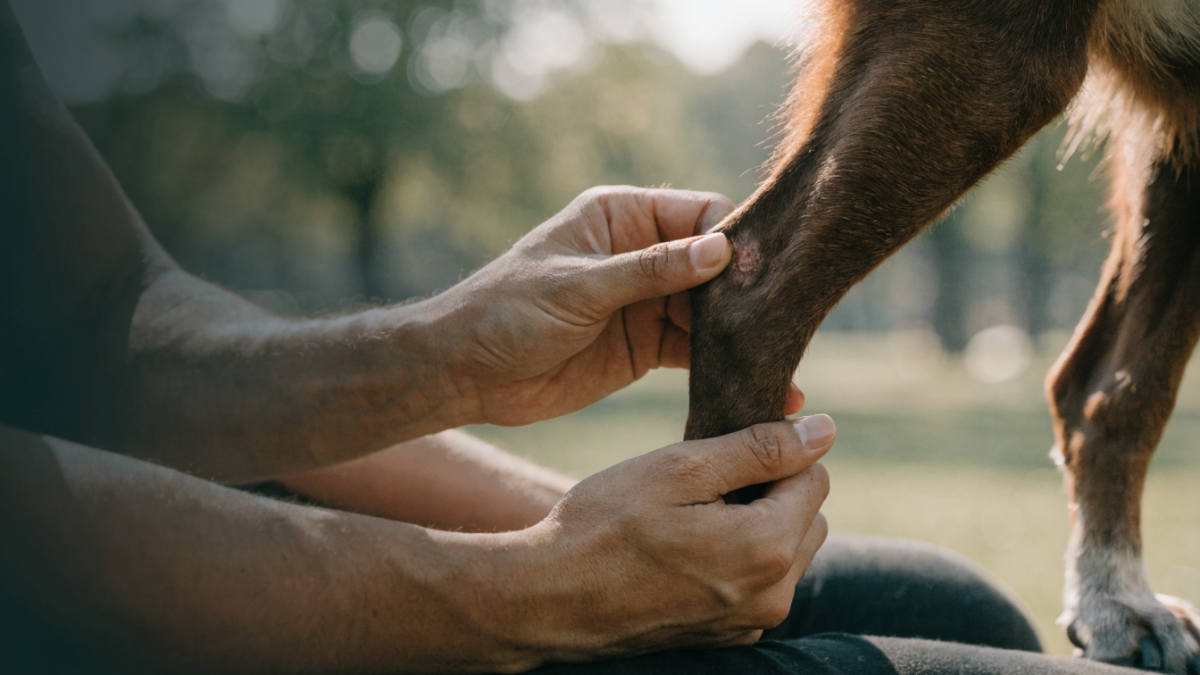
When Marcus, a four-year-old Belgian Malinois, came skidding across the agility course and slammed his knee into the base of an A-frame obstacle, his owner Lisa didn’t think much of it at first. He finished his run, tail wagging. But that evening, she noticed him licking obsessively at a raw, nickel-sized patch on his front knee where the hair and top layers of skin had been scraped away. “It’s just a skinned knee,” she told me on the phone. And she was right — sort of. But a skinned knee on a dog’s lower leg, or a scraped paw on a cat who tried to climb something she shouldn’t have, is a surprisingly complicated injury. These lower-leg abrasions, what veterinary medicine calls distal limb skin defects, are among the most common injuries I see in active pets — and honestly, some of the most frustrating to treat.
Why the Lower Leg Is Such a Problem Neighborhood
Think about the skin on your dog’s neck. You can grab a handful of it, stretch it, and it bounces back. Now look at the skin over your dog’s knee or hock — the equivalent of your shin or ankle area. There’s almost nothing there. The skin sits right on top of bone, tendon, and thin connective tissue with very little fat or muscle underneath to cushion it.
This matters enormously when skin gets scraped away. Elsewhere on the body, if you lose a patch of skin the size of a quarter, the surrounding loose skin can stretch to cover the gap — either naturally as the wound heals or surgically when I pull the edges together with sutures. But on the lower leg, there’s no slack. Trying to suture a wound shut under tension is like trying to zip a jacket that’s two sizes too small. The stitches either tear through the skin immediately or pull apart within days. Research on distal limb skin defects in dogs and cats consistently identifies this lack of tissue mobility as the central challenge in treating these wounds.
The lower leg is also a high-motion area. Every time your dog walks, the skin over the knee bends and stretches. Every time your cat jumps down from the counter, the hock flexes. This constant movement works against healing, disrupting the fragile new tissue that’s trying to form across the wound bed.
First Aid: What to Do in the First Ten Minutes
Before I get into what happens at the clinic, let’s talk about what you should do at home, because the first few minutes after an abrasion happens can significantly influence how smoothly healing goes.
Stop the Bleeding
Most abrasions — even dramatic-looking ones — don’t bleed heavily because they involve the superficial layers of skin. But if there’s active bleeding, apply gentle, firm pressure with a clean cloth or gauze pad for three to five minutes. Don’t peek every thirty seconds to check if it’s stopped; you’ll just break the clot that’s forming.
Clean Gently, Don’t Scrub
Rinse the wound with clean water or sterile saline. If there’s visible debris — gravel, wood splinters, dirt — let the water do the work rather than scrubbing. I know it’s tempting to want to get every speck out immediately, but aggressive scrubbing damages the fragile remaining tissue and actually slows healing. If debris is embedded, leave it for your veterinarian to remove.
Assess for More Than Skin Deep
This is where owners most often underestimate injuries. When a dog slides across rough ground and skins a knee, that same impact can damage the joint capsule, tear a ligament, or cause deeper bruising that isn’t visible through the abrasion. Take a Siberian Husky named Kai, brought in for what looked like a minor knee scrape after a hiking fall; on examination, he’d also partially torn his cranial cruciate ligament — the same ligament that tears in human athletes. The abrasion was the visible injury, but the ligament was the real problem.
So look closely. Is your pet bearing full weight on the leg? Is there swelling extending beyond the scrape itself? Is the joint below the wound feeling warm or looking puffy? If the answer to any of these is yes, that’s not just a skinned knee — and you should see your veterinarian.
At the Clinic: The Sequence That Matters
When an athletic dog or a climbing cat arrives at a clinic with a lower-leg abrasion, the protocol is well established in veterinary wound management. The sequence is: clip, clean, debride, decide.
Clipping the hair away from the wound edges is step one, and it’s more important than owners often realize. Hair in a wound acts as a persistent source of contamination and prevents bandages and topical treatments from making contact with the wound bed. I clip widely — much more than owners expect — because I need to see the full extent of the injury.
Cleaning follows, typically with sterile saline or a dilute antiseptic solution. Debridement comes next: the removal of dead, damaged, or contaminated tissue. Dead tissue in a wound isn’t just useless — it’s actively harmful, serving as a food source for bacteria and blocking the growth of healthy new tissue. Depending on the wound, debridement can range from gently wiping away loose tissue to surgically cutting away damaged skin edges.
Then comes the decision: do I close this wound with sutures, or do I manage it open and let it heal on its own?
To Suture or Not to Suture
This is the central dilemma of distal limb abrasions, and there’s genuine clinical debate around it.
If I suture a lower-leg wound closed and there’s too much tension on the skin, the sutures will cut through the tissue like cheese wire. The wound opens back up, often worse than before because now I’ve damaged the skin edges further. On the other hand, if I leave the wound open to heal by second intention — meaning the body fills in the defect with new tissue on its own — it requires weeks of dedicated bandaging, multiple recheck appointments, and vigilant monitoring for infection. The wound needs to stay moist but not macerated, protected but not sealed off from air entirely.
I’ve changed my own approach over the years. Early in my career, I was more aggressive about trying to close distal limb wounds because it felt tidier, more definitive. But experience — and evidence — has pushed me toward more conservative open-wound management for many lower-leg abrasions, especially when the skin defect is large relative to the available surrounding tissue. Letting the wound declare itself — meaning waiting to see how the tissue looks after a few days of initial healing — often gives me better information about whether closure is realistic.
Dogs and Cats Don’t Heal the Same Way
Here’s something that surprised me when I first encountered it in the research and then confirmed in practice: cats and dogs heal wounds fundamentally differently.
A landmark study on cutaneous wound healing in cats, published in the Journal of Feline Medicine and Surgery, demonstrated that skin wounds in cats heal more slowly than equivalent wounds in dogs. But it’s not just a difference in speed — cats appear to use different biological mechanisms during second-intention healing. Their wounds contract less vigorously, meaning the wound edges don’t pull together as efficiently on their own.
In practical terms, this means that a lower-leg abrasion on a cat often requires a longer healing timeline and more intensive management than the same wound on a dog. This is compounded by the fact that cats are generally less tolerant of bandages than dogs. A bandage on a cat’s paw or lower leg is an invitation for determined removal, and a cat who manages to chew through their bandage and lick the wound can introduce bacteria that set healing back significantly.
I think of Olive, a three-year-old indoor-outdoor tabby who scraped her hind hock sliding off a wooden fence. Her owner brought her in within hours, which was excellent. But keeping a bandage on that leg for the three weeks it needed to heal was a daily negotiation involving recovery suits, e-collars, and eventually a light custom wrap that Olive found just barely tolerable. Her dog counterpart with an identical injury probably would have worn a standard bandage without complaint and healed in ten days.
When Standard Care Isn’t Enough
The encouraging news is that the vast majority of wounds — even challenging distal limb abrasions — heal successfully with standard care. But for the minority that don’t, veterinary medicine has developed increasingly sophisticated options.
Medical-grade honey products, which harness the enzymatic production of low-level hydrogen peroxide and maintain a moist wound environment, have gained solid evidence for managing stubborn open wounds. Hydrogel dressings help maintain the moisture balance that healing tissue needs. For larger defects that won’t close on their own, negative pressure wound therapy — essentially a medical-grade vacuum applied to the wound — can dramatically accelerate the formation of healthy tissue. And for athletic dogs who need to return to sport, specialized skin flap techniques can relocate healthy skin from areas with more tissue availability to cover lower-leg defects.
The Bigger Picture
Most skinned knees and scraped legs are minor setbacks, not major injuries. A few days of rest, proper wound care, and a little patience will see most pets back to their usual antics. But don’t let that familiarity make you dismissive. A lower-leg abrasion deserves the same thoughtful assessment you’d give any injury — because what looks like a simple scrape on the surface can hide joint damage beneath, and because healing on the lower leg is genuinely harder than healing anywhere else on the body.
And here’s a broader thought worth sitting with: the athletic dogs and climbing cats we love are doing what their wild ancestors did — running, jumping, climbing, and occasionally getting hurt in the process. When we bring animals into our homes and ask them to navigate our environments — agility courses with rigid obstacles, fences with splintering wood, concrete and asphalt instead of forest floor — we owe them attentive care when those environments scrape them up. Understanding why a skinned knee is more complicated than it looks isn’t just good medicine. It’s part of the responsibility that comes with sharing our lives with animals whose bodies were designed for a different, wilder world.