
Every trainer I know has had this conversation. Client comes in and says: "My dog is impossible to walk. He's always pulling to sniff everything."
My usual question back: "Are you letting him sniff?"
Most of the time, the answer is no. They're trying to keep moving, maintain a straight line, cover distance. The dog is pulling toward every interesting smell because he's not getting what he needs from the walk.
What Sniffing Does for a Dog
Dogs experience the world primarily through scent. A dog's nose contains roughly 300 million olfactory receptors compared to about 6 million in humans. The portion of their brain devoted to processing scent is proportionally about 40 times larger.
When a dog sniffs a fire hydrant, they're reading a message board: who passed here, when, their reproductive status, their health, their emotional state. It's rich, complex information processed at remarkable speed.
This processing is cognitively demanding. A 15-20 minute sniff walk on a long line — where the dog can explore and sniff freely — is often more tiring than a 45-minute brisk structured walk. The brain is doing serious work.
The Behavior Benefits
Reduced arousal and reactivity. Dogs that get regular sniff time are generally calmer. The mental stimulation provides an outlet for energy that might otherwise manifest as destructive behavior, excessive barking, or leash reactivity.
Better leash behavior overall. When dogs know they'll get sniff time, they're often less desperate and frantic about getting to every smell. The anticipation of permission to sniff makes the structured parts of the walk easier.
Emotional decompression. For anxious or stressed dogs, sniffing has a naturally calming effect. The focused concentration of processing scent lowers heart rate and cortisol for many dogs. This is why structured "sniff walks" are often prescribed for newly adopted dogs, recovering dogs, and dogs going through life transitions.
How to Build a Sniff Walk
A sniff walk doesn't have to replace all structured walking. Think of it as one mode among several.
Cue the permission. Give a word or phrase that signals "sniff time" — "go sniff," "free time," "explore." This also teaches the dog that other cues mean leash manners are expected, because permission to sniff is something they earn by not always being in it.
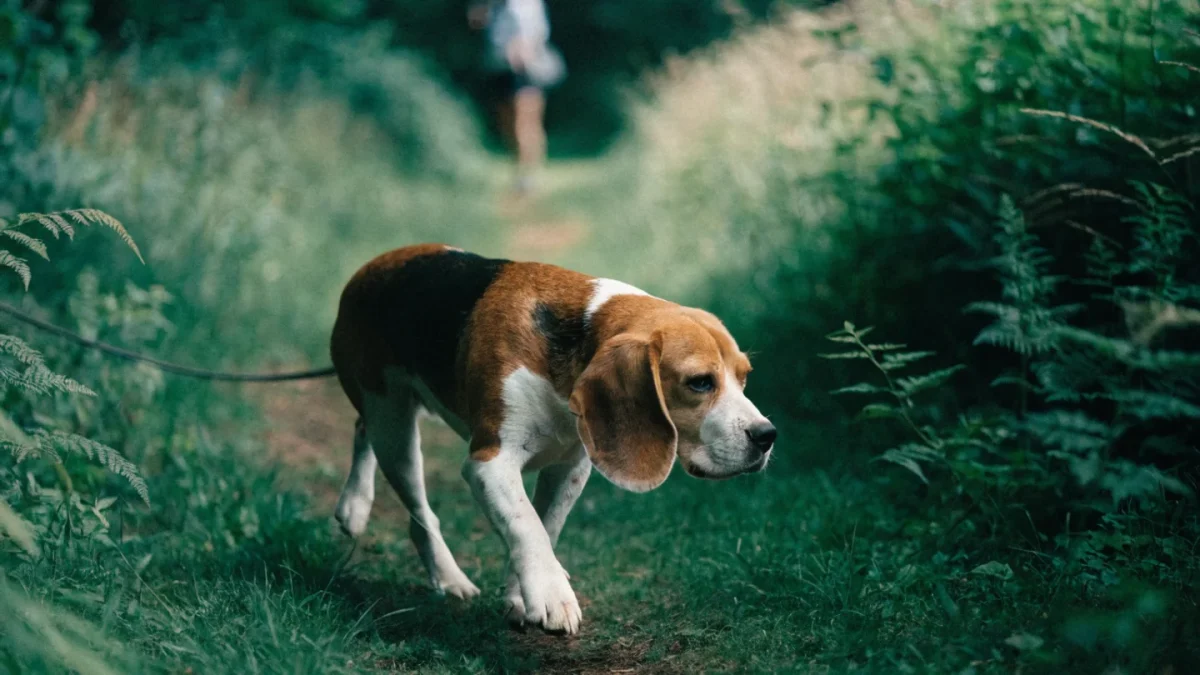
Use a long line. A 15-30 foot long line lets the dog range and explore without you following their nose everywhere. You follow generally, not precisely.
Set the pace by the dog. Stop when they stop. Move when they move. This is their walk, not yours.
Aim for varied environments. New smells are more enriching than familiar ones. Vary your routes, visit natural areas with animal scents, explore different neighborhoods.
What You're Not Doing
Sniff walks aren't about ignoring leash manners entirely or letting pulling go unchecked. The dog should still be moving with you at the other end of a loose long line — they just have much more freedom in where they direct their nose.
Leash walking skills and sniff time aren't in conflict. They're complements. You train one and give permission for the other. (See also: dog sports and enrichment.)
Give your dog at least one proper sniff walk a week. Watch what happens to their overall energy, demeanor, and behavior. Most owners are genuinely surprised by the difference it makes — all from slowing down and following a nose.