

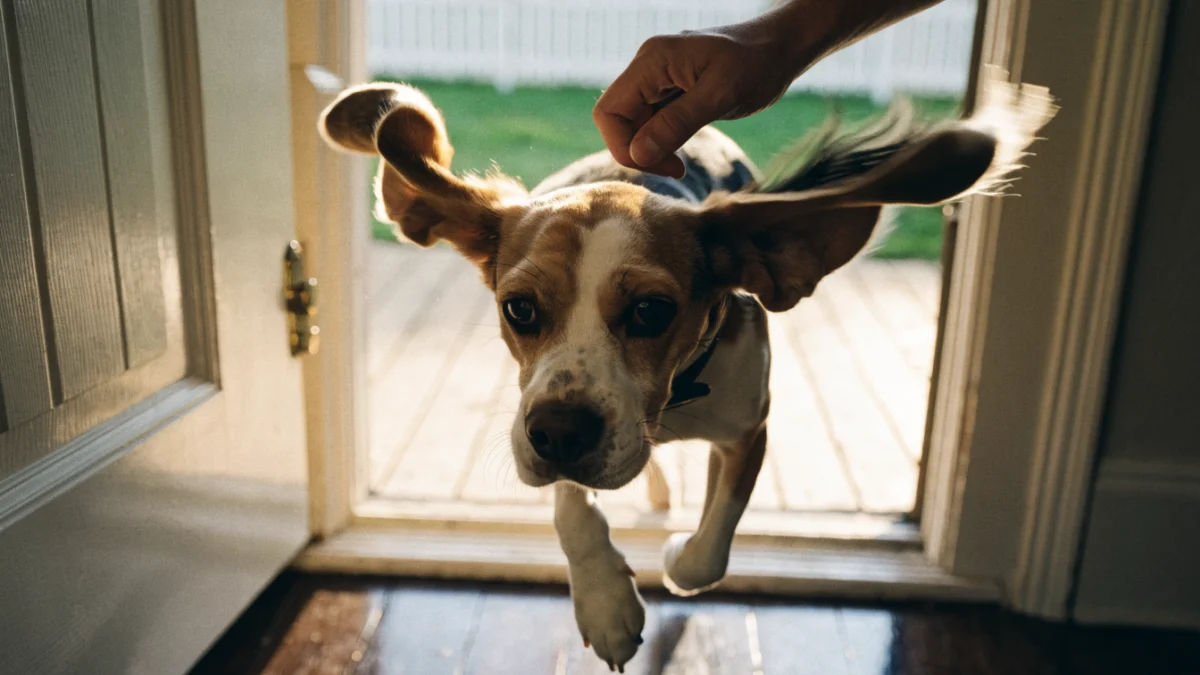
The fastest dog I’ve ever seen wasn’t at a racetrack. It was a nine-year-old beagle named Louie who heard the rustle of a grocery bag, cleared the kitchen in two seconds, and was through the front door before his owner got one foot over the threshold. He was found four hours later, asleep under a neighbor’s azaleas, completely unbothered by the whole ordeal. His owner was not. Roughly one in three pets goes missing at some point in its lifetime, and if you own a door dasher, a fence jumper, or a cat who treats every open door like a personal invitation, you already know the dread. Here’s the good news: most escapes are preventable, and even the ones that aren’t are far more recoverable than people think — if you know what to do in the first hour.
Why Pets Bolt (And Why Every Successful Dash Makes the Next One Harder to Stop)
A dog who runs out the door isn’t being defiant or testing you. He’s playing a slot machine, and the slot machine pays. Outside is squirrels, new smells, the neighbor’s trash can, a game of chase with a panicking human. Every successful dash reinforces the behavior, which is exactly why yelling at the dog after you’ve caught him does absolutely nothing. The reward already happened. The lesson already landed.
The usual motivators are predictable: boredom and under-exercise, prey drive, mating instinct (intact animals roam dramatically more), fear triggers like thunder and fireworks, and plain curiosity. If your dog’s escape habit is fueled by pent-up energy, no training plan will out-work a bored border collie with six hours to kill. Exercise and enrichment are prevention, not a nice-to-have.
And skip the internet’s favorite fixes — spray bottles, scat mats, booby-trapped thresholds. The,[1] and pretty much every welfare-focused trainer land on the same point: punishment after the fact is ineffective, and punishment near the doorway can backfire badly. A dog who gets scolded at the door doesn’t learn to stay inside. He learns to bolt faster, to get away from you and the scary doorway. I used to think a firm “no” at the threshold helped. I was wrong, and it took watching a client’s terrier start launching through the door at double speed to see it.
The Threshold Stay: Teaching Your Dog the Door Isn’t an Invitation
Build the Skill Nowhere Near the Door
Start with impulse control, not the front door. Hand-feed a simple “choice” game: close your fist around a handful of kibble, let your dog poke and lick at it, and open your hand the moment he backs off. He learns that backing away, not pushing in, is what pays. Then put that impulse on a mat — a solid “place” cue six or eight feet from the door gives your dog a job to do instead of orbiting the exit.
Next, teach “wait” at interior doors. Bedroom, bathroom, the hallway — low stakes, zero adrenaline. Open the door a crack; if your dog holds, release him with a consistent word (“okay,” “free,” whatever you’ll actually remember). The lesson you’re installing is that a door opening predicts staying, and exiting only happens on release or on leash. Never on his own initiative.
Add the Three D’s — One at a Time
Once the behavior holds at interior doors, move to the front door and layer in duration, distance, and distraction — separately at first. A common mistake is testing all three at once: doorbell rings, guest arrives, you take a step back, and the whole thing collapses. When your dog breaks a stay, that’s not failure, that’s data. You went too fast. I worked with a Lab whose trigger was the delivery doorbell — the driver’s van could be three houses away and she’d already be posted at the door. We spent two weeks on doorbell recordings alone at low volume before she could hold a place through an actual package drop. Boring? Extremely. It also worked.
While you’re training, manage the environment so rehearsals can’t happen. A baby gate or ex-pen blocking the entryway, a leash clipped on before the door opens, a crate or safe room during parties and delivery windows, and a standing house rule that no dogs are in the foyer when the door’s in play. Every successful dash strengthens the habit, so your job is to make dashes physically impossible during the retraining window.
Cats Can Learn This Too
Cat bolting follows the same logic in reverse: make the door area boring and the rest of the house great. Feed and play far from the entry, use a clicker and treats to build a “place” or “station” behavior away from the door, and desensitize the doorbell with treats at low volume. Microchip-activated pet doors are genuinely useful in mixed households — they let the dog out without giving the cat an exit. And if your indoor cat is desperate for outdoor time, harness and leash training, done patiently, is a far better outlet than gambling on the door.
Escape-Proofing the Yard
Do a Bolt Audit
Walk your fence line like a dog would — low, slow, and looking for opportunity. Check for gaps under gates, and look hard at your latches: plenty of dogs learn to flip a standard latch with a nose or paw, so a padlock or double-latch setup is cheap insurance. Inventory the climb aids. That woodpile, the trash can, the patio chair sitting against the fence? I once walked a yard with a client and her husky mix, and the dog demonstrated the problem herself — she went up the woodpile like a staircase and sat on top of the six-foot fence, surveying her kingdom. Move climb aids away from the fence, trim tree limbs that overhang it, and recheck everything after storms.
Hardware That Earns Its Keep
Most dogs can’t clear a six-foot fence, so that’s your baseline — but athletic breeds need more. Coyote rollers (spinning bars mounted along the top rail) stop climbers and jumpers. For diggers, bury hardware cloth in an L-shape along the fence line, or attach a dig apron at the base; a determined terrier can excavate under a fence in minutes. Self-closing gate hinges close the most common gap of all: the one humans forget about.
What about invisible fences? Honest take: some setups work for some dogs, but motivated dogs blow through the shock when the chase is good enough, and the fence does nothing to keep loose dogs, coyotes, or anything else out. There’s also a real risk that the correction creates fear or reactivity near the boundary. If that tradeoff doesn’t sit right with you, physical barriers plus training are the sturdier answer.
Layer Your ID
If you want to know how to stop your dog from escaping the yard, the honest answer is layers — and that includes ID. Collar tag, registered microchip, and ideally a GPS collar with geofence alerts. The microchip numbers are hard to argue with: in one large veterinary study, chipped dogs made it home 52.2% of the time versus 21.9% without a chip, and chipped cats 38.5% versus 1.8%. That last one is a twentyfold difference. But a chip only works if the registration is current — vet groups even run an annual “Check the Chip” push every August for a reason. Bluetooth trackers are a decent budget layer, but know their limits: no live GPS, and they rely on someone’s phone passing nearby.
Your Indoor Cat Escaped Outside? The First Hour, Step by Step
Before anything else, burn this fact in: an indoor cat that escapes outside does not behave like your cat. Per recovery protocols used by groups like the [2] panicked indoor cats hide in silence, usually within a three-to-five house radius of the exit point. They won’t meow. They won’t come when called. They can stay put for five to ten days — even while starving. Every instinct tells you to search far and wide. That’s the classic mistake.
- Don’t chase, and don’t yell. Chasing drives a panicked cat farther away or deeper into hiding. I know it feels wrong. Do it anyway.
- Mark the exact exit point and direction. Close other doors so the way back through the same door stays open.
- Search low, quiet, and close. Under decks, porches, stairs, bushes, vehicles, sheds. Get on the ground with a flashlight — eye-shine gives away a hiding cat.
- Come back at dusk and dawn. Cats are crepuscular; those are the windows when a scared cat will move. Bring smelly food (tuna, sardines), a familiar treat bag or squeaky toy. Sit still, call softly, listen.
- Lay a scent trail. A worn shirt or the cat’s bedding near the door. The litter box outside is debated — some recovery folks swear by it, others warn it draws feral cats and wildlife, including coyotes, that can push your cat farther out. Know the tradeoff before you use it.
- If you spot her and she won’t come, use a humane trap with strong bait instead of lunging. One grab attempt that fails can reset the clock by days.
- Sound the alarm immediately. Confirm the microchip registration, notify shelters and vets and visit in person every two or three days, post to neighborhood apps and lost-pet groups now, not tomorrow, and put up flyers. Free facial-recognition lost-pet databases now let you search found-animal listings nationwide with one photo.
And don’t quit early. Survey data shows 93% of lost dogs and 75% of lost cats eventually get recovered, and around 59% of cats come home on their own — but cats are routinely found after weeks, not hours. I know an indoor tabby who spent nine days under her own front deck while her owners, following the “search close” advice, finally spotted her eye-shine at 5 a.m. with a flashlight. Day two is not the end. Day nine wasn’t either.
One last thing worth sitting with: keeping pets contained isn’t just about them. Free-roaming cats in the U.S. kill an estimated 1.3 to 4 billion birds and 6.3 to 22.3 billion small mammals every year, according to a landmark 2013 study in Nature Communications. A loose dog is a coyote strike or a car waiting to happen. Train the threshold, audit the fence, layer your ID — and if the worst happens anyway, search close, search quiet, and search at dusk.
Sources
- Animal Humane Society — animalhumanesociety.org
- Community Cat Coalition — facebook.com