

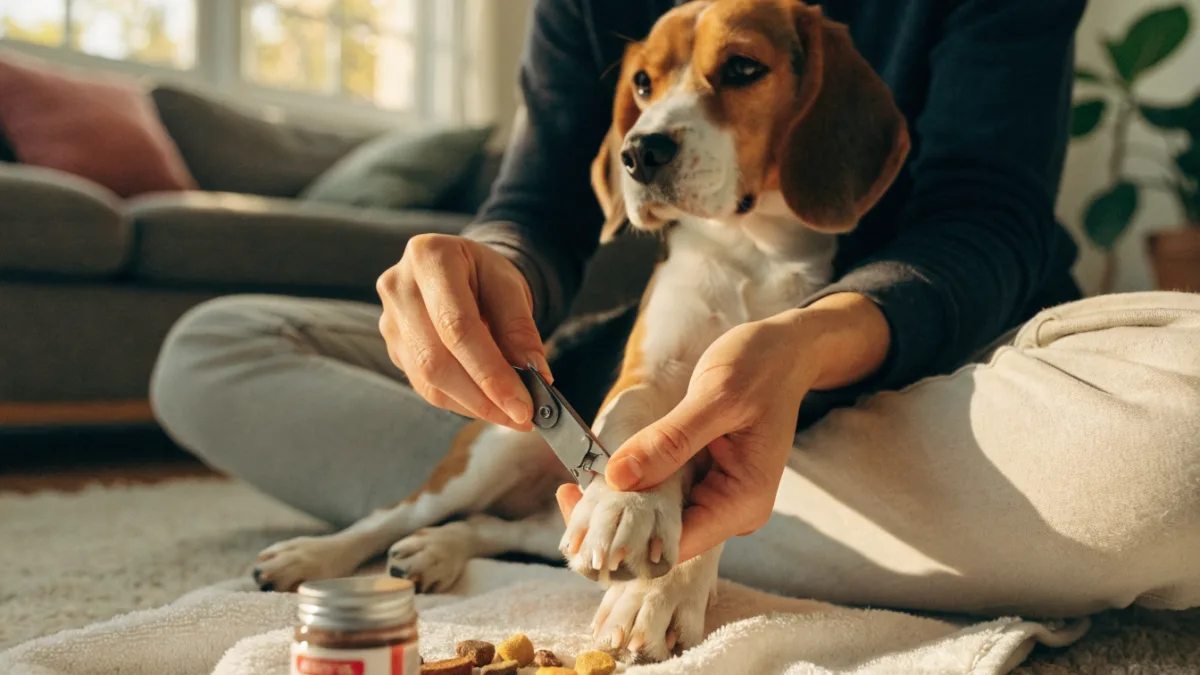
Trim your dog’s nails every three weeks and you’re signing up for about 17 trims a year — well over 200 across an average lifetime. Run every one of those as a wrestling match and you’ll exhaust both of your patience reserves long before the clippers wear out. Here’s the part most guides bury: the whole problem collapses to one measurable benchmark. When your dog tolerates two calm hands on a paw for ten full seconds, the actual cutting is the easy part. Getting there costs nothing but treats and a few minutes a day — and the same system works on cats.
Why Nail Day Becomes a Wrestling Match
Nearly every home-trim disaster follows the same script. An owner cuts too deep once, the nail bleeds, the dog decides clippers mean pain, and the owner decides trims mean blood. Nobody’s wrong, exactly — but the nails keep growing. As the nail lengthens, the quick lengthens with it, so every skipped month makes the next attempt riskier. Avoidance isn’t a neutral choice; it compounds.
Money drives a lot of it. In online grooming communities you’ll find owner after owner saying the quiet part out loud —,[1] so it’s home trims or nothing. That’s honest math, not negligence. A home trim done right costs you five minutes and a handful of treats.
Dark nails crank the fear up another notch. Over on,[2] the most common confession is some version of “I can’t judge where to cut” — usually followed by the story of the time they found out. There’s a fix for that, and I’ll get to it. But first, the philosophical piece: the old answer to a struggling dog was more restraint. Pin harder, go faster, add a second person. The cooperative-care movement flipped that script, and it’s gone mainstream — Fear Free certification, launched in 2016 by Dr. Marty Becker, trained a generation of vets and groomers to earn an animal’s cooperation instead of extracting it by force. Those same drills scale down perfectly to your kitchen floor.
Find the Quick Before It Finds You
Light nails: read the pink
Translucent nails make this easy. Hold the paw gently, press the pad to extend the nail, and you’ll see the pink quick through the nail wall. Cut 2–3 mm ahead of it — close enough to be worth the trouble, far enough that a flinch doesn’t turn into a bleed. Most cats and plenty of dogs with pale coats have see-through nails, so for them, this section is the whole job.
Dark nails: cut slivers, read the cross-section
Black nails hide the quick, so you stop guessing and start reading. Take tiny sliver cuts at roughly a 45-degree angle, and after each one, inspect the face you just exposed. A chalky white ring on the cut surface is your green light for another sliver. When that ring gives way to a darker, damp-looking center, you’re standing on the quick’s doorstep. Stop. This is the single most useful skill in DIY nail care, and almost nobody teaches it.
Two checkpoints tell you when you’re overdue: if you hear clicking on hard floors, or if the nails curl toward — or touch — the ground while the pet is standing, it’s time. Most dogs need a trim every two to four weeks, though dogs walked daily on pavement grind their own nails down and can stretch the interval.
I fostered a retired racing Greyhound named Billie with quarry-black nails and quicks that ran nearly to the tips — kennel dogs aren’t trimmed often, and the quick follows the nail. Three months of weekly sliver trims pulled her quicks back to normal length. Frequent small trims do exactly that: the quick recedes to match the shorter nail. Long quicks aren’t permanent; they’re just a project.
Clippers, Grinders, and the Powder You Hope to Skip
You don’t need brand names here — the type matters far more than the logo:
- Scissor (plier) clippers — my pick for dogs. The cutting action is clean, you can see exactly where the blades meet the nail, and they handle thick nails without crushing them.
- Guillotine clippers — a split decision among groomers. Some love them for small dogs; the blade dulls with use and must be replaced, and threading the nail through the hole costs you precision on dark nails.
- Rotary grinders — nearly impossible to injure a pet with, and they leave smooth edges that don’t splinter. The catch is noise and vibration: many dogs need a week of grinder-introduction sessions before it ever touches a nail.
- Styptic powder — not optional. Keep it within arm’s reach before the first cut. Plain cornstarch works in a pinch, but the real powder stops bleeding faster.
For cats, buy the small scissor-type clippers meant for them. Full-size dog clippers on a cat’s claw is like trimming a bonsai with hedge shears — technically possible, wrong in every way that matters.
From One Second to Ten: The Desensitization Ladder
The [3] lays out the progression I’ve used on every reluctant dog since, and it works because it starts absurdly small. Pick a quiet spot, keep sessions to two or three minutes, and use treats your pet gets nowhere else — liver, cheese, whatever buys real attention:
- Touch the paw for one second, treat, release. Then three seconds. Then five. If your dog pulls away, you went too fast — drop back a step, don’t push through.
- Build to the benchmark: two hands on the leg and paw, calm hold, a full ten seconds. That’s the whole title of this article. A dog who passes this test is ready for tools.
- Bring the clippers into the picture as a neutral object. Hold them in your free hand during handling sessions. Touch each nail with the closed clippers. Treat every contact.
- Run mock trims: everything but the cut. Grip, pad press, clipper placement, release, treat. Repeat until it’s boring.
- Cut one real nail. Then end the session. Yes, one nail. That’s not a consolation prize — it’s a complete, successful session.
Billie the Greyhound needed three weeks of this before I took her first nail. I’ve also had dogs step up the entire ladder in four days because nobody had ever asked them politely before. The speed doesn’t matter; the sequence does. Daily short sessions beat weekly long ones every time.
Cats, Close Calls, and Knowing When to Escalate
Cutting cat claws at home
Cats are easier than their reputation suggests, if you exploit their schedule. Trim during the post-dinner drowse — a sleepy cat tolerates what an alert cat will not. Set the cat on your lap facing away from you, take one paw, press the pad to extend the claw, and take only the hooked tip. Cat quicks sit plainly visible in translucent claws, so the same 2–3 mm rule applies. One or two claws, then let go before the cat decides the session is over. If the cat says no, believe it and try tomorrow; a cat you’ve forcibly restrained once is a cat you’ll be chasing for a year. And skip the full-body towel wrap unless it’s genuinely unavoidable — for most cats, gentle lap restraint is less provocative.
One thing declawing is not: a shortcut. It’s amputation of the toe at the last joint, opposed by major veterinary organizations and banned in a growing number of countries and regions. Trims and glue-on nail caps are the humane options, full stop.
If you hit the quick
It will happen eventually, to everyone. Stay flat-calm — your gasp teaches more fear than the cut did. Press a dab of styptic powder into the tip with firm pressure for 10 to 15 seconds. Then end on a win: a treat, one easy nail you’re confident about, done. Never punish, never scold, never make the next session pay for this one. The animal remembers your reaction longer than the pain.
When home isn’t enough
Some animals carry anxiety past what treats alone can reach, and that’s a veterinary conversation, not a training failure. For genuinely phobic pets, vets now prescribe medication combined with desensitization — the medication alone doesn’t fix nail trims; it lowers the starting anxiety so the drills can actually work. Scratchboards deserve a mention too: the sandpaper-topped boards that teach dogs to file their own nails went viral for a reason, and they’re a legitimate option for dogs who never make peace with clippers. For a dog whose quicks have grown past what you can safely take, one professional trim — sedated if needed — followed by weekly slivers at home holds the ground you paid for.
The takeaway is smaller and bigger than nail care. Ten seconds of tolerance, 2-millimeter cuts, treats that mean something — that’s the entire technical package. What it buys is 17 uneventful trims a year instead of 17 fights, and an animal that doesn’t vanish when the clippers come out of the drawer. Every trim done without force teaches the same lesson from a different angle: that handling isn’t something done to them, but with them. Few things we do for the animals in our homes say that so clearly, so often, for the price of a few minutes and a piece of cheese.
Sources
- they can't afford professional grooming every few weeks — facebook.com
- r/doggrooming — reddit.com
- San Diego Humane Society's training guide — sdhumane.org