

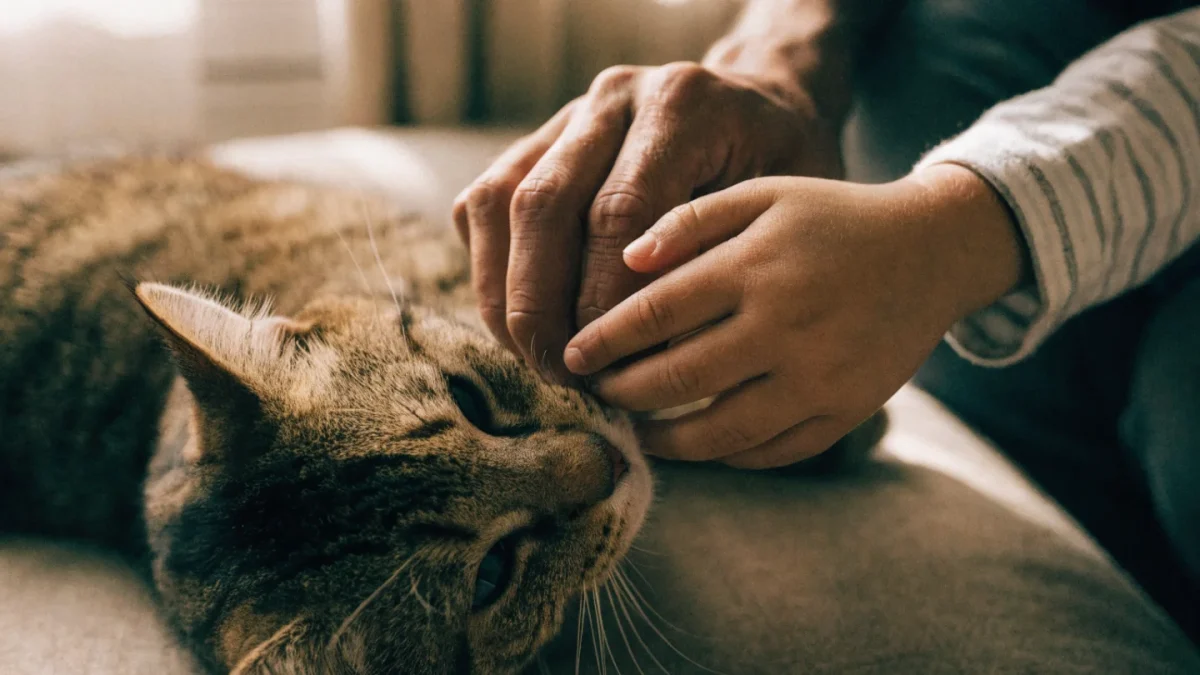
You can't explain consent to a two-year-old using words alone. But you can take their hand, show them how to touch the cat softly, and say "gentle, gentle" until the motion becomes automatic. That's where it starts — and it takes a lot longer than one lesson.
Teaching children to interact respectfully with animals isn't a single conversation. It's hundreds of small moments, repeated corrections that stay calm instead of angry, and a lot of modeling the behavior you want to see.
Start With Body Language
The single most useful thing you can teach a child about animals is how to read basic body language — because animals are constantly communicating, and kids who can't read those signals miss the warnings that prevent bites and scratches.
For dogs:
- Relaxed and happy: Loose body, tail wagging broadly, soft eyes, mouth slightly open
- Uncomfortable: Lip licking, yawning (when not tired), turning head away, whale eye (showing the whites of their eyes)
- Warning: Stiff body, fixed stare, growling, showing teeth, raised hackles
For cats:
- Content: Slow blinks, relaxed body, ears forward, kneading
- Uncomfortable: Flattened ears, twitching tail, dilated pupils, leaning away
- Warning: Hissing, swatting, arched back, fur puffed up
These are the basics, but even young children can learn the big ones: "When the cat's ears go flat, she wants to be left alone" or "When the dog turns away from you, stop touching him."
Model It First
Kids learn more from watching you than from listening to you. Touch the pet gently in front of your child. Talk through what you're doing: "I'm scratching behind her ears because she likes that. See how she's leaning into my hand? That means she's happy."
Also model stopping. "She just moved away from me, so I'm going to let her go. She'll come back when she's ready." This teaches the child that interaction is a two-way choice, not something you impose.
Teach the Rules (and Repeat Them Endlessly)
The specific rules will depend on the pet and the child's age, but these universal ones cover most situations:
- Ask before touching. For other people's pets, this is literal ("Can I pet your dog?"). For family pets, it means approaching calmly and letting the pet initiate or accept contact rather than grabbing.
- No pulling, squeezing, or hitting. This seems obvious, but toddlers don't have refined motor control, and what feels like a gentle grab to them can feel like a yank to a pet.
- Leave them alone when they're eating or sleeping. This is a safety rule. Many bites and scratches happen when a pet is startled or protecting their food.
- If the pet walks away, let them go. This is the consent rule, and it's the hardest for young children to accept because they want to keep playing.
You will repeat these rules many, many times. That's normal. Repetition isn't failure — it's how learning works, especially for young children.
Build Responsibility Gradually
The responsibility piece isn't about handing a child a task list. It's about age-appropriate involvement that grows over time:
Ages 2-4: Help fill the water bowl (with a parent pouring). Put food in the bowl with help. Practice gentle touch with supervision.
Ages 5-7: Fill food and water bowls independently. Help brush the pet. Remind parents when supplies are running low.
Ages 8-10: Full feeding routine. Help with litter box or yard cleanup. Participate in grooming. Begin walking the dog with a parent present.
Ages 11+: Can manage most daily pet care with minimal oversight. Walk the dog independently (depending on the dog and the neighborhood). Recognize when something seems off and report it to a parent.
For a structured approach to this, creating pet chore charts for kids breaks it down into manageable daily tasks.
The critical thing: the parent is always the backup. If the child forgets to feed the dog, the dog still gets fed. Pet care responsibility teaches the child; it doesn't mean the pet's welfare depends on a child's memory.
When Gentle Doesn't Come Naturally
Some kids are rough without meaning to be. They're not being cruel — they're excited, or they don't understand their own strength, or they haven't developed the motor control for gentle touch yet.
For these kids:
Practice with stuffed animals first. Show the difference between gentle and rough touch. Let them practice until the gentle version is consistent.
Redirect instead of punish. "Let's try that again more softly" is more effective than "Don't do that!" Positive reinforcement for gentle behavior teaches faster than punishment for rough behavior.
Supervise more closely. A child who tends toward rough handling needs closer supervision during pet interactions — not as punishment, but as protection for both the child and the animal.
Be patient. Motor skills and impulse control develop at different rates. A child who's rough at three may be wonderfully gentle at five. The consistent teaching matters more than the timeline.
The Empathy Connection
Something I've noticed from watching my friends' kids interact with their pets: the gentleness isn't just about mechanics. It's about the child learning to consider another being's experience. When a child asks "Does the cat like that?" they're practicing perspective-taking — a fundamental empathy skill that translates directly into how they treat other people.
This doesn't happen automatically. It happens because a parent takes the time to say "How do you think the cat feels right now?" and "What is the dog telling you with his body?" — and does it consistently, patiently, for years.
For the full guide to raising kids with pets and more on when to step in during pet-child interactions, those pieces provide the broader context.
FAQ
What should I do if my child hurts the pet?
Stay calm. Comfort the pet first (this models empathy), then explain to the child what happened and why the pet is upset. Don't shame the child — use it as a teaching moment. "When you squeezed too hard, it hurt her. Let's practice gentle touch." If the behavior is repeated, increase supervision and practice gentleness consistently.
At what age can a child be trusted alone with a pet?
This varies by child and pet, but most experts recommend active supervision until at least age 6, and continued check-ins until age 10 or older. The answer depends less on the child's age and more on their demonstrated behavior — a child who consistently reads body language and respects boundaries can earn more independence gradually.
My child is afraid of our pet. What do I do?
Don't force interaction. Let the child observe from a distance and approach on their own timeline. Model calm, positive interactions so the child can see that the pet is safe. Forcing a fearful child to touch or hold an animal usually makes the fear worse. Gradual, voluntary exposure — at the child's pace — is what works.