

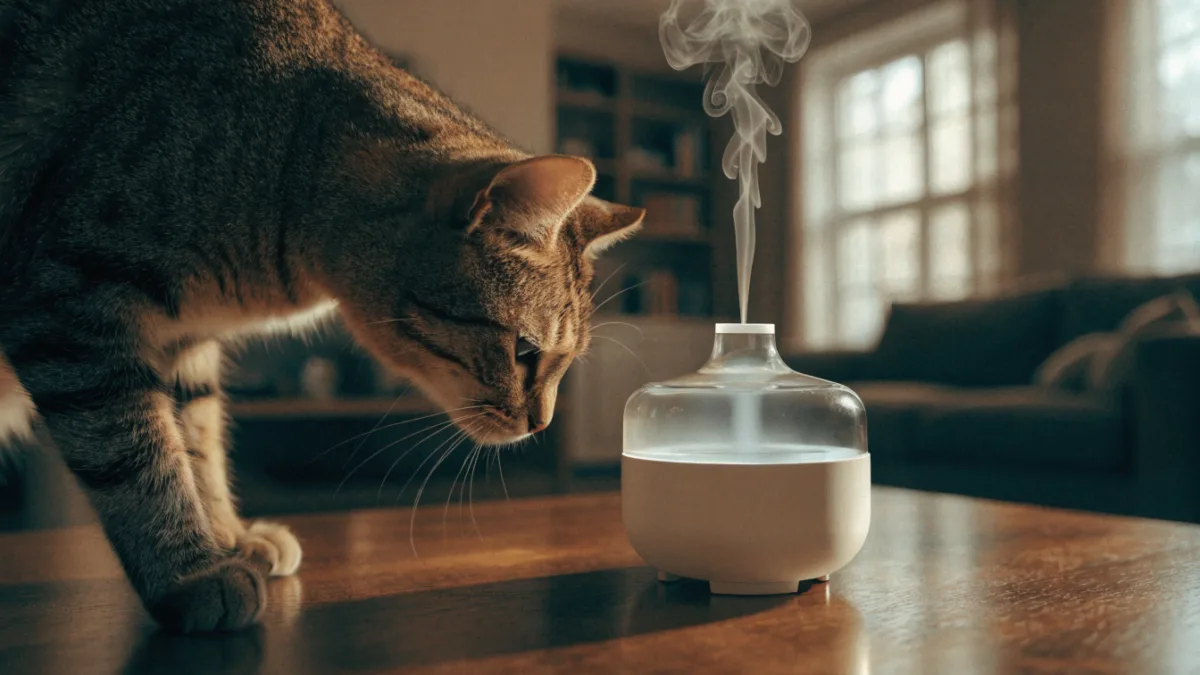
Picture a spring emergency: a woman named Karen brings her three-year-old Bengal cat, Mochi, into a clinic. Mochi was drooling, her breathing was rapid and shallow, and she couldn’t walk straight — she kept listing to the left like a tiny, furry boat taking on water. Karen was terrified, and frankly it is a frightening case to witness. The cause? A waterless essential oil diffuser that Karen had been running in her bedroom with peppermint and eucalyptus oil “to help her sleep.” She’d done her research on which oils were good for humans. What she hadn’t realized was that the same oils could be quietly poisoning her cat.
I see some version of this story far too often. Essential oil diffusers have exploded in popularity over the past decade — driven by home fragrance trends, multi-level marketing companies, and a well-intentioned push toward “natural living.” Animal poison control centers have reported a significant spike in essential oil poisoning cases, and I’d bet most veterinarians in practice today can name at least one patient who was sickened by a diffuser. So let’s talk about what’s actually happening, why our pets are so vulnerable, and what you can do to keep your home smelling fresh without putting your animals at risk.
Why “Natural” Doesn’t Mean Safe
Here’s the thing I hear most often from pet owners: “But it’s natural! It’s from a plant!”
I understand the impulse. When we see the word “natural” on a product, we tend to equate that with “gentle” or “harmless.” But nature produces some of the most potent toxins on earth — botulinum, arsenic, cyanide. The fact that something comes from a plant tells us nothing about whether it’s safe for a particular species to inhale, ingest, or absorb through their skin.
Essential oils are not gentle infusions. They’re highly concentrated chemical compounds. It takes roughly 150 pounds of lavender flowers to produce a single pound of lavender essential oil. These are powerful, biologically active substances, and that’s exactly why they can do so much damage when they encounter an animal whose body isn’t built to process them.
The Biology: Why Pets Can’t Handle What We Can
The Liver Enzyme Problem
The root of the issue comes down to a specific enzyme — or rather, the lack of one. Pets, and particularly cats, are missing a critical liver enzyme called glucuronyl transferase. I know, it’s a mouthful. But what it does is simple: it helps the body break down and eliminate certain compounds through a process called glucuronidation (essentially, the liver attaches a sugar molecule to a toxin so the body can flush it out).
Humans have this enzyme. Dogs have a limited version. Cats? They’re essentially missing it for many of the compounds found in essential oils. So when a cat inhales diffused tea tree oil or gets eucalyptus on their skin, those compounds circulate through their body with nowhere to go. Their liver can’t process them, can’t package them up for elimination, and so the toxins build up — damaging tissue along the way.
Why Cats Are Especially Vulnerable
Cats take the brunt of essential oil toxicity for three reasons:
- Liver biology: As I mentioned, they lack the enzymes needed to metabolize these compounds.
- Thin skin: A cat’s skin is significantly thinner than human skin, which means oils absorb into their bloodstream much faster.
- Grooming behavior: When diffused oils settle on a cat’s fur, they lick it off during grooming — turning a skin exposure into an ingestion exposure.
Dogs are not exempt from harm, but their livers are somewhat better equipped than cats’. Still, certain breeds — particularly small breeds and dogs with pre-existing respiratory conditions — can have serious reactions to diffused oils.
How Exposure Actually Happens
Most people assume the danger is their pet knocking over a diffuser and drinking the liquid. That does happen, and it’s an emergency. But the more insidious exposures are the ones you might not even notice.
Inhalation
When a diffuser runs — especially in a small, enclosed space like a bedroom or studio apartment — it fills the air with microscopic droplets of essential oil. Your pet breathes those in. For animals with sensitive respiratory systems (and cats, in particular, have incredibly delicate airways), those droplets irritate the lungs directly. There are documented cases of cats developing aspiration pneumonia and chemical pneumonitis simply from sleeping in a room where a diffuser ran overnight.
Skin Absorption and Grooming
Those same micro-droplets settle on your pet’s fur. Oils are lipophilic — they’re drawn to fat — and they pass through animal skin remarkably fast. Once absorbed, they enter the bloodstream. And as I mentioned with cats, grooming turns a dermal exposure into an oral one. I saw a Dachshund named Cooper who developed red, weeping sores on his belly after his owner ran a citrus blend diffuser in the living room for a week. The oils had settled on the floor where he liked to nap.
Direct Ingestion
This is the scenario most people picture: a curious pet knocks over a diffuser and licks up the spill. With concentrated oils, even a small amount can cause chemical burns in the mouth and throat, vomiting, and rapid systemic toxicity.
The Oils That Cause the Most Damage
Not all essential oils carry the same risk, but some are genuinely dangerous for pets. Here are the ones I see cause problems most frequently:
- Tea tree (Melaleuca) oil — One of the most common culprits in reported toxicity cases
- Peppermint oil — Frequently used for human “energy” and headache relief
- Eucalyptus — Popular in cold-and-flu blends
- Cinnamon oil — Common in seasonal “cozy” scent blends
- Wintergreen — Particularly dangerous; contains methyl salicylate, related to aspirin
- Clove oil — Found in many dental and “warming” products
- Pine oil — Used in cleaning products and “forest” scent blends
- Citrus oils (lemon, orange, bergamot) — Surprising to many people, since citrus fruits themselves aren’t toxic to dogs
- Pennyroyal — Extremely toxic; sometimes sold for flea control despite the danger
Waterless Diffusers: A Step Up in Risk
There’s an important distinction between types of diffusers that I think a lot of people miss. Ultrasonic diffusers dilute essential oils in water before dispersing them as a fine mist. Waterless diffusers — sometimes called nebulizing diffusers — disperse pure, undiluted essential oil directly into the air. They produce a stronger scent, which is why some people prefer them. But from a veterinary toxicology standpoint, they’re far more dangerous. They put concentrated oil into the air at levels that can overwhelm a pet’s system much faster.
If you’re going to use any diffuser (and I’ll get to why I generally advise against it), the ultrasonic version at least dilutes the oil somewhat. But don’t let that give you false confidence — even diluted oils can cause serious harm over time.
Warning Signs: What Essential Oil Poisoning Looks Like
Early recognition can save your pet’s life. If you use essential oils and notice any of the following symptoms, turn off the diffuser, ventilate the space, and call your veterinarian or a pet poison helpline immediately:
- Drooling excessively — often the first sign of oral irritation or nausea
- Difficulty breathing, wheezing, or panting — signs of respiratory irritation
- Lethargy or unusual fatigue — your pet seems “off” or unresponsive
- Wobbliness or uncoordinated walking (ataxia) — a neurological sign that the toxins are affecting the nervous system
- Vomiting
- Redness, blistering, or chemical burns on the skin
- Pawing at the mouth or face
One thing worth repeating: don’t wait for symptoms to worsen. If you know your pet was exposed to a potentially toxic oil, call before symptoms appear. Toxicologists can help you determine whether you need to come in based on the specific oil, the amount, and your pet’s species and size.
The “Pet-Safe” Label Problem
You’ll find products marketed as “pet-safe essential oil blends” online and in pet stores. I understand why people buy them — the marketing is reassuring, and the intention is good. But here’s where I have to be honest with you: I have not seen reliable veterinary evidence that any essential oil blend is truly safe for cats. Dogs have a slightly higher tolerance, but the fundamental liver enzyme issue remains.
Some oils are less toxic than others. That’s true. But “less toxic” is not the same as “safe,” and I worry that the “pet-safe” label gives people a false sense of security that leads to prolonged exposure. Over time, even low-level exposure to essential oils can stress your pet’s liver and respiratory system in ways that don’t show up until there’s real damage.
I’ve changed my own thinking on this over the years. Early in my career, I was more permissive about “mild” oils. But after seeing enough cases of chronic respiratory irritation and liver enzyme elevation in pets from households with diffusers, I now recommend avoiding volatile oils entirely in homes with cats, and using extreme caution with dogs.
What I Recommend Instead
You want your home to smell good. I get it — I have two dogs and a cat, and I’m not immune to the occasional “eau de wet Lab” situation. Here’s what I suggest instead of diffusers:
- Address the source. A good air purifier with a HEPA filter does more for pet odors than any fragrance. It removes the particles causing the smell rather than masking them.
- Simmer plain water with pet-safe herbs. A pot of water with a sprig of rosemary or thyme on the stove adds a subtle scent without the concentrated compounds found in essential oils.
- Open windows. Ventilation is genuinely the most effective way to clear indoor odors.
- Bake. A batch of cookies makes your house smell incredible, and your dog will appreciate it far more than any diffuser.
If you absolutely want to use a diffuser — and I know some of you will — at minimum, follow these rules: never use it in a room your pet can’t leave, never run it in an enclosed space, keep the door open, stick to ultrasonic (water-based) diffusers, avoid all the oils I listed above, and watch your pet closely for any behavioral changes. And please, talk to your veterinarian about your specific situation.
None of the remedies I’ve mentioned should replace professional veterinary advice — every pet’s situation is different, and your vet can help you make decisions based on your animal’s species, breed, age, and health history.
The bottom line is this: our pets trust us to make their environment safe. They don’t get to choose what we diffuse into the air they breathe or what settles on the floors where they sleep. The essential oil industry is booming, and the marketing is persuasive — but your cat’s liver doesn’t care about marketing. When in doubt, skip the scent. Your pet won’t miss it, and honestly, neither will you once you get used to clean, fresh air instead.