

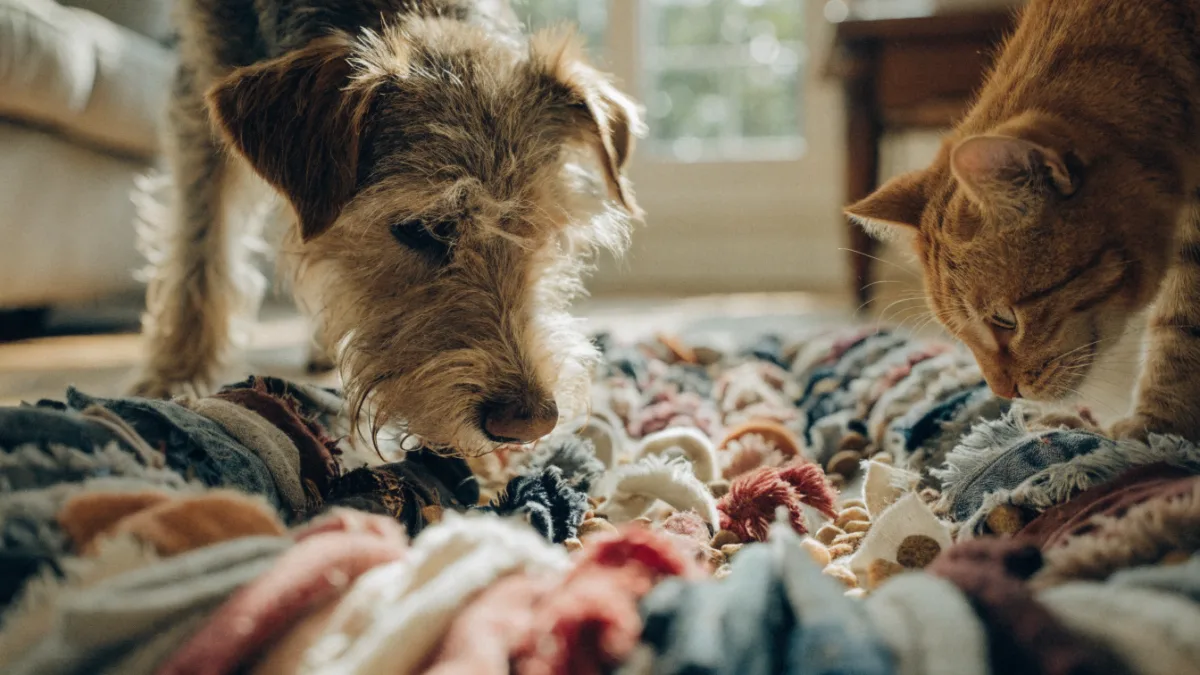
Let’s be completely honest about the traditional food bowl: it is a convenience invented for humans, not a feature designed for animals. If you have a cat like my Mochi, who inhales her breakfast in forty-five seconds flat and then immediately starts yowling for entertainment, or a dog with the endless energy of my roommate’s terrier mix, Buster, you already know that a bowl of kibble does absolutely nothing to keep them occupied. Pets are wired to hunt, sniff, sniff, and forage. When we hand them a free meal in a ceramic dish, we completely bypass their natural instincts. The result? Mind-numbing boredom that usually results in them tearing apart your throw pillows or knocking your favorite mug off the kitchen counter just to see what sound it makes.
The absolute best way to combat this isn’t another long, exhausting walk or dragging a feather wand around your living room until your shoulder gives out. It is mental exhaustion. And the secret weapon to achieving it is an upcycled DIY foraging mat. Often called snuffle mats, these scent-driven puzzle mats force your pet to use their nose and brain to find their food. The pet care industry has fully embraced the trend toward sustainability, and making your own mat out of old household textiles is a fantastic way to reduce environmental waste while saving a significant amount of money on commercial plastic puzzle toys.
The Science of Sniffing: Why Mental Exhaustion Wins
Physical exercise is vital, but for most companion animals, mental stimulation is far more effective at combating boredom than physical activity alone. Think about it from an evolutionary perspective: dogs and cats are built to hunt. Their wild counterparts spend the vast majority of their waking hours tracking, stalking, and foraging for food. Our house pets still have those exact same brain pathways. When they are denied the opportunity to “work” for their meals, they get restless.
Foraging mats engage both the mind and the body. By hiding kibble or treats within the folds of fabric, you are giving your pet a job to do. They have to sniff out the food, problem-solve to figure out how to move the fabric, and use their motor skills to extract the reward. It provides crucial mental exhaustion. In fact, veterinary behaviorists are increasingly prescribing mental enrichment as a primary therapy for behavioral issues like separation anxiety, excessive barking, and destructive scratching. Ten minutes of intense sniffing on a foraging mat can tire out a dog or cat just as much as a thirty-minute walk, simply because processing scent takes an incredible amount of brain power.
Not Just for the Dogs
While these mats are heavily marketed toward the canine crowd, they are highly effective enrichment tools for cats as well. Cats are natural foragers, and using a scent-driven puzzle taps directly into their instinctual hunting behaviors. According to feline welfare experts at,[1] foraging mats are phenomenal ways to engage a cat’s mind and body simultaneously. Mochi absolutely loves hers—it takes her three times as long to eat her dinner, and she usually takes a massive nap immediately afterward, which is a win for both of us.
Gathering Your Upcycled Stash
One of the best parts of this project is that you likely already have everything you need lying around your house. Upcycling household materials like old towels, worn-out blankets, and scrap fabric drastically reduces the cost of pet enrichment compared to buying fancy toys. Plus, it keeps those textiles out of landfills.
To build a solid foraging mat, you need two main components: a sturdy base and a variety of fabric strips.
The Base
You need something that can withstand scratching, pawing, and enthusiastic sniffing. Your best options for a base are a rubber sink mat with pre-made holes, an upcycled rubber bath mat, or a heavy-duty canvas or duck cloth grid. A rubber sink mat is usually the easiest option because the holes are already perfectly spaced for threading fabric.
The Fabric Strips
This is where you get to clean out your closets. You want materials that are safe, washable, and ideally won’t fray into a tangled mess. Here is what works best:
- Scrap Fleece: Old fleece blankets or jackets are the gold standard. Fleece does not fray when cut, meaning you don’t have to hem any edges. To make perfect strips, cut your fleece into pieces exactly 3 inches wide by 12 inches long.
- Old Towels: Worn-out bath or hand towels are excellent for adding texture. You can cut these into narrower strips, usually about 1 to 2 inches wide.
- Cotton T-Shirts: That oversized concert tee from 2015 that has a hole in the armpit? Cut it up. Cotton jersey material is soft, stretches slightly, and is incredibly easy to knot.
The “No-Sew” Construction Zone
If you are like me and barely know which end of the sewing machine is the front, do not panic. You absolutely do not need any crafting skills to make a foraging mat. The most common and accessible method is entirely no-sew.
However, there is a minor debate in the DIY community over sewing versus knotting. Sewing the fabric strips down takes significantly more effort and skill, but it results in a highly durable mat that can withstand heavy chewers. Knotting the strips through a grid is much faster and easier, but it requires you to occasionally repair the mat if your pet manages to pull a strip loose. Since I prefer easy projects that I can do while watching television, I am firmly Team No-Sew.
How to Make the Mat
- Prep your base: If you are using a rubber sink mat, you are ready to go. If you are using heavy canvas, you will need to carefully cut a grid of small slits into the fabric using sharp scissors, spacing them about an inch or two apart.
- Grab a strip: Take one of your pre-cut pieces of fleece or towel and fold it neatly in half lengthwise.
- Poke it through: Take the folded end and push it up through the underside of one of the holes in your base. Push it through just enough to form a small loop on the top side.
- Knot it: Take the two loose, long ends of the fabric strip, wrap them over the top of the base, and push them completely through the small loop you just made. Pull tight to secure the knot on the top surface.
- Repeat until your fingers hurt: Keep repeating this process across the entire grid. Alternate colors and textures to make it visually interesting and physically varied for your pet’s nose. Once the whole base is covered, it should look like a very shaggy, colorful rug.
Note: If your pet has a history of destroying stuffed animals or swallowing non-food items, please defer to your veterinarian or a professional trainer before introducing a fabric puzzle. A fabric mat might not be the right fit for every animal.
Introducing the Mat and Keeping It Clean
You have built the mat, gathered the treats, and you are ready for some peace and quiet. But if you just bury food at the bottom of a dense mat and hand it to your pet, they are going to get frustrated and give up. You have to teach them how to use it.
Start incredibly easy. Scatter a few highly scented, high-value treats loosely on top of the fabric strips. Let your pet see you doing this. Once they realize the mat equals snacks, they will naturally start rooting around in the fabric. Over the course of a few days or weeks, you can gradually push the kibble and treats deeper into the folds of the material, making them work harder and use their noses more intensely to find the payoff.
Safety and Maintenance
While these mats are incredible boredom-busters, safety has to come first. Pets should always be supervised when using foraging mats. Some animals—particularly dogs who love to shred—may try to chew and swallow the fabric strips. Swallowing fabric can lead to dangerous gastrointestinal blockages. If your pet starts treating the mat like a chew toy rather than a puzzle, take it away immediately.
As for hygiene, you are dealing with slobber, wet noses, and crumbling kibble, so the mat will get gross. Fortunately, because homemade mats are made from upcycled textiles, they are completely machine washable. Just toss the whole mat in the washing machine on a hot cycle with pet-safe detergent, and let it air dry completely before stuffing it with food again. This makes it incredibly easy to clean and sanitize, keeping both your pet and your home safe from bacteria.
Final Thoughts
Creating an upcycled foraging mat is more than just a fun weekend craft; it is a genuine investment in your companion animal’s cognitive health. By tapping into their natural hunting instincts, you are giving them a fulfilling, scent-driven job that leaves them mentally satisfied and happily exhausted. It is an incredibly effective way to alleviate destructive boredom while keeping perfectly good textiles out of our overflowing landfills. So grab those old bath towels, clear off the kitchen table, and start knotting. Your couch cushions—and your pets—will thank you.
Sources
- Best Friends Animal Society — bestfriends.org