

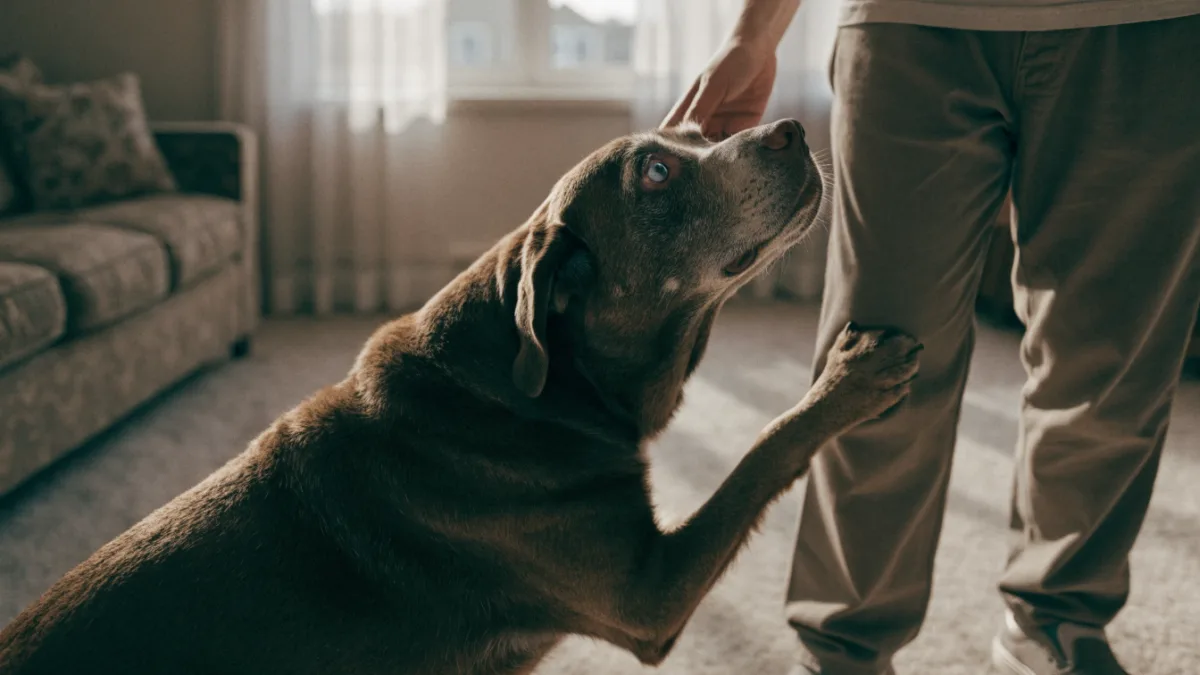
I’ll never forget the appointment with Marion and her 11-year-old Golden Retriever, Biscuit. Marion was exhausted. “He’s become my shadow,” she told me, gesturing to Biscuit, who was pressed firmly against her leg. “He follows me into the bathroom. He panics if I close a door between us. He’s always been a loving dog, but this is extreme. I’ve been working with a trainer on separation protocols for two months and nothing is improving.”
I watched Biscuit navigate the exam room. He moved cautiously, his nose working overtime, his body angled slightly toward Marion. When my technician walked past him on his left side, he flinched, hard. That single flinch told me more than any behavioral history could. I dimmed the lights in the room and watched his pupils. Then I turned them back up. His pupils were sluggish to constrict. I asked Marion when she’d last noticed Biscuit making eye contact with her. She paused. “I don’t know. Weeks, maybe?”
Biscuit didn’t have separation anxiety. Biscuit was going blind.
The Misdiagnosis Gap: When Clinginess Isn’t Behavioral
The term “Velcro dog” gets thrown around a lot in training circles and online forums. It describes a dog who sticks to their person constantly, following them from room to room, unable to settle when their human is out of sight. And sure, some dogs are simply deeply bonded. My own Border Collie, Ness, spent 14 years acting as my personal bathroom escort. That was her personality from the day I brought her home at eight weeks old.
But here’s what I need pet parents to understand: sudden onset clinginess is almost never a behavioral problem. When a dog who has been independent for years suddenly cannot bear to let you out of their sight, something has changed. And more often than my colleagues and I would like to admit, that something is physical.
A significant percentage of senior dogs diagnosed with separation anxiety are actually experiencing underlying medical issues, including deteriorating eyesight, hearing loss, chronic pain, or cognitive decline. The behavioral label gets slapped on first because it’s the symptom owners can see. The medical cause hides underneath.
Why Vision Loss Looks Like Anxiety
Dogs are remarkably good at hiding physical vulnerability. It’s an instinct wired deep into their evolutionary history. In the wild, an animal who appears weak or impaired becomes a target. So instead of stumbling around and making it obvious that they cannot see well, dogs compensate. They use their other senses. They memorize the layout of the house. And they stick close to the one thing they know will keep them safe: you.
When your dog’s vision begins to fail, you become their seeing-eye person. The hyper-attachment is not a behavioral flaw or a failure of training. It is a survival mechanism. Your dog is clinging to you because their world is getting darker, and you are the lighthouse.
Marion told me she had been scolding herself for “reinforcing” Biscuit’s neediness. She’d read advice online telling her to ignore attention-seeking behavior, to crate-train harder, to push through the crying. That advice, which comes from a reasonable place in standard behavioral modification, becomes actively harmful when the dog is terrified because they literally cannot see.
Spotting the Difference: Healthy Bonding vs. Medical Clinginess
So how do you tell the difference between a dog who just loves you and a dog who is scared? Here is what I ask my clients to watch for:
- Timeline matters. A dog who has always been clingy is likely just temperamentally attached. A dog who becomes clingy over weeks or months is signaling that something has changed.
- Situational awareness. Does your dog panic specifically in low light, at dusk, or in unfamiliar environments? Vision-impaired dogs often hold it together in bright, familiar settings and fall apart in dim or new ones.
- Reluctance to navigate. Is your dog suddenly hesitant to jump on the couch, navigate stairs, or walk into certain rooms? This often looks like stubbornness or joint stiffness, but it can be a vision problem.
- The startle response. Does your dog flinch or snap when approached from a specific angle, especially their side or from behind? This is one of the most reliable early indicators of unilateral or asymmetric vision loss.
- Physical changes. Cloudy, bluish, or whitish eyes are visible signs, though not all vision loss presents with obvious eye changes.
For Biscuit, the clues were all there in hindsight. Marion mentioned he had stopped retrieving tennis balls in the backyard. She thought his hips were bothering him. He had also begun refusing to walk down their hallway at night. She assumed he was being stubborn. In reality, the dim hallway combined with his nuclear sclerosis, a hardening of the lens that’s common in senior dogs, made it nearly impossible for him to see where he was going.
Other Medical Conditions That Mimic Separation Anxiety
Vision loss is far from the only physical issue that gets mislabeled as a behavioral problem. Before we land on any diagnosis, I always screen for several other possibilities.
Hearing Loss
Dogs who are losing their hearing become clingy for the same reason as dogs losing their sight. They can no longer track your movements through sound, so they stay physically close to compensate. A common sign: your dog seems to “ignore” commands they once knew perfectly, but they respond immediately when you stomp on the floor or use large hand gestures.
Canine Cognitive Dysfunction
This is the canine equivalent of dementia, and recent research has shown it overlaps significantly with sensory loss. Dogs with Canine Cognitive Dysfunction, or CCD, may pace at night, seem disoriented in familiar places, or become anxious when left alone. Some owners describe a “sundowners” effect where the dog becomes restless and agitated in the evening hours. The tricky part is that CCD and vision loss often occur together in aging dogs, and the combination can produce profound anxiety that looks purely behavioral.
Chronic Pain
A dog with untreated dental disease, arthritis, or gastrointestinal discomfort may seek constant proximity because physical contact with their person is soothing. Pain also makes the world feel more threatening, which increases the drive to stay near a safety figure.
What to Do If Your Velcro Dog Might Have a Medical Issue
The single most important piece of advice I can give you is this: see your veterinarian before you hire a trainer. I am not anti-training. Good positive-reinforcement training is invaluable for dogs. But no amount of desensitization training will fix a physical deficit. If your dog is clinging to you because they cannot see, the solution is not a behavioral protocol. The solution starts with a diagnosis.
Ask your vet for a thorough ophthalmic exam. In some cases, they may refer you to a veterinary ophthalmologist for a more detailed assessment. Be prepared to ask questions about nuclear sclerosis versus cataracts, whether your dog’s breed has genetic predispositions to conditions like progressive retinal atrophy, and what the timeline for progression might be.
While you are waiting for your appointment, do not ignore your dog’s need for reassurance. Old-school advice about not “rewarding” clingy behavior with attention does not apply when the clinginess is rooted in fear. Comfort your dog. Let them lean on you. You are not making the problem worse. You are giving a frightened animal the one thing they need most: safety.
Helping Your Vision-Impaired Dog Regain Confidence
Once a diagnosis is made, there is genuinely so much you can do. I have seen vision-impaired dogs live full, joyful lives with a few environmental adjustments and the right support.
Scent work has emerged as a powerful confidence-builder for dogs losing their sight. Because a dog’s sense of smell is their primary sense, engaging it through nose-work games gives them a way to interact with the world that does not depend on vision. Simple games like hiding treats around a room or teaching your dog to find a specific scent can help them feel capable and independent again. Several of my clients have described their dogs “un-sticking” from their side after just a few weeks of consistent scent games.
Environmental management matters too. Keep furniture in consistent positions. Use textured runners or mats to mark different zones of your home. Consider accessibility tools like halo harnesses, which function like a cane for a blind dog, bumping off obstacles before the dog’s face does. Pheromone diffusers can also help calm dogs experiencing the stress of sudden sensory deprivation, though they are a support tool rather than a solution on their own.
The Bottom Line
Biscuit’s story has a good ending. Once Marion understood what was happening, everything shifted. She stopped the separation training. She started describing herself as his guide. She added nightlights throughout the house, began scattering scent trails for him to follow in the yard, and let him sleep beside her bed without guilt. At his next visit, three months later, Biscuit walked into my exam room with his tail up and his nose working. He still stayed close to Marion, but the frantic, pressed-against-her-leg desperation was gone.
“I wish I hadn’t wasted two months trying to train it out of him,” Marion told me. “He wasn’t being bad. He was asking for help.”
If your dog has become suddenly clingy, especially if they are entering their senior years, please look past the behavior. Get a full medical workup before you assume it is anxiety. The kindest thing you can do for your aging companion is to investigate the medical side of what looks like a behavioral problem. Because sometimes, that Velcro dog is not being needy. They are being brave, and they are asking you to help them find their way through a world that has gone dark.