

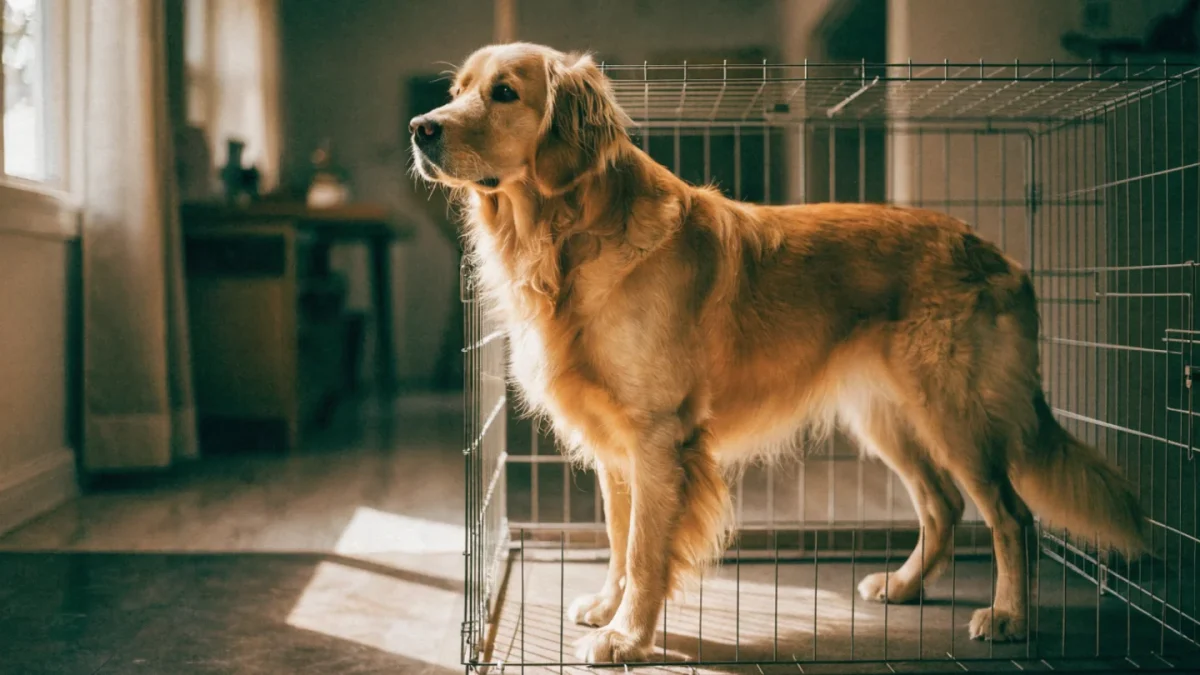
Crate sizing is one of those things that seems minor but has real training implications. A crate that's too big undermines house training. A crate that's too small is unkind. Getting the size right from the start makes everything else easier.
The Core Rule
The crate should be just large enough for your dog to:
- Stand up without their head touching the top
- Turn around in a complete circle
- Lie fully stretched out
That's the upper limit for training purposes, not the lower limit for comfort. A crate that allows those three things is an appropriate size.
Why Not Bigger?
People often buy the biggest crate they can find, thinking more space is kinder. During house training, it isn't.
Dogs instinctively avoid soiling their sleeping area. This instinct is the basis of crate training for house training. But if the crate is large enough to have a "bathroom end" and a "sleeping end," the instinct doesn't apply. The dog simply uses one side and ignores it.
A properly sized crate keeps the whole space as sleeping space — and the dog holds on until they're let out.
Measuring Your Dog
To measure correctly:
- Have your dog stand squarely
- Measure from the tip of their nose to the base of their tail (not including the tail) — this is length
- Measure from the floor to the top of their head, or to the top of their ears if they're erect-eared — this is height
- Add 2-4 inches to each measurement for the crate dimensions
For length: crate length should be nose-to-tail measurement plus 2-4 inches.
For height: crate height should be floor-to-head measurement plus 2-4 inches.
Buying for a Puppy
If you're buying a crate for a puppy, buy the adult size with a divider. Buying a puppy-sized crate and then replacing it when the dog grows is expensive and wasteful.
Most wire crates for larger breeds come with a metal divider panel. Position the divider to create a space appropriate for the puppy's current size. Move it as the puppy grows. (See also: wire crate vs. plastic crate vs. soft-sided.)
Approximate Size Guide by Breed Group
These are general starting points — individual dogs vary considerably within breed groups:
- Toy breeds (Chihuahuas, toy Poodles): 18-22 inch crates
- Small breeds (Beagles, Shih Tzus, Dachshunds): 24-30 inch crates
- Medium breeds (Cocker Spaniels, Border Collies, Australian Shepherds): 30-36 inch crates
- Large breeds (Labradors, Golden Retrievers, German Shepherds): 36-42 inch crates
- Extra-large breeds (Great Danes, Mastiffs, Saint Bernards): 48-54 inch crates
These are approximate — always measure your actual dog.
For Travel Crates
Airline travel has specific requirements. Most airlines require a crate with enough room for the dog to stand, turn, and lie down, with specific door and ventilation requirements. Check the airline's current requirements — they change and vary.
The complete crate training guide has more on setup, and the crate type comparison helps if you're still deciding on a style.
Measure twice, buy once. A correctly sized crate is a long-term investment — most dogs use their crate for years. Getting the size right from the start saves frustration later.