

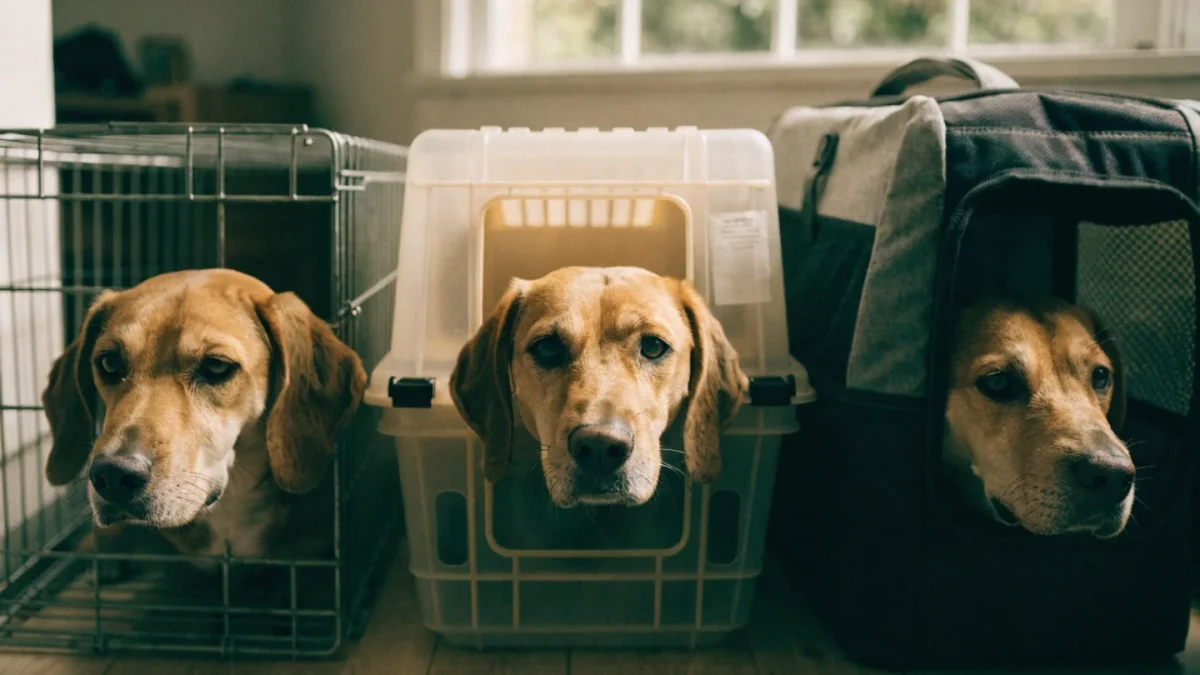
The crate aisle at a pet supply store offers a bewildering number of options. Wire, plastic, soft-sided, heavy-duty — and a price range from budget to "is this crate diamond-lined?" Most owners don't need anything exotic. Here's a practical breakdown.
Wire Crates
Best for: Home training, most puppies, dogs that do well with visibility.
Wire crates fold flat for storage, have good airflow, and let the dog see the surrounding environment. That visibility is often calming for dogs that like watching household activity.
Most wire crates come with a divider panel — useful for puppies, because you can block off part of the crate and expand as the dog grows. This prevents puppies from using one end as a bathroom.
Limitations: Heavier than soft crates. Less enclosed — some dogs that prefer a den-like space don't settle as well in wire crates. If your dog is a Houdini and can work the door latch, look for latches that require deliberate human action to open.
Temperature: Wire crates offer less insulation. In cold environments, a cover (blanket or crate cover) helps retain warmth.
Plastic Crates
Best for: Dogs that prefer enclosed spaces, airline travel, dogs being transported in vehicles.
Plastic crates (often called airline crates) are more den-like — enclosed sides give a more private, cave-like feel that many dogs find settling. Some dogs that won't settle in a wire crate are perfectly calm in a plastic one.
Most airline travel requires an approved hard-sided plastic crate. If you travel by air, start with a plastic crate so the dog learns to accept the type they'll actually use.
Limitations: More cumbersome to store (doesn't fold flat). Less airflow than wire in warm environments. Can't add a divider panel for puppies.
Soft-Sided Crates
Best for: Crate-trained adult dogs for occasional transport and travel. Not for training.
Soft-sided crates are lightweight and fold flat, which makes them convenient for travel and events. But they are not training crates.
A dog in the learning phase of crate training can damage or escape a soft crate easily. A determined dog can chew through the mesh in minutes. These crates require a dog that is already reliably crate-trained — they're a reward for that training, not a vehicle for it.
Limitations: Not for untrained dogs. Not for dogs that scratch, chew, or push at boundaries. Some are not airline-approved.
Heavy-Duty and Indestructible Crates
Best for: Escape-artist dogs, dogs with severe crate anxiety, dogs in professional working environments.
Heavy-duty metal crates exist for dogs that have destroyed or escaped standard crates. They're significantly more expensive and heavier, but provide containment for dogs that need it.
If your dog is escaping a standard wire crate, a heavy-duty option is worth considering — but also investigate the underlying anxiety driving the escape behavior. Containment doesn't fix the underlying issue.
The Practical Choice
For a puppy being trained from scratch: start with a wire crate with a divider panel. Most versatile, best visibility, easiest training setup.
For a dog that will be traveling by air: plastic crate from the start. Same crate the dog will use in transit. (See also: dog training tools and equipment.)
For a crate-trained dog at events or light travel: soft-sided for convenience.
Check the travel crate selection article for airline-specific requirements, and the complete crate training guide for the full process.
Don't overthink the crate type at the start. A good-quality wire crate is the right choice for most situations. The type matters less than the training.