

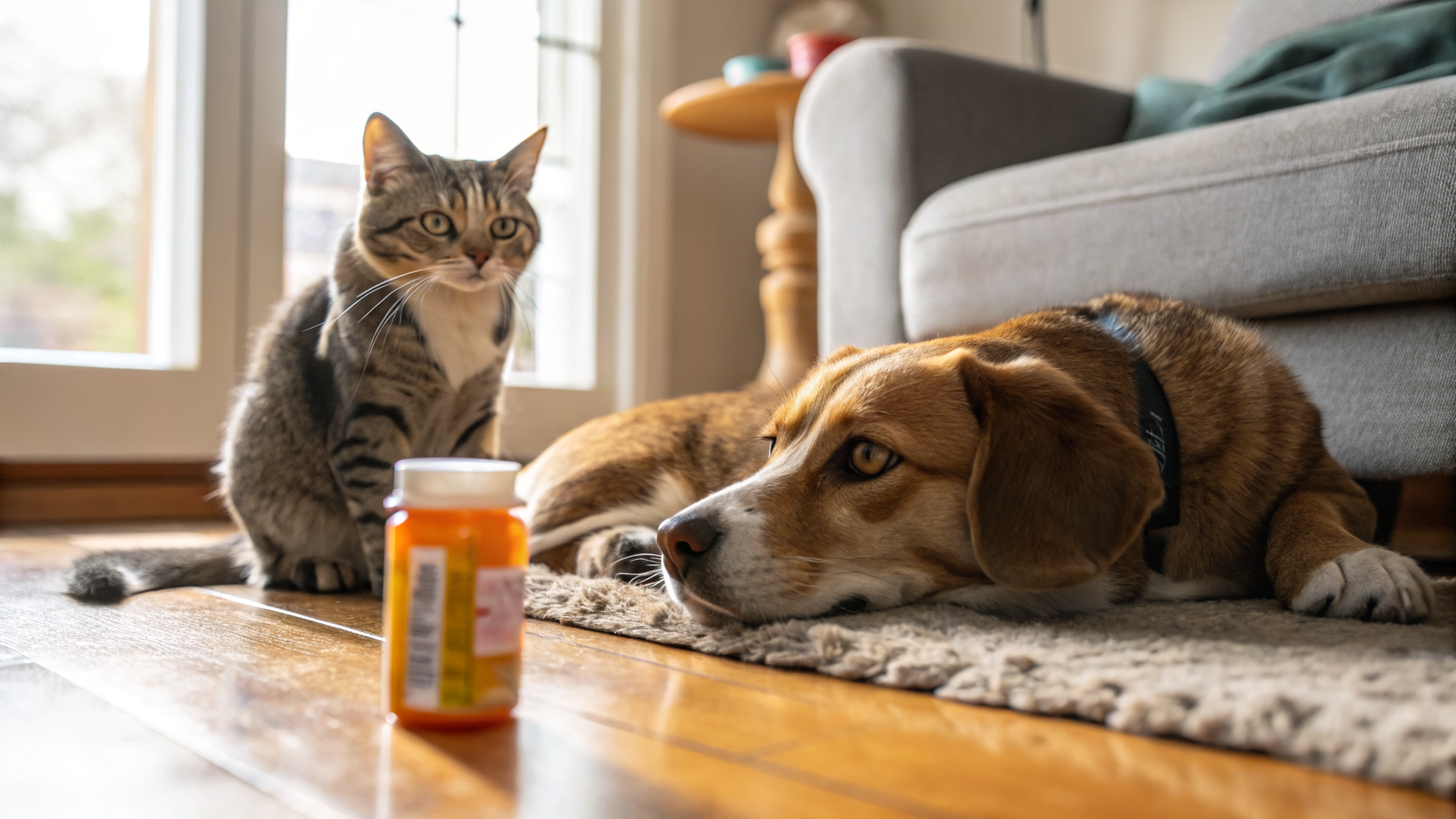
Permethrin toxicity in cats tends to look like this. A three-year-old calico named Luna is rushed into an emergency clinic at 11 PM. Her owner, Karen, is in tears. Luna is twitching uncontrollably, drooling so heavily that her chest fur is soaked, and her body temperature has spiked to 105.8°F — well above the normal 101.5°F. What had changed in the household that day? Karen had put new flea drops on her Golden Retriever that morning — the ones she bought at the grocery store. She hadn’t applied anything to Luna directly. But Luna loved to groom her big brother, and she’d spent the afternoon rubbing against the wet spot on the back of his neck where the medication was applied. That’s all it took. The active ingredient in that dog flea medication — permethrin — was doing what it does to cats: attacking her nervous system. Luna survived, but it took three days of intensive care, IV fluids, muscle relaxants, and round-the-clock seizure monitoring. Not every cat is as fortunate.
Why Dog Flea Medication is So Dangerous for Cats
The story I just told isn’t rare. Insecticide toxicity from flea and tick products consistently ranks among the top five most common causes of pet poisoning reported by poison control centers worldwide. And the primary culprit is a chemical called permethrin — a synthetic version of a compound naturally found in chrysanthemum flowers.
Permethrin is incredibly effective at killing fleas and ticks on dogs. It’s widely used in spot-on treatments, sprays, and yard products because it’s relatively inexpensive and long-lasting. But here’s where biology becomes treacherous: cats lack a specific liver enzyme called glucuronosyltransferase. Think of this enzyme as a chemical bouncer — its job is to grab toxins, attach a molecular “tag” to them, and escort them safely out of the body through urine or bile. Cats evolved on a diet of pure prey, and their livers simply never developed the machinery to process certain plant-based compounds. This is the same reason cats can’t tolerate essential oils, acetaminophen, or aspirin the way humans and dogs can.
When a cat’s liver encounters permethrin with no enzyme to break it down, the chemical accumulates rapidly. It binds to sodium channels in nerve cells — essentially keeping the “on switch” stuck — causing continuous nerve firing. The result is the cascade of symptoms I saw in Luna: muscle tremors that progress to full seizures, uncontrolled drooling, vomiting, and a body temperature that climbs dangerously high as the muscles generate heat from constant contraction.
Spot-On Treatments Carry the Highest Risk
Of all the flea product formulations out there, concentrated “spot-on” liquid treatments applied to the back of the neck are the most common source of severe poisoning. These products are designed to deliver a large dose of active ingredient that then spreads across the dog’s body through the skin’s natural oils. The concentration is high precisely because it needs to last for an entire month. When that same concentrated dose ends up on a cat — whether applied accidentally or absorbed through contact — it’s often a lethal amount delivered all at once.
Secondary Exposure: The Hidden Danger in Multi-Pet Homes
What catches many owners off guard is that their cat doesn’t need to have medication applied directly. Secondary contact is frighteningly easy in households with both dogs and cats.
I saw this with a client named Marcus and his two pets: a 5-year-old Labrador named Cooper and a 7-year-old tabby called Socks. Marcus applied a permethrin-based spot-on treatment to Cooper in the morning before work. That evening, Sons started drooling and walking with an unsteady, drunken gait — what we call ataxia. Marcus hadn’t even considered the connection until I asked about other pets. Socks routinely slept curled up against Cooper’s back. The application site, still potent hours later, had transferred onto Socks’s fur. When Socks groomed himself afterward, he ingested the chemical orally — which is even more dangerous than skin absorption.
To prevent this, I always advise multi-pet households to keep dogs and cats separated until the application site is completely dry — typically 24 to 48 hours. If your cat is a dedicated groomer of other pets, that separation period should be non-negotiable.
Recognizing the Signs of Poisoning
If you even suspect your cat has been exposed to a dog flea product, don’t wait for symptoms to worsen. The progression from mild tremors to life-threatening seizures can happen in under an hour. Here’s what to watch for:
- Muscle tremors and twitching — often starting in the ears or face, then spreading to the legs and whole body
- Seizures — uncontrolled convulsions, loss of consciousness, paddling of the legs
- Excessive drooling (hypersalivation) — the mouth overproduces saliva as the nervous system misfires
- Vomiting and diarrhea — the body attempting to expel the toxin
- Hyperthermia — dangerously elevated body temperature, sometimes exceeding 106°F, as constant muscle activity generates heat
- Dilated pupils and sensitivity to light
- Depression or collapse
What to Do in an Emergency
If you see these signs — or if you know your cat has come into contact with a dog flea product — act immediately. Every minute matters.
- Bathe the cat right now. Use warm water and a mild dish soap (the kind that cuts grease). The medication is oil-based, and dish soap is specifically formulated to break down oils. Lather thoroughly, especially around the neck and shoulders where exposure is most concentrated. Rinse completely and repeat. Don’t use flea shampoo — you’d only be adding more chemicals to an already overwhelmed system.
- Call your veterinarian or an emergency animal hospital while you’re bathing the cat, or immediately after. Tell them specifically what product was involved, the active ingredient, and the approximate time of exposure. Have the packaging on hand if possible.
- Keep the cat warm and quiet during transport. Wrap them in a towel — body temperature regulation becomes erratic during toxicity, and they can swing between dangerously high and dangerously low temperatures.
- Do NOT induce vomiting unless a veterinarian specifically instructs you to. With topical exposure, the toxin is absorbed through the skin, and inducing vomiting adds stress without addressing the real problem.
Treatment at the clinic typically involves intravenous fluids to support kidney function and flush the bloodstream, muscle relaxants to control tremors and seizures, and active cooling measures if body temperature is dangerously high. Many cats require hospitalization for 48 to 72 hours. Survival rates are good when treatment begins early — but delays dramatically reduce the odds.
The “Vice Versa” Problem — and Other Common Mistakes
People often ask me: “What happens if I use cat flea medication on my dog?” The honest answer is that it’s rarely lethal, but it’s still a mistake. Cat products are typically formulated at lower concentrations because cats are more sensitive, so applying them to a dog usually means the dog remains unprotected — still vulnerable to fleas, ticks, and the diseases they carry. At worst, a dog might experience mild gastrointestinal upset or skin irritation.
That said, extreme overdosing of certain ingredients can cause adverse reactions in any species. This brings me to a practice that happens far too often: dose-splitting. An owner buys a large-dog flea medication because it’s more cost-effective, then tries to divide it for a smaller dog or — catastrophically — for a cat. This almost always results in a dangerous overdose. The liquid doesn’t divide evenly, the concentration isn’t what you think it is, and you’re essentially playing pharmacist without a pharmacy degree. I’ve changed my stance on this over the years — early on, I was more relaxed about the idea of creative dosing. After reading the outcome data, I’m firm now: use the correct product, in the correct size, for the correct species. Every time.
The Natural Alternatives Trap
I understand the impulse to avoid chemicals entirely. When clients tell me they’ve heard that tea tree oil, pennyroyal, or garlic can repel fleas naturally, I don’t dismiss them. I know where they’re coming from — the desire to use something gentle and holistic. But I have to redirect them to the evidence. Many essential oils are even more toxic to cats than permethrin, precisely because of that same missing liver enzyme. Tea tree oil, for instance, can cause severe liver failure, muscle tremors, and collapse in cats at very small doses. Pennyroyal has been linked to fatal poisoning. Garlic and onion compounds destroy red blood cells, leading to life-threatening anemia.
“Natural” does not mean “safe.” Poison ivy is natural. Cyanide is natural. What matters isn’t whether something occurs in nature — it’s whether your cat’s body can process it.
The Bigger Picture: Environmental Impact
There’s another dimension to this conversation that goes beyond our individual pets. The flea and tick medications we apply — including permethrin — don’t stay on our animals. When treated dogs swim in lakes and rivers, when we bathe them and the washwater flows down the drain, when rain washes residue from yards into storm drains, these pesticides enter aquatic ecosystems.
Permethrin is highly toxic to aquatic life. It kills fish at extraordinarily low concentrations, disrupts the development of amphibians — many of which are already in alarming decline worldwide — and devastates populations of aquatic insects that form the base of freshwater food webs. It’s also acutely toxic to bees, which are essential pollinators already under enormous pressure from habitat loss and pesticide exposure.
The rise of tick-borne diseases like Lyme and the devastating Cytauxzoonosis — a nearly always fatal disease in cats spread by ticks — means that effective prevention is more important than ever. Warmer climates are expanding tick ranges into areas where they were never a problem before. I’m not suggesting we abandon flea and tick prevention; the diseases these parasites carry are real and serious. But I am suggesting we be thoughtful about what we use, how we use it, and what happens to it after it leaves our pets.
Choose the safest effective product for each specific pet. Use it correctly. Store it safely. And never, ever assume that what works for one species will work for another — no matter how similar they may seem curled up together on your couch. The three-pound tabby sleeping against your sixty-pound retriever has a fundamentally different biology. Understanding and respecting that difference is one of the most important things you can do to keep all your animals — and the wild world they’re connected to — safe.