

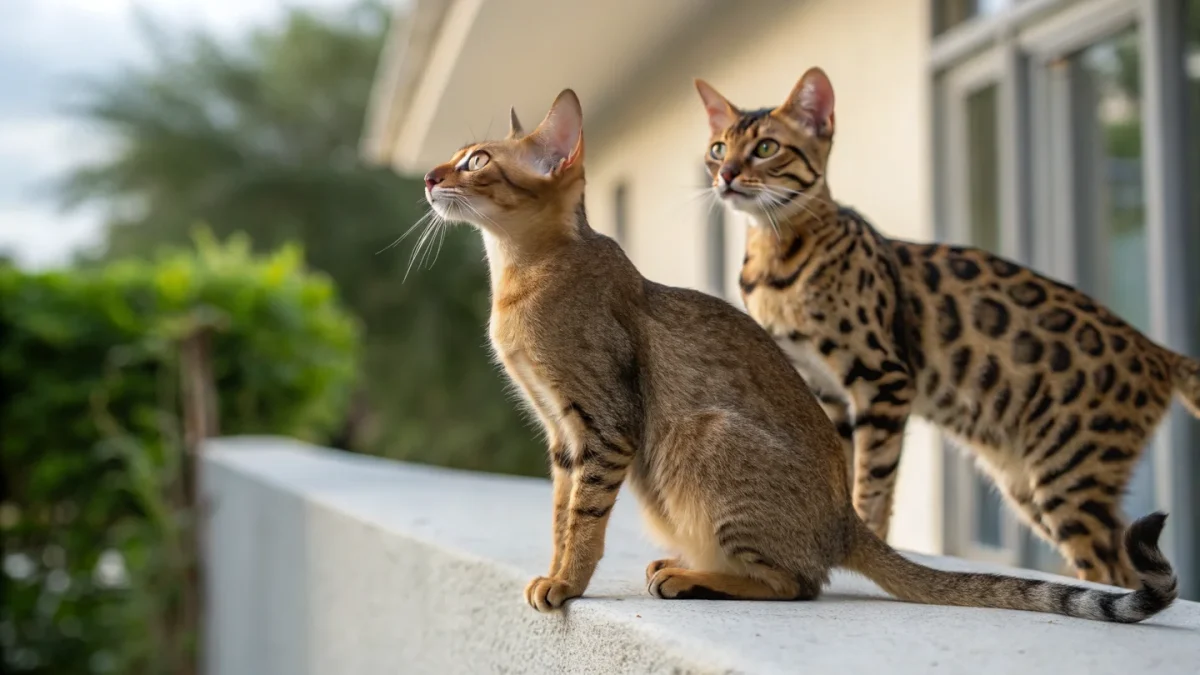
In the world of active cat breeds, the Abyssinian and the Bengal are the two names that come up most often. Both are energetic, intelligent, and completely unsuitable for owners who want a cat to occupy a chair decoratively. But choosing between them based on "both are active" is like choosing a marathon runner and a sprinter based on "both are fast." The energy comes in different shapes.
The cat breed comparison guide explains how to evaluate these differences.
Quick Comparison
| Trait | Abyssinian | Bengal |
|---|---|---|
| Build | Small-medium, slender | Medium-large, muscular |
| Coat | Short, ticked tabby | Short, spotted or marbled with sheen |
| Origin | Ancient domestic cat | Serval hybrid (many generations removed) |
| Energy | Very high | Very high |
| Prey drive | High | Very high |
| Vocalization | Moderate | Moderate (chirps, trills) |
| Social with strangers | Generally friendly | Variable |
| With small pets | Manageable with care | High risk |
| Legal considerations | None |
Personality Differences
Abyssinian: One of the oldest domestic cat breeds — the Abyssinian breed profile covers their ancient origins and the ticked coat genetics in detail — the Abyssinian has been shaped by thousands of years alongside humans. The energy is channeled through curiosity — they want to explore everything, know what everyone is doing, and insert themselves into activity. They're social with strangers and adaptable in multi-pet households. The play drive is high, but it's balanced by genuine social interest in people.
Abyssinians are slighter than they appear. The long legs, arched back, and alert ears on a small frame give the impression of a larger animal. They're fast, agile, and quieter than the amount of activity they create would suggest.
Bengal: The Bengal's energy is more physical in nature. Where the Abyssinian is curious, the Bengal is predatory — the energy often has a hunt-context quality that distinguishes it from the Abyssinian's more exploratory temperament. Climbing to the highest point, stalking movements, intense focus on moving objects: the wild heritage shows in how the energy expresses itself. The Bengal breed profile covers the Asian leopard cat hybrid origins, the generation classification system, and legal considerations that vary by jurisdiction.
The coat is more striking — the spotting or marble pattern with the distinctive iridescent quality is genuinely beautiful in a way that photographs don't fully capture. Adults are heavier and more powerful than Abyssinians.
Management Differences
Both breeds need daily interactive play and an enriched environment. The Bengal's needs are slightly higher in intensity — both in terms of how much physical outlet is needed and in terms of how destructive the energy becomes if insufficient outlets are provided.
Small pets are a more serious concern with Bengals. An Abyssinian in a home with a parakeet requires thoughtful management. A Bengal in that same situation is a genuine welfare risk to the bird.
The Verdict
Choose the Abyssinian if you want a highly active, curious, elegant companion that is more socially flexible with strangers and other pets, doesn't have the hybrid-origin prey intensity, and brings active energy without the raw physical power of the Bengal. Slightly easier to manage; no legal complications.
Choose the Bengal if you want the visually spectacular spotted coat, are prepared for the higher physical enrichment requirements, don't have small pets at risk, and find the wilder-natured quality of the breed part of the appeal rather than a concern.
For most households comparing these two breeds, the Abyssinian is the more manageable choice. The Bengal is extraordinary — but the extraordinary comes with conditions.