

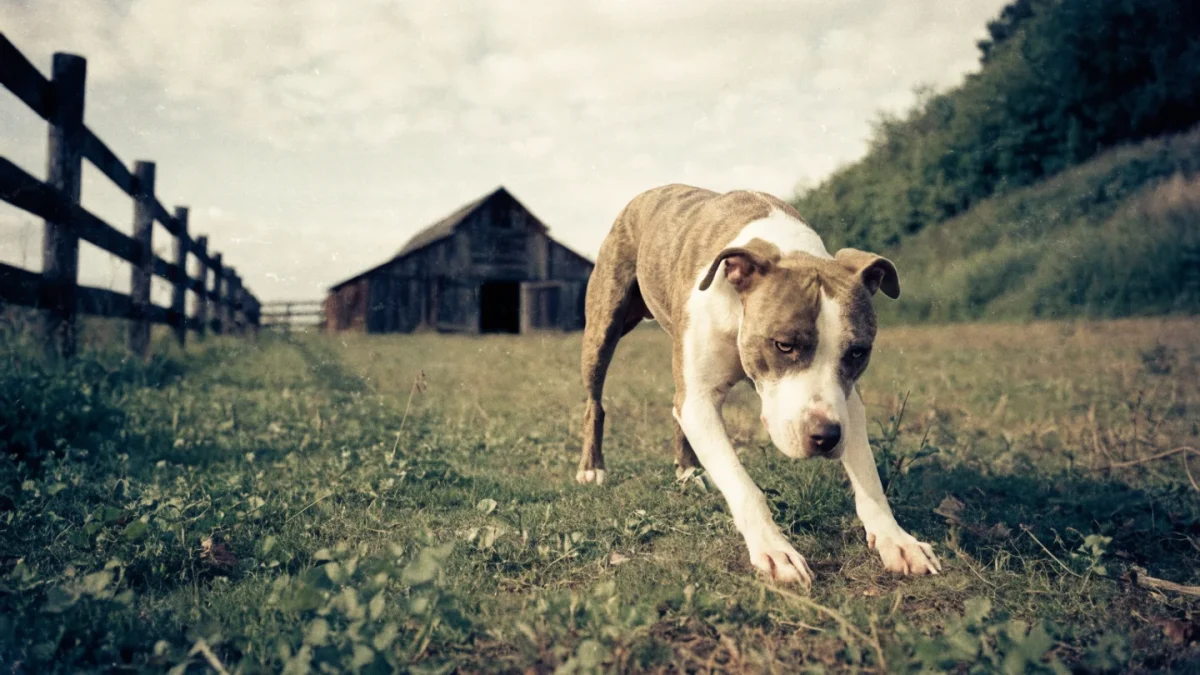
During both World Wars, the United States government chose a pit bull-type dog as its military recruitment mascot. The image appeared on propaganda posters encouraging enlistment, buying war bonds, and supporting the war effort. An actual pit bull named Sergeant Stubby served with the 102nd Infantry in World War I, participated in 17 battles, earned a rank, and was decorated for bravery — the most celebrated war dog in American history up to that point. The same breed type that once represented American tenacity on recruitment posters would, less than seventy years later, become the target of more restrictive legislation than any other dog in the Western world.
The arc of pit bull terrier history origins legislation is one of the most dramatic reversals in the relationship between humans and any domestic animal. Tracing that arc honestly requires following the evidence rather than the narratives — and there are plenty of competing narratives to choose from.
British Origins: Blood Sports and Breed Formation
The story begins in early 19th-century Britain with the crossing of Old English Bulldogs — stockier, more athletic animals than the modern English Bulldog — with various terrier breeds. The goal was functional: combine the bulldog's grip strength and tenacity with the terrier's speed, agility, and high prey drive. The resulting dogs were called bull-and-terriers, and their primary uses were blood sports.
Bull-baiting was the original application — dogs were set against tethered bulls in public spectacles that drew large crowds and heavy gambling. Bear-baiting served a similar function. Parliament banned both practices in 1835 under the Cruelty to Animals Act, but enforcement was uneven, and the dogs were quickly redirected toward activities that were easier to conceal from authorities: ratting competitions in enclosed pits and organized dog fighting. The Old English Bulldog's own history and selective transformation during this period runs parallel to the APBT story — both breeds were fundamentally reshaped by the same legislative moment.
It is worth being direct about this: dog fighting is a foundational part of this breed's history. Pretending otherwise serves no one. The breed was shaped, in part, by selective pressures from that activity. Understanding that history honestly is necessary for understanding the breed's behavioral tendencies today, particularly around dog-directed drive.
The Atlantic Crossing
British and Irish immigrants brought their bull-and-terrier dogs to North America throughout the mid-1800s. In America, the breed found a different purpose. The vast agricultural landscape demanded versatile working dogs, and the bull-and-terrier's combination of strength, drive, and handler loyalty made it well-suited to farm life.
These dogs caught semi-feral hogs and cattle — dangerous work that required a dog willing to grip and hold a large, aggressive animal. They controlled vermin populations. They guarded homesteads. And they became family companions in an era when dogs lived and worked alongside people daily rather than being kept as primarily indoor pets.
The breed diverged from its British ancestors during this period. American breeders generally selected for a slightly larger, more versatile animal. The emphasis shifted from pit performance toward working utility and household compatibility. This divergence would eventually produce distinct breeds on paper, even as the genetic overlap remained substantial.
Official Recognition and the AKC Split
In 1898, Chauncy Bennett founded the United Kennel Club in Kalamazoo, Michigan, with the American Pit Bull Terrier as its cornerstone breed. The UKC was, for its first years, essentially an APBT registry. Bennett's own dog, Bennett's Ring, was the first registered animal.
The American Kennel Club took a different path. In 1936, the AKC began registering pit bull-type dogs under the name American Staffordshire Terrier — a deliberate rebrand that distanced the breed from its fighting heritage by dropping "pit" from the name entirely. The Staffordshire Terrier Club of America, founded in 1936, supported this repositioning.
From 1936 onward, the APBT and the AmStaff existed as parallel breeds with shared ancestry but diverging breeding priorities. AmStaff breeders focused increasingly on conformation showing, producing a somewhat stockier, heavier dog. APBT breeders maintained a broader range of working-type builds. Many individual dogs were dual-registered. The genetic separation between the two breeds remains incomplete to this day.
The "Golden Age" Myth — and the Reality
The period from roughly 1900 to 1975 is sometimes characterized as the breed's golden age — when pit bulls were beloved American family dogs, appeared in advertising, and lived uncontroversial lives. This narrative is partially true but significantly oversimplified.
Pit bull-type dogs were genuinely popular during this period. They appeared in commercial advertising, were featured in the Our Gang/Little Rascals comedies (Petey was a registered pit bull-type dog), and were common in working-class American households. RCA's "His Master's Voice" dog, Nipper, is sometimes claimed as a pit bull, though historical records indicate he was a mixed breed — most likely a combination of Smooth Fox Terrier and Bull Terrier, born in Bristol, England, in 1884. His biographer noted he had "plenty of bull terrier in him," but he was not a pit bull-type dog in the American sense of the term.
But dog fighting also continued throughout this period, driven underground but never eliminated. The breed's dual existence — as both beloved pet and fighting dog — ran in parallel for the entire twentieth century. The difference between then and now is not that fighting disappeared, but that media coverage of it eventually arrived.
The 1980s Shift
The transformation of the pit bull's public image from American mascot to public threat happened with remarkable speed. A 1987 cover story in Sports Illustrated titled "The Pit Bull: Friend and Killer" is often cited as a turning point in media coverage. The article framed the breed as uniquely dangerous, and the media cycle that followed amplified that framing into a sustained moral panic.
Several factors converged. Dog fighting prosecutions became more visible. Urban drug culture adopted pit bull-type dogs as status symbols and guard animals, frequently conditioning them for aggression through abuse and isolation. High-profile bite incidents — some involving actual APBTs, many involving misidentified dogs — generated intense news coverage. The breed became a symbol of urban danger in the public consciousness.
The legislative response was swift. In 1989, the United Kingdom passed the Dangerous Dogs Act 1991, which banned the breeding, sale, and ownership of pit bull terriers. Dozens of cities and countries followed with their own breed-specific legislation over the following decades. The legal frameworks vary enormously — from outright bans to mandatory registration, sterilization, muzzling requirements, and insurance mandates.
The Nanny Dog Question
The claim that pit bulls were historically known as "nanny dogs" — trusted guardians of children — deserves separate examination because it circulates so widely and influences how people perceive the breed's history.
The earliest documented use of the phrase appears in a 1971 New York Times article quoting Lillian Rant, then president of the Staffordshire Bull Terrier Club of America. The statement referred to Staffordshire Bull Terriers in England, not American Pit Bull Terriers. No historical documentation from the 19th or early 20th century uses the term "nanny dog" in connection with any breed.
Period photographs showing children with pit bull-type dogs do exist — as do period photographs showing children with virtually every popular dog breed of the era. Photography conventions of the time regularly posed children with family animals. These images document proximity, not a specific childcare function.
The nanny dog narrative, while well-intentioned, is ultimately counterproductive. It creates unrealistic expectations about the breed's natural behavior around children and provides a false sense of security that discourages appropriate supervision. APBTs can be wonderful with children. That reality doesn't require historical mythology to validate it.
The Breed Today
The American Pit Bull Terrier in 2026 exists in a state of contradiction. It remains one of the most common dog types in the United States — shelter populations alone confirm this. It is the subject of more legislation, more media coverage, more advocacy, and more controversy than any other breed. It is simultaneously banned in some jurisdictions and celebrated in others.
The scientific and policy conversation is shifting. Multiple studies have questioned the reliability of visual breed identification, the efficacy of breed-specific legislation in reducing bite incidents, and the validity of breed as a predictor of individual behavior. Several jurisdictions that enacted BSL in the 1990s and 2000s have since repealed it in favor of breed-neutral dangerous dog laws that focus on individual behavior and owner responsibility.
The breed's future will be shaped less by what the dogs themselves do than by what humans — legislators, breeders, owners, and media — decide to do with the evidence. The APBT has survived blood sports, a transatlantic migration, a century of underground fighting, a media-driven panic, and legislative attempts to eliminate it entirely. Whatever else you say about this breed, it is not fragile.