

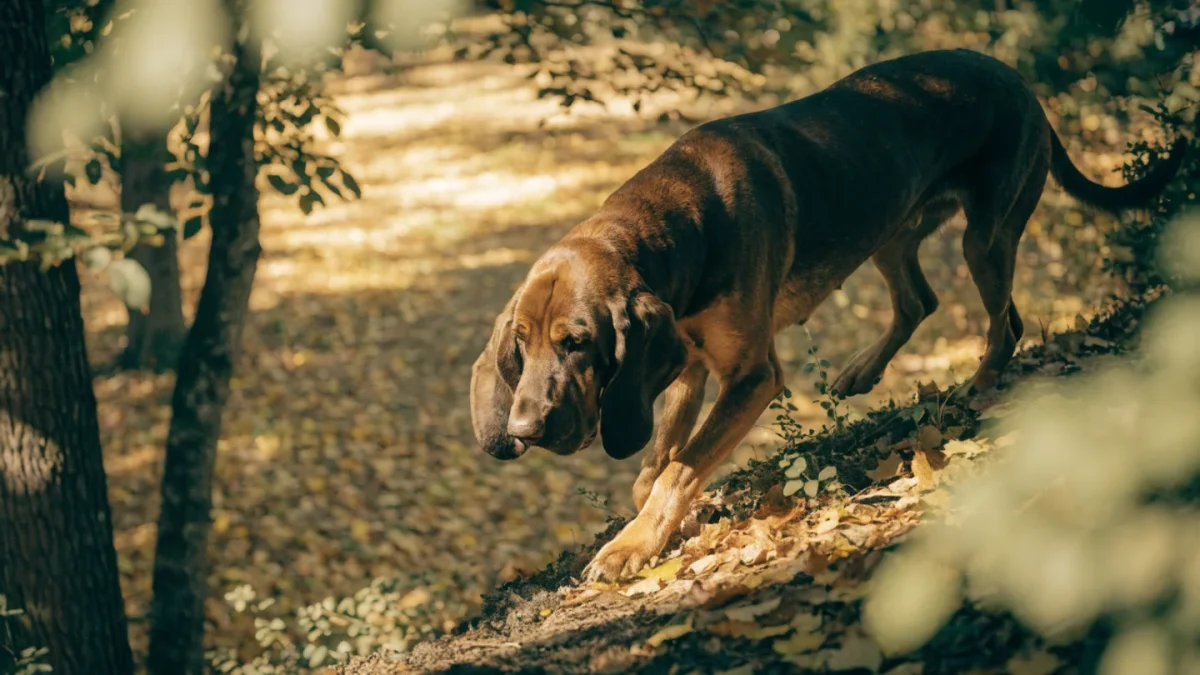
A Bloodhound named Nick Carter tracked a trail that was 105 hours cold — over four days old — and followed it to a successful find. That record, set in the early 1900s, demonstrated something that still staggers biologists: a Bloodhound's nose contains approximately 300 million scent receptors, compared to roughly 6 million in a human nose, and the area of the dog's brain devoted to analyzing scent is proportionally 40 times larger than ours. When a scenthound puts its nose to the ground, it's reading a chemical narrative that is entirely invisible to us.
The Hound Group contains some of the oldest known breed types in existence. Egyptian tomb paintings from over 4,000 years ago depict dogs that are immediately recognizable as sighthounds — lean, long-legged, built for speed. The Saluki is often cited as one of the oldest domesticated breeds, with archaeological evidence placing its ancestors in the Fertile Crescent roughly 5,000 years ago. Hound breeds predate every modern kennel club by millennia.
Two Subtypes, One Purpose
The Hound Group divides along a fundamental biological line: how the dog locates its quarry.
Scenthounds
Scenthounds — Beagle, Bloodhound, Basset Hound, Coonhound varieties, Foxhound, Dachshund — hunt by following scent trails. They were developed to track game over long distances, often for hours, using their noses as their primary sensory tool.
Physically, scenthounds share adaptations that serve scent work: long, drooping ears that sweep scent particles toward the nose; loose facial skin (particularly around the jowls) that traps scent molecules near the nostrils; deep chests that house substantial lung capacity for sustained effort; and sturdy, often low-slung builds that keep the nose close to the ground.
Behaviorally, scenthounds are driven, persistent, and nearly impossible to distract once they lock onto a scent trail. They were bred to work in packs, which gives them a generally sociable, tolerant temperament with other dogs. They're vocal — baying, howling, and barking were essential for communicating their location to hunters who couldn't see them through dense terrain.
The Beagle is the scenthound most commonly kept as a family pet, and its popularity has created a gap between what owners expect and what they get. A Beagle's nose overrides everything. Training recall is a lifelong project because the competing motivation — following that scent — is wired at the deepest biological level. For the full breed profile covering temperament, health, and that legendary nose, see the Beagle complete breed guide.
Sighthounds
Sighthounds — Greyhound, Whippet, Saluki, Afghan Hound, Irish Wolfhound, Borzoi — detect and pursue prey by vision. They were developed for coursing: spotting game across open terrain and running it down through sheer speed.
The physical design of a sighthound is pure aerodynamic engineering: deep, narrow chest; flexible spine that allows a double-suspension gallop; long legs; small head; and minimal body fat. A Greyhound can reach 72 km/h — faster than every other land animal except the cheetah. A Whippet can accelerate from standing to full speed in seconds.
Sighthound behavior is fundamentally different from scenthound behavior. Where scenthounds are social, vocal pack hunters, sighthounds tend toward quiet independence. Many sighthounds are cat-like in their domestic behavior — affectionate on their terms, comfortable with long periods of rest between bursts of intense activity, and somewhat reserved with strangers.
The most common misconception about sighthounds is that they need enormous amounts of exercise. Greyhounds, in particular, are sprinters — not marathon runners. They expend energy in explosive bursts and then rest for extended periods. Many retired racing Greyhounds adapt beautifully to apartment life because their actual daily exercise requirement is a few moderate walks and the occasional opportunity to run in a safely enclosed space.
The Independence Factor
What unites scenthounds and sighthounds — and separates the entire group from sporting, herding, and working breeds — is independent hunting drive. These dogs were bred to make autonomous decisions in the field: which trail to follow, which direction to run, when to accelerate, when to bay. They don't look to their handler for instruction mid-hunt. They follow their instincts.
This independence is often labeled "stubbornness," but that's a mischaracterization. A Beagle ignoring your recall command isn't being defiant — it's prioritizing a biological imperative that predates your voice cue by thousands of years. Training hounds is absolutely possible, but it requires:
- Realistic expectations about off-leash reliability (most hound owners accept that trustworthy off-leash recall may never happen)
- High-value food rewards that compete with instinctive drives
- Short, engaging training sessions that work with the dog's attention span rather than against it
- Secure fencing that accounts for the dog's escape motivation
Health Patterns in the Hound Group
Health concerns in the hound group diverge along the scenthound-sighthound divide:
Scenthound health concerns:
- Obesity is the leading preventable health issue in scenthounds. Beagles, Basset Hounds, and Dachshunds are particularly prone to weight gain, and their food motivation makes portion control essential.
- Ear infections are endemic in long-eared scenthounds. Those magnificent ears create the perfect environment for bacterial and yeast growth.
- Intervertebral disc disease (IVDD) is a major concern in Dachshunds and Basset Hounds, both of which have chondrodystrophic (dwarf) skeletal structures that put increased stress on spinal discs.
- Bloat (GDV) affects deep-chested scenthounds, particularly Bloodhounds and large Coonhound breeds.
Sighthound health concerns:
- Anesthesia sensitivity is a well-documented concern in sighthounds, particularly Greyhounds. Their low body fat percentage and unique liver metabolism affect how they process certain anesthetic agents. Any veterinarian treating a sighthound should be aware of breed-specific anesthesia protocols.
- Bloat is a risk in deep-chested sighthounds, including Irish Wolfhounds, Greyhounds, and Borzoi.
- Osteosarcoma occurs at elevated rates in several large sighthounds, particularly Irish Wolfhounds and Scottish Deerhounds.
- Cardiac conditions — dilated cardiomyopathy in Irish Wolfhounds, mitral valve disease in Cavalier-related breeds — are significant concerns.
Cross-group note: Sighthounds typically have lower reference ranges for thyroid hormones than other breeds, which can lead to misdiagnosis of hypothyroidism if breed-specific values aren't used. This is a normal physiological variation, not a disease state.
Living With Hounds
Hounds reward owners who appreciate their independence rather than fighting it. The ideal hound owner finds the breed's autonomous personality charming, doesn't need a dog that hangs on their every word, can tolerate vocalization (scenthounds) or aloofness (sighthounds), and provides secure containment.
That last point deserves emphasis. Hounds escape. Scenthounds follow a scent trail through any gap in fencing. Sighthounds can clear surprisingly high fences when motivated by prey. Physical containment — adequate fencing, secure doors, leash management — isn't paranoia with hounds; it's baseline responsible ownership.
The hound group offers something that other breed groups don't: dogs that are self-contained personalities rather than extensions of their handler. If you want a dog that adores you but also has its own agenda, its own interests, and a mind it's perfectly willing to use independently, a hound might be exactly what you're looking for. If you need total obedience and off-leash reliability, look at non-sporting breeds on a case-by-case basis — or consider a sporting or herding breed instead.
Frequently Asked Questions
Are hounds hard to train?
Hounds are not intellectually limited — they learn commands quickly. The challenge is motivating consistent compliance against competing instinctive drives. A Beagle understands "come" perfectly; it simply weighs that cue against whatever scent it's tracking and often decides the scent wins. Training hounds successfully means using extremely high-value rewards, keeping sessions short and engaging, and accepting that off-leash reliability in unsecured areas may never reach the level you'd get with a Labrador or German Shepherd.
Can sighthounds live with cats and small pets?
This varies significantly by individual and breed. Some sighthounds have intense prey drive that makes coexistence with cats genuinely dangerous. Others — particularly retired Greyhounds that have been temperament-tested — live peacefully with cats. The key is individual assessment, not breed-level assumptions. Sighthound rescue organizations typically evaluate prey drive before placement. Small animals like rabbits and guinea pigs are generally at higher risk and should be kept separate regardless of the individual dog's temperament.
Why do hounds howl?
Baying and howling are functional communication tools developed for pack hunting. When a scenthound locates a scent trail or trees quarry, its howl carries across long distances to alert the hunting party. In domestic settings, the same vocalization is triggered by loneliness, excitement, sirens, or other dogs' vocalizations. You can manage excessive howling through exercise, mental stimulation, and not rewarding the behavior with attention — but completely eliminating it from a scenthound goes against the breed's fundamental wiring. If a quiet dog is important to you, scenthounds are probably not your group.