

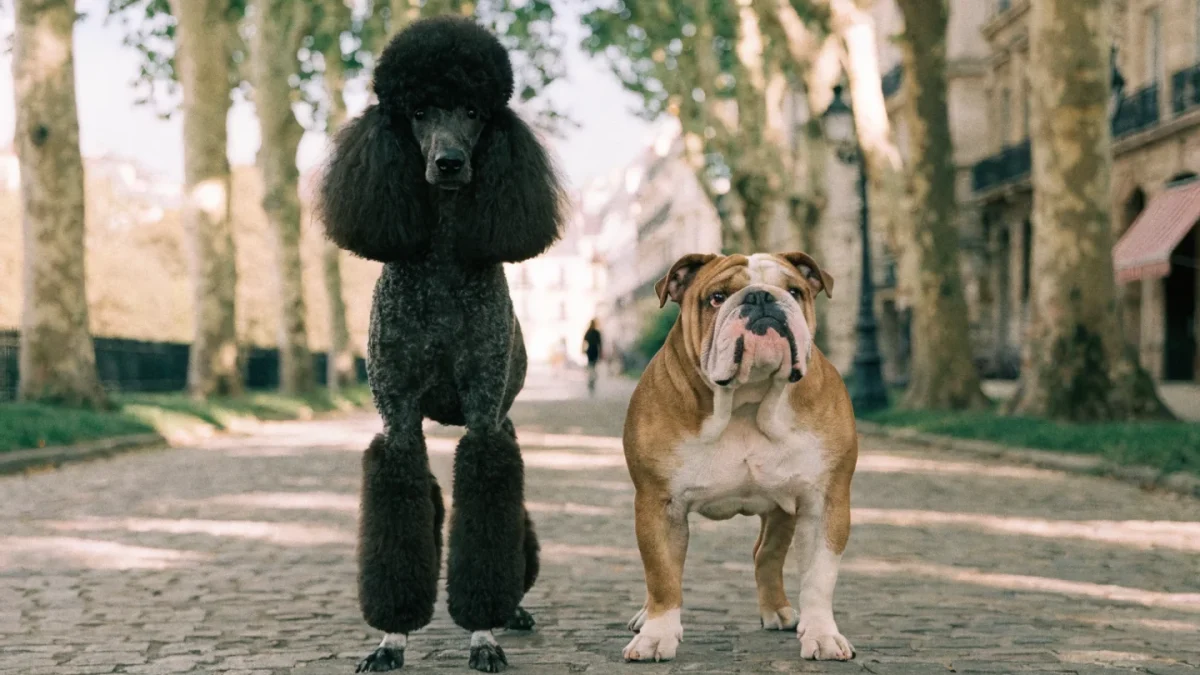
The Standard Poodle was originally a water retriever — a rugged working dog that spent its days plunging into freezing lakes to fetch ducks. The elaborate show clips that look purely decorative today actually evolved from functional field trims: handlers shaved the body to reduce drag in water while leaving hair on the joints and chest for insulation. The pompoms on the hips protected the kidneys from cold. That a breed with this working heritage sits in the Non-Sporting Group alongside the Bulldog — a former bull-baiting dog — and the Dalmatian — a coaching dog that ran alongside horse-drawn carriages for miles — tells you everything about what the Non-Sporting Group actually is: the place where breeds go when they don't fit anywhere else.
The Non-Sporting Group is defined by absence rather than presence. It has no unifying function, no shared physical profile, no common behavioral thread. Every other breed group can be described in terms of what its members were bred to do. The Non-Sporting Group can only be described in terms of what its members weren't bred to do — or rather, what they no longer do, since many of these breeds had original functions that no longer exist or that evolved in ways that don't align with any remaining group.
Why the Non-Sporting Group Exists
Every classification system needs a miscellaneous category, and the Non-Sporting Group is exactly that. When the AKC organized breeds into groups, any breed whose original function didn't clearly align with Sporting, Hound, Working, Terrier, Toy, or (later) Herding got placed here by default.
The result is the single most internally diverse group in any breed classification system. Consider the range:
- Size: Lhasa Apso (5-8 kg) to Standard Poodle (20-32 kg)
- Coat: Hairless (Chinese Crested, technically Toy in AKC but Non-Sporting in some systems) to profusely coated (Chow Chow, Keeshond)
- Energy: Low (Bulldog, Basset-like lethargy) to high (Dalmatian, endurance athlete)
- Temperament: Friendly and outgoing (Bichon Frise) to reserved and aloof (Chow Chow, Shar-Pei)
- Original function: Bull-baiting (Bulldog), water retrieving (Poodle), coaching (Dalmatian), monastery guarding (Lhasa Apso), multipurpose farm work (Chow Chow)
This diversity makes the Non-Sporting Group simultaneously the least useful for generalizations and the most interesting for individual breed study.
Representative Breeds
The Bulldog has undergone one of the most dramatic transformations in breed history. The original bulldog was a lean, athletic animal bred for bull-baiting — a blood sport outlawed in England in 1835. After the ban, breeders reshaped the dog into a companion animal, progressively shortening the face, widening the body, and reducing the overall athleticism. Today's Bulldog is among the most brachycephalic breeds, and the health consequences of that extreme conformation — respiratory compromise, overheating, joint problems, difficulty whelping — represent one of the breed world's most heated ethical debates.
The Standard Poodle is arguably the most misplaced breed in the Non-Sporting Group. It's a versatile working dog — retrieving, tracking, agility, obedience — with intelligence that consistently places it in the top three of working intelligence assessments. The Poodle's reputation as a prissy show dog is one of the greatest injustices in canine stereotyping. Under that clip is an athletic, driven, genuinely smart animal that can outwork many sporting breeds.
The Dalmatian was bred as a coaching dog in the 1800s — it ran alongside horse-drawn carriages for miles, serving as both a status symbol and a guard for the horses and cargo. That heritage produced a dog with extraordinary endurance (Dalmatians can run for hours) and a strong affinity for horses. The breed's popularity spiked dramatically after certain animated films, leading to a wave of impulse purchases by families unprepared for a high-energy, high-maintenance breed. Many of those dogs ended up in shelters.
The Chow Chow is one of the oldest breeds in existence, with archaeological evidence placing its ancestors in China over 2,000 years ago. Originally a multipurpose working dog — guarding, herding, hauling, and hunting — the Chow is distinctive for its blue-black tongue, lion-like mane, and reserved, almost cat-like temperament. Chow Chows bond deeply with their family but can be genuinely aloof with strangers and intolerant of unfamiliar dogs.
The Bichon Frise is a cheerful, people-oriented companion breed that traces its ancestry to Mediterranean water spaniels. Bichons are hypoallergenic in the colloquial sense — they produce less dander than many breeds and don't shed in the conventional way — but no dog is truly hypoallergenic. Their white, curly coat requires regular professional grooming to prevent matting.
The Lhasa Apso served as a sentinel dog in Tibetan monasteries for over a thousand years, alerting monks to approaching strangers. Despite its small size (5-8 kg), the Lhasa has a surprisingly assertive personality — it was bred to be watchful and suspicious, and those instincts remain intact. First-time owners who expect a compliant lap dog from a Lhasa Apso are in for a reality check.
Health Patterns in the Non-Sporting Group
Because the group is so diverse, health patterns must be discussed at the breed level rather than the group level. A few themes emerge:
Brachycephalic health issues affect the Bulldog, French Bulldog, Boston Terrier, and Shih Tzu — all breeds with shortened skulls. Brachycephalic obstructive airway syndrome (BOAS), overheating, dental crowding, eye problems, and difficulty with exercise are shared concerns across these breeds.
Skin conditions appear frequently in Bulldogs (fold dermatitis), Shar-Peis (mucinosis, recurrent skin infections), and Dalmatians (atopic dermatitis). The Shar-Pei's famously wrinkled skin creates moisture-trapping folds that require regular cleaning.
Urinary issues are a distinctive concern in Dalmatians, which have a unique uric acid metabolism that predisposes them to forming urate kidney and bladder stones. This is a breed-specific metabolic trait not shared by any other breed — a 2004 study in the Journal of Veterinary Internal Medicine put the prevalence of clinical urate calculi at roughly 34% among male Dalmatians, with a heritability high enough that breeders can select against it.
Joint and spinal issues affect Bulldogs (hip dysplasia, spinal malformations) and French Bulldogs (IVDD due to their semi-chondrodystrophic structure).
Poodle-specific concerns include Addison's disease, bloat (in Standard Poodles), epilepsy, and progressive retinal atrophy. Hip dysplasia screening is recommended for Standard Poodles.
Choosing a Non-Sporting Breed
The practical advice for anyone considering a non-sporting breed is simple: ignore the group label entirely and research the individual breed as if it existed in a group by itself. The information you need isn't "what are non-sporting breeds like" — because that question has no meaningful answer — but rather "what is a Dalmatian like" or "what does a Bulldog need."
Some starting guidance by lifestyle:
Low-energy households: Bulldogs, French Bulldogs (with serious caveats about brachycephalic health), Lhasa Apsos, and Shih Tzus are generally lower-energy breeds that adapt well to quieter lifestyles.
Active households: Dalmatians and Standard Poodles need significant daily exercise. A Dalmatian without an outlet for its endurance will become destructive. A Standard Poodle without mental and physical stimulation will become neurotic.
Allergy-conscious households: Poodles and Bichon Frises produce less dander and loose hair than most breeds, though individual sensitivity varies. "Hypoallergenic" is a spectrum, not a binary.
For a broader perspective on how hound breeds and other groups compare, or to understand the full breed group framework, start with the group that matches your lifestyle needs and narrow from there. The Non-Sporting Group simply requires you to skip the group step and go directly to breed-level research.
Frequently Asked Questions
Why isn't the Poodle in the Sporting Group?
In many international classification systems, it is. The FCI classifies Standard and Miniature Poodles in Group 9 (Companion and Toy Dogs), while the AKC places them in Non-Sporting. The Poodle's water-retrieving history would logically place it with sporting breeds, and some breed historians argue it belongs there. The AKC classification reflects the breed's evolution into a primarily companion and show dog in the American context, though Standard Poodles continue to prove themselves in field trials, hunt tests, and retrieving work.
Are Bulldogs healthy enough to recommend?
This is the breed world's most uncomfortable question. The honest answer is that Bulldogs as currently bred face significant health challenges that prospective owners must take seriously: brachycephalic airway obstruction, inability to thermoregulate effectively, high rates of cesarean birth, skin fold infections, and skeletal abnormalities. Some breeding programs are working toward more moderate conformation with longer muzzles and less extreme body proportions. If you're drawn to the Bulldog temperament, seek out breeders prioritizing health and moderate structure, and budget for above-average veterinary costs.
Which non-sporting breed is best for first-time owners?
The Bichon Frise is frequently recommended for first-time owners due to its friendly temperament, manageable size, adaptability to different living situations, and relatively forgiving nature with handling inconsistencies. The Standard Poodle is excellent for active first-time owners who want a highly trainable, versatile companion — though it requires commitment to grooming and exercise. Avoid breeds with significant health management needs (Bulldogs, Shar-Peis) or strong-willed temperaments (Chow Chows, Akitas — though the Akita is Working Group in AKC) as a first dog unless you've done extensive research and ideally spent time around the breed.