

The American Temperament Test Society's cumulative testing data shows the American Pit Bull Terrier passing at approximately 86% — comparable to or slightly above the Golden Retriever's 85.2% and the Border Collie's pass rate. The ATTS test evaluates a dog's reaction to strangers, unusual stimuli, and environmental stressors rather than measuring aggression directly. The results suggest that the gap between public perception and tested temperament is wider for the APBT than for almost any other breed. That single data point won't settle the debate about this breed's nature, and it shouldn't. Temperament is far too complex to reduce to a single percentage. But it does suggest that the gap between public perception and tested behavior is wider for the APBT than for almost any other breed alive today. For more, see American Pit Bull Terrier.
Understanding american pit bull terrier temperament requires separating what the breed actually is from what decades of media coverage and political controversy have made people believe it is. Both the breed's fiercest advocates and its most vocal critics tend to deal in absolutes. The reality, as with most things involving living animals, resists simple categorization.
The Human Bond
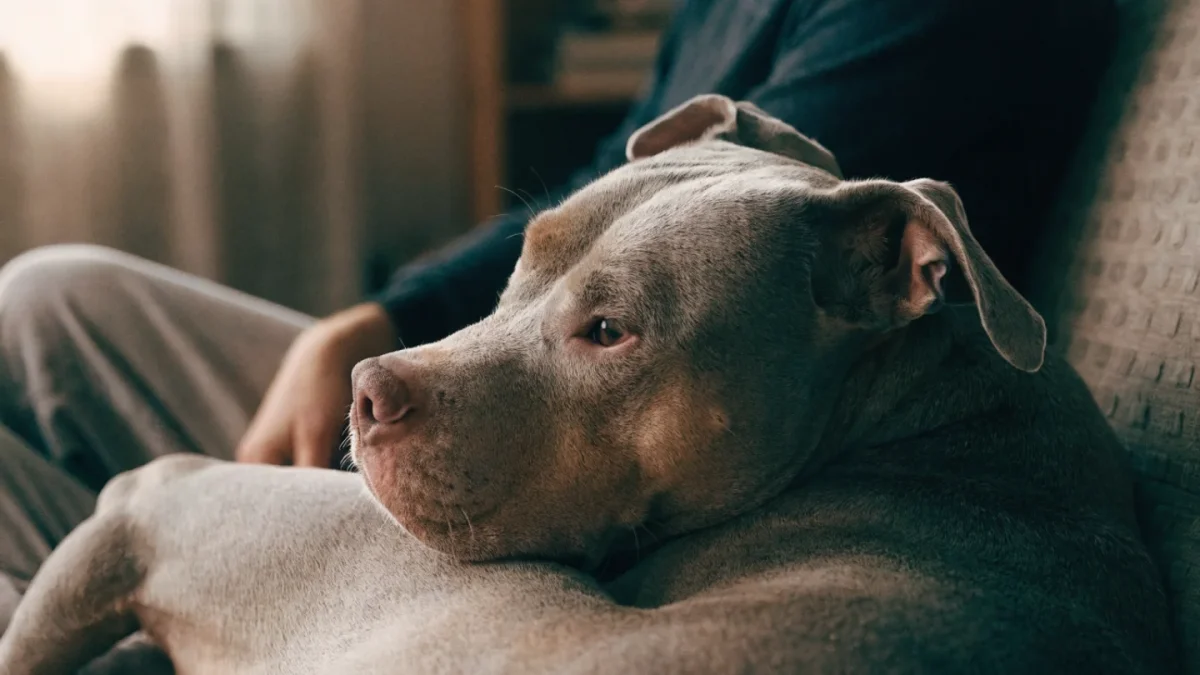
The defining feature of APBT temperament is an intensity of human attachment that catches many first-time owners off guard. This is not the eager-to-please biddability of a retriever or the handler focus of a herding breed. It is something closer to devotion — a bone-deep orientation toward its primary person that expresses itself through constant physical proximity, persistent eye contact, and an emotional sensitivity that seems mismatched with the breed's physical toughness.
APBTs read human emotional states with striking accuracy. Owners routinely report that their dogs respond to stress, sadness, or anxiety with targeted comfort-seeking behavior — pressing against the person, laying a head in the lap, or simply refusing to leave the room. This is not unique to the breed, but the consistency and intensity of the response is notable. The APBT does not observe your mood. It absorbs it.
This sensitivity has a flip side. APBTs are poor candidates for households with chronic tension, yelling, or conflict. Environmental stress affects them more than their physical appearance suggests. A breed that looks like it could handle anything is, emotionally, less armored than most people assume.
Confidence Versus Aggression
A well-bred, properly socialized APBT carries itself with a quiet confidence. The breed is not nervy, not reactive to novel stimuli, not prone to the fear-based aggression that characterizes many anxious breeds. A stable APBT encountering something new is more likely to approach and investigate than to retreat or posture. This confidence is one of the breed's genuine strengths and one of the reasons the breed performs well in structured temperament evaluations.
The confusion between confidence and aggression is where public understanding breaks down most severely. A confident dog is not a dangerous dog. An APBT that holds its ground, makes direct eye contact, and does not defer to other dogs is exhibiting breed-typical confidence, not threatening behavior. People unfamiliar with the breed often misread these signals because they're calibrated to the more deferential body language of retrievers and spaniels.
Actual human-directed aggression in APBTs is not a breed characteristic. The breed's history, counterintuitively, selected against it. Dogs used in organized fighting had to be handled by humans during extremely high-arousal states. Dogs that bit handlers were removed from breeding programs, sometimes lethally. The result, documented across multiple generations, is a breed with an unusually high threshold for redirecting aggression toward people. For more, see History of the American Pit Bull Terrier: From Nanny Dogs to Legislation Targets.
This does not mean that individual APBTs never bite people. Any dog of any breed can bite under sufficient provocation, pain, fear, or resource guarding pressure. It means that human-directed aggression in an APBT is more likely an individual behavioral or medical issue than a breed-wide predisposition.
Dog-Directed Drive: The Honest Part
Here's where temperament discussions about this breed need to get uncomfortable, because this is the part that advocacy groups sometimes minimize and that fearmongering sources distort.
Many American Pit Bull Terriers have meaningful dog-directed drive. This is a genetic tendency — not a certainty, not a guarantee, but a statistically elevated probability — toward confrontation or intolerance of other dogs. It varies enormously between individuals. Some APBTs are social with other dogs throughout their lives. Others develop selectivity as they reach social maturity, typically between 12 and 36 months.
This drive has its origins in the breed's history and cannot be entirely socialized away. A well-socialized APBT is better equipped to manage the impulse, but the impulse itself is part of the breed's genetic inheritance. Pretending it doesn't exist does the breed no favors — it sets owners up for situations they aren't prepared to handle and contributes to the very incidents that fuel anti-breed sentiment.
What responsible management looks like: supervising all interactions with other dogs, maintaining control in public spaces, recognizing that your friendly puppy may develop different preferences as an adult, and having a realistic plan for a multi-dog household that includes separation protocols if needed. This is not paranoia. It is breed-appropriate preparedness.
Sensitivity and Emotional Intelligence
If the Labrador Retriever's emotional range runs from happy to very happy, the APBT operates across a broader and deeper spectrum. These dogs sulk. They hold grudges against specific dogs while adoring others. They respond to the emotional tone of a conversation they can't possibly understand with behavioral adjustments that suggest some form of comprehension.
APBTs are also remarkably sensitive to correction. Harsh verbal reprimands from a bonded owner will shut many APBTs down completely — the dog may refuse to make eye contact, leave the room, or display avoidance behavior for hours. This sensitivity is at direct odds with the breed's tough exterior and catches many owners off guard. The dog that can pull a weighted sled without flinching will crumble under a raised voice from the person it cares about most.
This has training implications. The breed responds far better to positive reinforcement and redirection than to punishment-based methods. APBTs are eager to work, quick to learn, and highly motivated by both food and handler approval. Harsh methods produce anxiety, avoidance, and a deterioration of the trust bond that defines the breed's best quality.
Energy Pattern and Maturation
Contrary to the assumption that APBTs are constantly wired, most adults have a surprisingly effective off switch — once they have been adequately exercised. The breed alternates between periods of high-energy drive and genuine relaxation. An APBT that has had its exercise needs met will spend much of the remaining day doing an excellent impression of a throw pillow.
Adolescent APBTs (roughly 8 months to 2.5 years) are a different story. This is the peak energy period, when physical capability outpaces impulse control and the dog is testing social boundaries with other animals and environmental challenges with equal enthusiasm. This phase is when many owners decide the breed is "too much" — and it is also the window during which the foundations of adult behavior are being set. What you invest in training and structured activity during this period pays lifelong dividends.
The breed matures slowly. Full physical maturity may not arrive until age two or later, and behavioral maturation — particularly around dog-directed behavior — may continue to shift until age three. Evaluating an APBT's permanent temperament based on its behavior at 10 months is premature.
The Right Context
The APBT's temperament is not inherently problematic. It is contextually demanding. This is a dog that thrives with a handler who provides clear structure, physical outlets, emotional consistency, and honest acknowledgment of the breed's characteristics — including the challenging ones. In that context, the APBT's combination of loyalty, intelligence, sensitivity, and athletic drive produces a partnership that owners of other breeds sometimes struggle to understand.
In the wrong context — isolation, inconsistency, a handler who is either afraid of the dog or proud of its capacity for intimidation — the same traits that make the breed exceptional become liabilities. The temperament hasn't changed. The management has.