

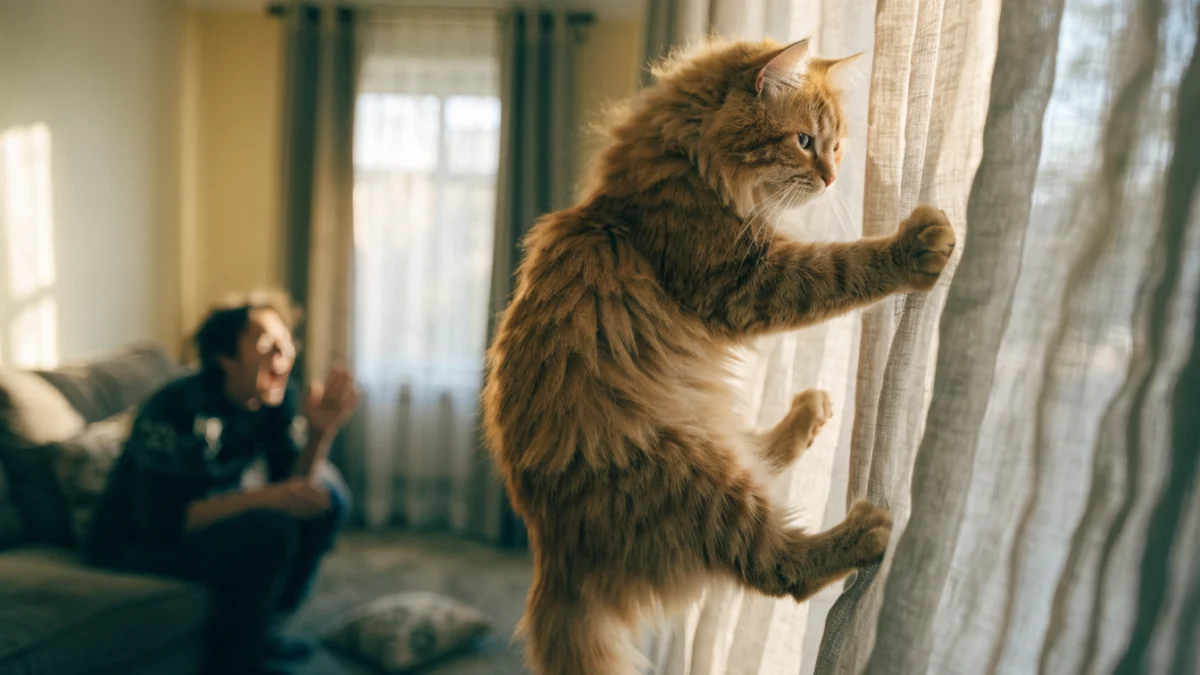
Picture this: Your dog is sprinting toward a busy street, or your cat is scaling your living room curtains like a fluffy mountaineer. Panic sets in. You do exactly what any normal human would do—you scream their name at the top of your lungs. “Buck, no! Get down!”
It feels like the right thing to do. You need to stop the dangerous behavior right now. But here’s the hard truth I had to learn the hard way: you’re falling into the attention trap. When you yell at your dog or cat to stop doing something, you aren’t correcting them. You might actually be rewarding the behavior you want them to stop.
The Attention Trap: Why Your Outburst is a Reward
Let’s talk about “accidental reinforcement.” It sounds like clinical jargon, but the concept is incredibly simple. To an attention-seeking pet, negative attention is still attention. If your cat knocks a glass off the table and you yell at them from across the room, they just succeeded in getting you to engage. You stopped watching TV. You stood up. You looked directly at them. You used a loud, high-energy voice.
To your pet, that’s a massive win.
I used to think raising my voice would establish some sort of boundary. I was wrong. When you yell a pet’s name to stop them from doing something bad, they interpret that engagement as a reward. You are accidentally feeding the exact habit you want to extinguish. As,[1] to a pet seeking interaction, yelling is just another form of play.
The Timing Problem: Why Pets Don’t Get It
Dogs and cats don’t experience time the way we do. They live in the present. If your dog chews up your favorite sneakers while you’re at the grocery store, yelling at them when you get home does absolutely nothing.
Dogs lack the cognitive ability to connect your current yelling with a shoe they destroyed three hours ago. They only see you coming home and throwing a fit. They learn to associate you—the person coming through the door—with unpredictable, frightening behavior.
It’s even more obvious with cats. Cats naturally interpret tone and body language rather than human vocabulary. Have you ever seen two cats discipline each other by yelling? No. They use body language, blocking, or simply walking away. Because cats do not use yelling as a form of discipline among themselves, they are completely unresponsive to it as a correction tool. If you,[2] for climbing the curtains, they just think you’re having a weird, loud temper tantrum. They might stop temporarily because the noise startled them, but they haven’t learned that climbing curtains is bad. They’ve just learned to wait until you aren’t looking.
Fear, Stress, and the Erosion of Trust
There’s this outdated idea that pets act out of “spite” and that loud noises establish dominance or respect. Let’s kill that myth right now. Pets do not understand punishment after the fact. They don’t feel guilt; they feel fear.
Yelling triggers a massive stress and anxiety response in both species. In dogs, it causes them to become fearful, avoidant, and cautious around you. They aren’t learning to respect you; they’re learning to be scared of you. In cats, it causes acute stress and erodes the fragile trust they’ve built with you.
This is why there is a growing debate in pet owner communities. If you look at [3] you’ll see a massive cultural shift. Many modern behaviorists and pet owners classify frequent yelling as a form of emotional abuse due to the chronic stress and psychological harm it inflicts on the animal. More traditional owners might view it simply as a normal, harmless way to set boundaries, but the veterinary consensus is clear: punitive measures fail to address the root cause of the behavior.
Decades of veterinary and behavioral science advocate against punitive measures because they fail to address the root cause of the behavior. To an animal, yelling just feels like unpredictable aggression.
Proactive Management: The Real Training Starts Early
So, if yelling doesn’t work, what do you do when your dog is chasing a car or your cat is shredding the sofa?
Here’s the secret: the real training happens long before the chaotic moment ever begins. You have to use proactive management.
You can’t wait until your dog is locked onto a speeding tire to teach them not to chase cars. By then, it’s too late. Let me tell you about a client I worked with a few years ago. She had a brilliant, high-drive Australian Shepherd named Ranger. Ranger loved to herd cars. It was incredibly dangerous, and naturally, she would scream his name and panic every time a car drove by. The problem? Ranger loved the adrenaline of the chase, and her yelling just added to the chaotic energy of the moment.
We had to completely change the approach. We stopped walking on the sidewalk. We went to a quiet park far from traffic. Every time Ranger looked at a car—even from 100 yards away—I had the owner mark the behavior with a clicker and reward him. We taught him a “watch me” cue. Over weeks, we slowly decreased the distance. Ranger learned that checking in with his owner was far more rewarding than chasing a car.
Setting Up Your Dog
- Teach alternative behaviors like a rock-solid “leave it” or “watch me” cue when you’re sitting in your living room.
- Practice these cues in low-distraction environments, like your backyard, before taking them on the sidewalk.
- Reward heavily for eye contact. You are building a neural pathway so that when a squirrel darts out, your dog’s instinct is to look at you.
Setting Up Your Cat
- Provide legal alternatives. If you don’t want them on the kitchen counter, you have to provide higher, more appealing spaces.
- Invest in sturdy cat trees and place designated scratching posts near the furniture they keep attacking.
- Use environmental management. Close doors to keep them out of temptation, and use harmless deterrents like double-sided tape on counters.
Redirection: Show Them What to Do
Punishing a pet for doing the wrong thing just leaves a void. If you tell a dog “no” for jumping on guests, but you never teach them what to do instead, they’ll just go back to jumping.
The most effective training method is redirection. Show the pet what to do, rather than just punishing them for what not to do.
If your puppy is biting your hands, don’t yell. Quietly stand up, cross your arms, and end the game for 30 seconds. Then give them a toy and reward them for chewing that instead. If your cat is scratching the rug, gently pick them up, move them to their scratching post, and reward them with a treat when they use it.
In recent years, the veterinary and animal training industries have heavily adopted “Fear-Free” and low-stress handling practices. This represents a major cultural shift away from punitive corrections like scolding, toward purely proactive, positive-reinforcement-based pet management.
The best way to preserve your bond with your pet is to ditch the shouting matches. It takes practice to bite your tongue when your dog grabs your socks or your cat clears a shelf, but keeping your cool is the fastest path to a peaceful home. Remember that your dog or cat isn’t trying to ruin your day—they’re just being a dog or a cat. By managing their environment, providing legal outlets for their natural instincts, and rewarding the behaviors you want, you’ll build a relationship based on mutual trust rather than fear.
Sources
- decades of veterinary and animal behavior research show — facebook.com
- yell at your cat — quora.com
- online groups and forums — facebook.com