

Calcium and phosphorus. This is where most raw diets fail, and the consequences range from subtle to severe.
I've seen the severe end. A young German Shepherd named Ajax came in with a slight gait abnormality at eight months. His owner had been feeding raw since he was weaned — proudly, carefully, with a lot of thought. But his diet was based almost entirely on muscle meat: chicken breast, lean beef, some turkey. Essentially zero bone content. The X-rays showed what I'd feared: skeletal changes consistent with nutritional secondary hyperparathyroidism. His body had been pulling calcium from his bones to compensate for a dietary deficiency.
We corrected it. Ajax recovered. But it took months, and it was entirely preventable.
Why Muscle Meat Alone Doesn't Work
Raw meat is high in phosphorus and extremely low in calcium. This isn't a flaw in raw feeding specifically — cooked meat has the same profile. The difference is that commercial kibble is formulated with calcium added; raw diets require the owner to provide calcium from somewhere.
In whole prey, that calcium source is bone. An animal eating a whole rabbit gets muscle (phosphorus-dominant), bone (calcium-dominant), and organs. The combination balances. A bowl of boneless chicken breast provides none of the calcium balance.
The calcium-to-phosphorus ratio (Ca:P) for dogs should be approximately 1.2:1 to 2:1 — AAFCO guidelines set the allowable range at 1:1 minimum to 2.1:1 maximum, with the optimal ratio for adult dogs closer to 1.2–1.4:1 (Dobenecker et al., PMC, 2019; Merck Veterinary Manual, Nutritional Requirements of Small Animals). Muscle meat without bone typically yields a Ca:P ratio far below 1:1. Feeding this long-term causes the body to mobilize calcium from the skeleton to maintain blood calcium levels — which is what hyperparathyroidism does, and what it did to Ajax.
The Prey Model Ratio
The 80-10-10 ratio is the most commonly cited starting point for prey model raw:
- 80% muscle meat (including heart, which counts as muscle)
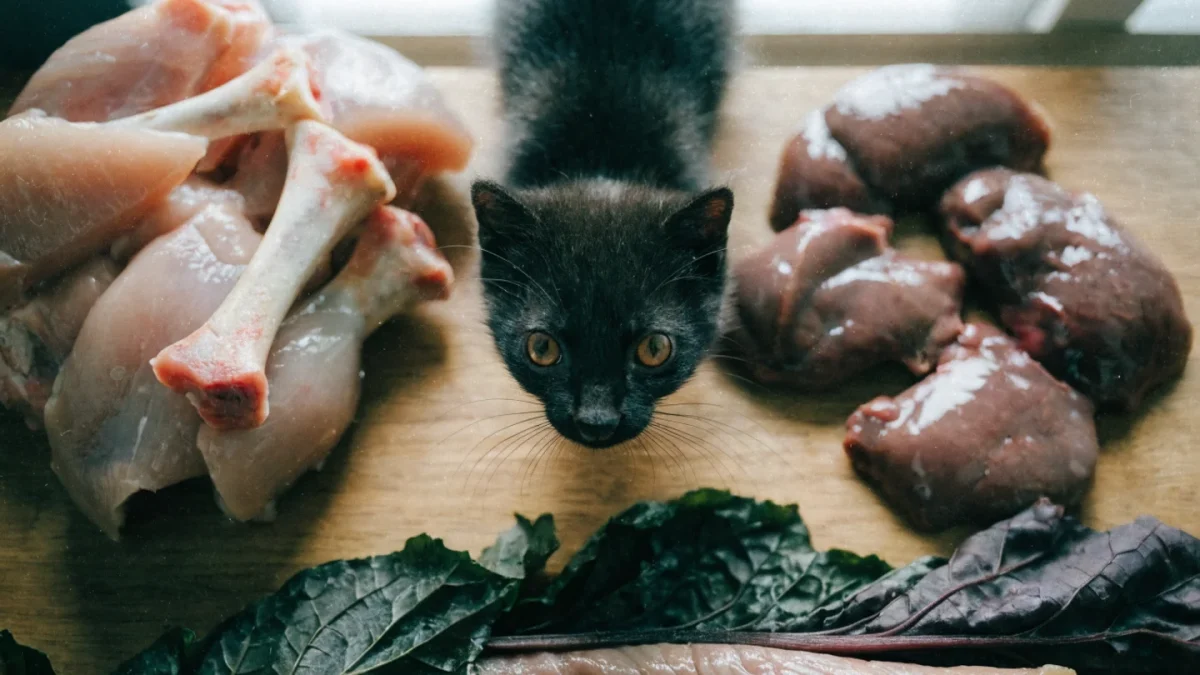
- 10% raw meaty bones
- 10% organs (at least half of which should be liver)
This is a rough approximation of the composition of whole prey. It's not a rigid formula — real prey varies considerably — but it provides a reasonable nutritional starting point.
Important note: the "10% bone" refers to the bone content within raw meaty bones, not 10% pure ground bone. A chicken leg quarter is roughly 27–30% bone by weight — so it would represent a smaller percentage of total diet weight than it sounds (this is a well-documented figure in raw feeding nutrition literature, consistent across multiple compositional analyses).
BARF diets (Biologically Appropriate Raw Food) add a plant component — usually 10–20% vegetables and some fruit — to this base. Whether the plant component adds meaningful nutrition to dogs (who can digest plant material better than cats) is debated. Most BARF advocates argue it provides phytonutrients and additional fiber. Most prey model advocates think it's unnecessary.
Getting Calcium Balance Right
There are two ways to provide calcium in a raw diet: raw meaty bones, or calcium supplement.
Raw meaty bones are the traditional approach. Soft options — chicken necks, wings, backs, and frames — are appropriate for most dogs. The bone is consumed, providing calcium. Hard weight-bearing bones (knuckles, femur shafts) are not appropriate for calcium supplementation because they're weight-bearing density and pose serious dental fracture risk.
Calcium supplements are used when raw bones aren't practical or when a dog has dental issues or swallowing concerns. Ground bone meal and calcium carbonate are common options. The challenge is dosing accurately — too much calcium is also a problem, particularly in growing large-breed puppies.
For puppies, calcium balance is more critical and the margin for error is smaller. Both excess and deficiency during growth phases cause skeletal problems. This is an area where I'd push very hard for professional formulation review if you're feeding a puppy a homemade raw diet.
Organ Meats: Essential and Easy to Overdo
The 10% organ component provides nutrients that muscle meat doesn't: fat-soluble vitamins (particularly vitamin A from liver), B vitamins, zinc, and other trace minerals.
Liver should make up at least half the organ portion — roughly 5% of total diet. Kidney, spleen, pancreas, and brain count as secreting organs and should make up the remainder.
The risk: vitamin A toxicity from excessive liver. Liver is extremely high in preformed vitamin A. Too much, over time, causes bone and joint problems and can be serious. Keeping liver at approximately 5% of total diet and not exceeding this prevents the problem while still providing the nutritional benefits.
I've seen two cases of suspected vitamin A toxicity in dogs on homemade raw diets — both were getting liver well above appropriate levels, in one case because the owner loved the dog's enthusiasm for liver and kept increasing it. More is not better with fat-soluble vitamins.
Common Mistakes and How to Fix Them
Muscle meat only, no bone or bone supplement — the Ajax scenario. Fix: introduce raw meaty bones or a calcium supplement at appropriate ratios.
Too much liver — vitamin A excess over time. Fix: reduce liver to 5% of total diet, substituting other organs for the remainder.
Not rotating protein sources — nutritional blind spots from single-protein reliance. Fix: rotate through 3–4 protein sources over time (not daily initially, but monthly rotation).
Using ground commercial bone meal in excess — provides calcium but also fluoride; overdosing is possible. Fix: measure carefully or use raw meaty bones where the balance is more naturally self-limiting.
No professional review — by far the most common root cause of all of the above. Fix: have your recipe reviewed by a veterinary nutritionist before committing to it long-term. Not a forum. A credentialed professional with access to nutrient analysis software.
How to start raw feeding safely before worrying about advanced balance sets the foundation — ratio optimization is an intermediate-level concern, not where beginners should start.
FAQ
Can I feed my dog only chicken as their raw protein?
You can for a period of time, but single-protein feeding long-term creates nutritional gaps. Chicken is a good starting protein because it's palatable and low-allergen for most dogs, but rotating through beef, lamb, rabbit, and other proteins over time provides better nutritional breadth. Think monthly rotation rather than daily.
Do I need to add vegetables to a raw diet?
For dogs, vegetables can provide fiber, phytonutrients, and variety, and there are proponents of both including and excluding them. They're not nutritionally required if the meat-bone-organ balance is correct and the diet is complete. For cats, vegetables are largely unnecessary and potentially counterproductive for their strictly carnivore metabolism.
How do I know if my calcium-phosphorus balance is correct?
Without having the recipe analyzed against published nutrient requirements, you can't know for certain. Visible signs of calcium deficiency (skeletal issues, poor growth in puppies) take weeks to months to appear. The best approach is to have the formulation reviewed by a veterinary nutritionist before problems develop, and then recheck bloodwork and physical condition at 6-month intervals.