

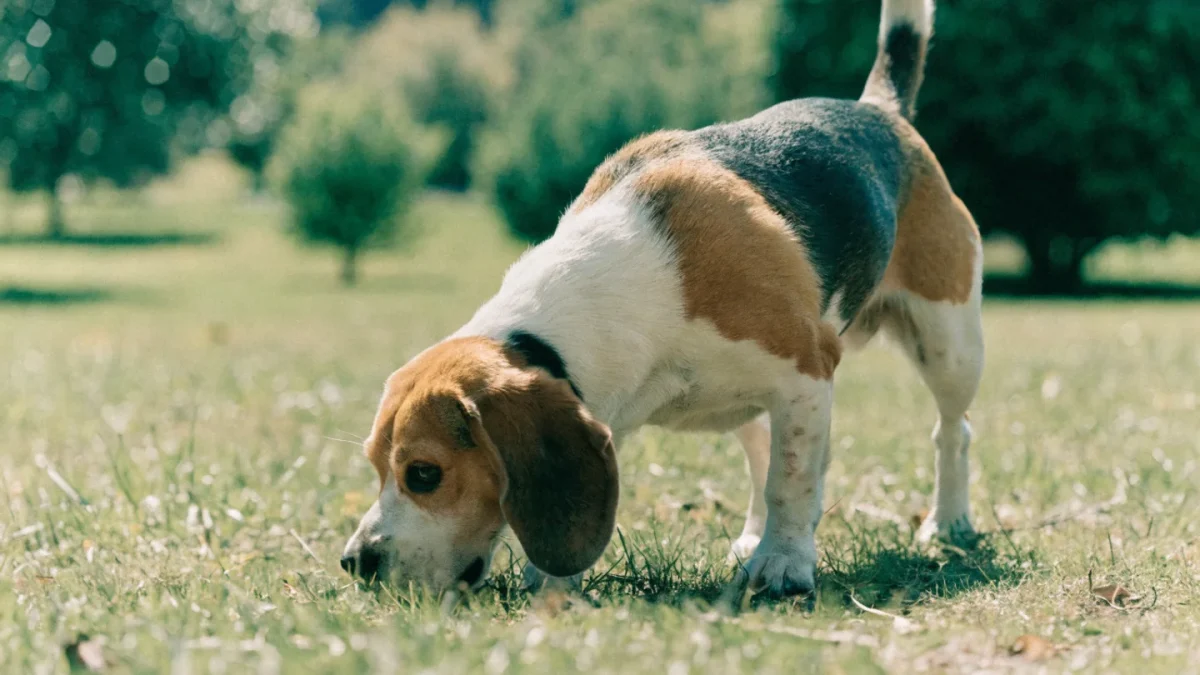
The beagle was originally expected to cover roughly 30 to 40 kilometers in a single day of hunting — trotting through fields, crashing through brush, casting back and forth across scent trails for six or eight hours at a stretch. No responsible owner needs to replicate that workload, but understanding the athletic baseline this breed was designed for explains why a fifteen-minute loop around the block leaves your beagle climbing the walls by evening.
Beagle exercise needs sit in a category that surprises people who chose the breed based on its compact size. This is not a lap dog with modest requirements. It's a working hound in a convenient package, and it needs activity that engages both its body and — critically — its nose.
The Numbers
An adult beagle in good health needs a minimum of 60 to 90 minutes of daily activity. That's not optional, and it's not a suggestion you can scale down once the dog "settles." Beagles don't settle. They reach physical maturity around 18 months and maintain a consistent energy level well into their middle years. Many beagles are still demanding full exercise routines at eight or nine years old.
Split the time across at least two sessions. A single long walk works less effectively than two moderate outings, because beagles — like most dogs — benefit from the mental reset of returning home and heading out again later. A morning walk of 30 to 40 minutes and an afternoon session of similar length is a reliable baseline.
Puppies under a year need less structured exercise but more frequent activity in shorter bursts. A common guideline is five minutes of exercise per month of age, twice daily — so a four-month-old puppy gets roughly 20 minutes per session. Over-exercising growing puppies risks joint damage, particularly in a breed predisposed to intervertebral disc issues.
Senior beagles slow down, but most still need 30 to 45 minutes of daily movement. The pace drops, the sniffing time increases, and the walks get shorter, but eliminating exercise entirely accelerates age-related decline.
Why Distance Doesn't Matter as Much as You Think
Here's the counterintuitive reality about beagle exercise: a 30-minute structured sniff walk will produce a calmer, more satisfied dog than a 60-minute forced march at human pace.
Beagles process the world through scent. Their roughly 220 million olfactory receptors are connected to a proportionally massive olfactory cortex, and that neural architecture demands input. A walk where the dog is hauled along at the owner's pace with no opportunity to investigate scent marks is physical exercise that ignores the beagle's primary cognitive need.
The complete beagle breed guide covers the breed's scent apparatus in detail. The practical implication for exercise is straightforward: let the dog sniff. Dedicate at least one walk per day — or a portion of each walk — to what's sometimes called a "decompression walk," where the dog sets the pace and direction, nose to the ground, following whatever interests it.
This is not a failure of leash discipline. It's targeted mental exercise for a breed that was built to track scent trails for hours. A beagle that gets adequate sniffing time is a beagle that doesn't destroy your furniture out of frustrated boredom.
Nose Work and Structured Activities
Beyond daily walks, beagles thrive with activities that challenge their olfactory abilities.
Scent games at home require minimal equipment. Hide treats in cardboard boxes scattered around a room and let the dog search. Start simple — three boxes, one treat — and increase complexity as the dog gets faster. Most beagles take to this immediately, because it's a domesticated version of exactly what they were bred to do.
Snuffle mats — fabric mats with deep folds that hide kibble or treats — serve a similar function and double as slow feeders for a breed notorious for inhaling meals.
Formal scent-work classes and tracking trials are available in most regions and offer structured progression from basic odor detection to complex search patterns. Beagles tend to excel in these activities, and the mental exhaustion from a 20-minute tracking session can equal or exceed a long walk in terms of settling the dog at home afterward.
Agility works for beagles, though with a caveat: the beagle temperament means compliance in an agility course depends heavily on whether the dog finds the activity rewarding on its own terms. Some beagles run agility courses beautifully. Others stop mid-course to investigate a smell and decline to resume.
Fencing and Off-Leash Realities
Secure outdoor space changes the exercise equation significantly. A beagle with access to a fenced yard gets incidental activity throughout the day — patrolling the perimeter, investigating scents that drift in from neighbors, chasing squirrels along the fence line.
The fencing requirements are specific. A minimum height of 150 centimeters is the standard recommendation. Beagles are not prodigious jumpers, but a motivated beagle can clear a low fence or find purchase on a chain-link panel. More commonly, they go under rather than over — digging at fence bases is common, and burying wire mesh along the perimeter is a practical preventive measure.
Electronic underground fences are unreliable for scent hounds. The deterrent stimulus competes with a scent-tracking drive that has been selectively reinforced over centuries, and the drive usually wins. A beagle on a hot scent trail will blow through an electronic boundary without hesitation and then be unwilling to cross back through it to return home.
Off-leash walking in unfenced areas is a risk most beagle owners should not take. Reliable recall requires the dog to prioritize the handler's voice over active olfactory stimulation, and that's a trade-off this breed almost never makes consistently. Long leads of 5 to 10 meters offer a compromise — more freedom to explore while maintaining physical control.
Signs of Insufficient Exercise
A beagle that isn't getting enough activity tells you clearly: sustained baying when home alone, destructive chewing (particularly items with strong scent profiles like shoes and laundry), escalating counter-surfing and garbage-raiding. These are exercise deficits, not behavioral problems.
Weight gain is the slower-burning consequence. Beagles are already prone to obesity, and under-exercised beagles gain weight quickly on standard portions.
The Right Routine
The simplest effective routine for an adult beagle: a structured morning walk (30 to 40 minutes, including 10 minutes of free-sniffing time), an afternoon activity session (nose work, scent games, a second walk, or supervised yard time), and regular puzzle feeders for incidental mental stimulation. Owners who add organized scent work on top of that baseline see the difference — a more content, settled dog with an appropriate outlet for drives that have nowhere else to go.