

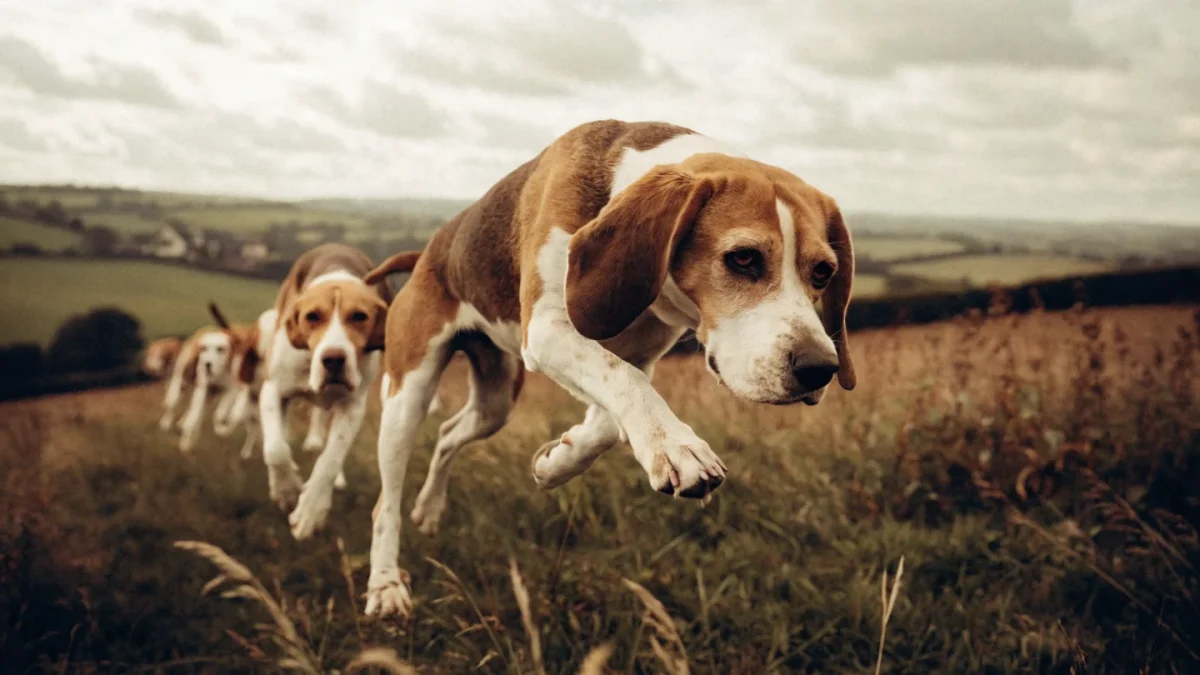
Queen Elizabeth I kept a pack of beagles so small they could stand on a dinner plate. They were called Pocket Beagles, they measured roughly 20 to 23 centimeters at the shoulder, and they are now completely extinct. The breed we know today as the beagle would tower over those Tudor-era dogs — and yet it carries their scenting instincts, their pack drive, and their voice almost unchanged across five centuries.
Beagle history origins stretch back far further than the English monarchy, though. Tracing this breed's lineage means following a scent trail that runs through ancient Greece, Roman Britain, medieval hunting estates, the agricultural hedgerows of rural England, an Illinois breeding program, and eventually into the most recognizable living rooms in American popular culture.
Before They Were Beagles
The earliest written record of dogs matching the beagle's general description comes from Xenophon, the Greek historian and soldier, writing around 400 BC. In his treatise Cynegeticus, he described small hounds used for tracking hares on foot — dogs prized not for speed but for stamina and an unrelenting nose. These weren't beagles in any modern sense, but they were the same functional type: compact, scent-driven, and designed to work at human walking pace.
Romans almost certainly brought similar hound-type dogs to Britain during their occupation, beginning in 43 AD. These dogs interbred with local hunting stock over the following centuries. By the time William the Conqueror arrived in 1066, small pack hounds were already established throughout the British Isles, though no standardized breed existed yet.
The word "beagle" appears in English records by the 1400s. Its etymology remains debated. Some linguists trace it to the French be'geule, meaning "open throat" or "wide mouth" — fitting for a breed famous for its carrying voice. Others link it to the Old English beag, meaning small, or the Celtic beag with the same meaning. The uncertainty is itself revealing: the breed predates the kind of systematic record-keeping that would settle the question.
The Miniature Era
Between the 1300s and 1500s, English royalty maintained beagle packs as much for entertainment as for hunting. Edward II and Henry VII both kept what records describe as "Glove Beagles" — dogs small enough to be held in a gloved hand. Elizabeth I's Pocket Beagles were even smaller, standing under 23 centimeters and reportedly carried to the hunting field in saddlebags.
These miniature beagles were a novelty more than a practical hunting tool. They could track a hare, but their tiny legs meant the hunt proceeded at a leisurely pace — which suited the social hunting parties of the Elizabethan court. The sport was the tracking, the social gathering, and the spectacle, not the speed of the kill.
As the full beagle breed guide notes, those miniature lines gradually died out as hunters demanded faster, more athletic hounds. By the 1600s, Pocket Beagles were increasingly rare. By the early 1700s, they had effectively vanished from breeding programs.
Two Hounds Become One
The 1700s are the pivotal century in beagle history. During this period, two distinct regional hound types dominated English rabbit hunting.
The Southern Hound was the larger of the two — heavy-boned, long-eared, with a deep, resonant voice and a methodical tracking style. It was slow, thorough, and suited to the rolling countryside of southern England where dense hedgerows and heavy cover made stamina more valuable than speed.
The North Country Beagle was the opposite: lighter, faster, more agile, with a higher-pitched voice and a tendency to run its quarry rather than methodically track it. Northern terrain was more open, and hunters there needed a hound that could cover ground quickly.
Neither type was formally standardized. Packs varied from estate to estate, bred according to the preferences and terrain of each landowner. But when hunters began crossing the two types — Southern endurance with Northern speed — the result was a medium-sized hound that combined the best working traits of both. This cross is the direct ancestor of the modern beagle.
Near-Extinction
The early 1800s nearly ended the beagle's story. Foxhunting had become the fashionable field sport among the English gentry, and foxhounds — larger, faster, designed to be followed on horseback — eclipsed beagles in popularity among the social class that had historically maintained the largest breeding programs.
The beagle survived for the most practical of reasons: farmers needed it. A mounted foxhunt required land, horses, grooms, and social standing. A farmer walking his fields with four or five beagles needed none of those things. Beagle packs persisted in England, Ireland, and Wales because they were the working person's hunting dog — efficient, inexpensive to keep, and capable of putting rabbit on the table.
This period of agricultural preservation is often glossed over in breed histories that jump from royal packs to Victorian dog shows. But it matters, because it shaped the breed's temperament. The beagles that survived weren't the novelty miniatures of Elizabeth's court. They were working animals, selected purely for scenting ability, stamina, pack compatibility, and a voice that could carry across a valley. Every practical trait that defines the modern beagle was pressure-tested in those hedgerow packs.
The Honeywood Revival
Reverend Phillip Honeywood of Essex assembled what most breed historians consider the foundational modern beagle pack in the 1830s. Honeywood bred exclusively for hunting performance — he had no interest in the show ring, which was only beginning to emerge as a concept. His dogs were consistent in type, reliable in the field, and became widely sought by other breeders looking to improve their own packs.
Thomas Johnson, a contemporary of Honeywood, took a different approach. He bred for both function and appearance, producing dogs that could hunt as effectively as Honeywood's stock but looked more refined doing it. Johnson's influence was critical as the dog show movement gained momentum in the mid-1800s and breeders began caring about aesthetic consistency alongside working ability.
The tension between field beagles and show beagles — between selecting for nose and selecting for looks — began in this era and persists today. Modern field-trial beagles tend to be leaner, longer-legged, and more intense in their tracking behavior. Show beagles are stockier, with more exaggerated ear length and a calmer disposition. Both are beagles, but they look and behave differently enough that a casual observer might not recognize them as the same breed.
Crossing the Atlantic
General Richard Rowett of Carlinville, Illinois imported beagles from England in the early 1870s and established what many consider the foundation of the American beagle population. Rowett's dogs were of exceptional quality — his strain became so well-regarded that "Rowett beagles" functioned almost as a sub-brand within the breed for decades.
The National Beagle Club formed in 1884, the same year the American Kennel Club recognized the breed. The timing wasn't coincidental — the late 1800s saw an explosion of breed standardization across both sides of the Atlantic, as dog shows became popular entertainment and kennel clubs began formalizing the characteristics that distinguished one breed from another.
In America, beagles found a new role. While English beagle packs continued to hunt rabbits in the traditional way — on foot, with a pack of hounds and a group of walking hunters — American hunters increasingly used beagles for cottontail rabbit hunting in smaller groups, sometimes with just one or two dogs. This selected for beagles that could work independently or in pairs rather than only in large packs, subtly shifting the breed's working style.
The Modern Beagle's Cultural Footprint
By the mid-twentieth century, the beagle had secured its position as one of the most popular breeds in the United States, consistently ranking in the top ten since the AKC began tracking registrations. Its popularity extended globally — beagles are among the most common breeds in the United Kingdom, Australia, Japan, and across Western Europe.
Charles Schulz's Snoopy, introduced in the Peanuts comic strip in 1950, cemented the beagle in American popular consciousness. Schulz chose the breed deliberately — he grew up with a pointer mix he considered the smartest dog he'd ever known, but he selected the beagle for Snoopy because its personality offered more comic potential. The independent streak, the food obsession, the dramatic emotional range — these are beagle traits that translated directly into forty-nine years of daily newspaper humor.
The breed's other major cultural role is less charming. Beagles have been the most commonly used dog breed in laboratory research for decades, chosen for their small size, docile temperament, and genetic consistency. This history has sparked significant public debate and periodic large-scale adoptions of retired laboratory dogs.
What the History Tells Us
The beagle is not a manufactured breed. It wasn't assembled from a blueprint or designed by committee. It evolved through 2,500 years of functional pressure — from ancient Greek hare hounds through Roman crossbreeding, medieval miniaturization, agricultural survival, Victorian standardization, and transatlantic transplantation.
That deep working history explains everything about the breed that owners either love or struggle with. The nose comes from millennia of scent-tracking selection. The independence comes from working without direct human supervision. The voice comes from pack communication across distance. The sociability comes from living elbow-to-elbow with other dogs for their entire evolutionary history.
Understanding where a breed has been is the most reliable way to predict what it will be like in your living room. In the beagle's case, 2,500 years of history points in a single, unmistakable direction: toward the next interesting smell.