

Ask most people what a beagle is like to live with, and they'll describe a dog that's friendly, easygoing, good with kids, maybe a little stubborn. Ask someone who actually owns one, and they'll tell you about the escape from the supposedly secure yard, the sound that woke the neighbors, the trail the dog was following so intently that it walked directly into a fence post and kept going.
The gap between the reputation and the reality of beagle temperament personality comes down to one thing the "friendly family dog" description consistently leaves out: the nose. A beagle doesn't experience the world the way you do. It doesn't even experience it the way most dogs do. Those 220 million olfactory receptors — roughly 44 times the number in a human nose — aren't just a feature. They're the dog's primary sense, the channel through which it understands where it is, what's happened recently, and what's worth investigating. When a scent trail is active, that signal competes with everything else — your voice, the recall cue you spent months training, the treat in your pocket. Sometimes it wins. Often it wins. Understanding beagle temperament means understanding that relationship between nose and brain, because nearly every behavioral trait people celebrate or struggle with traces directly back to it.
The Nose Runs the Show
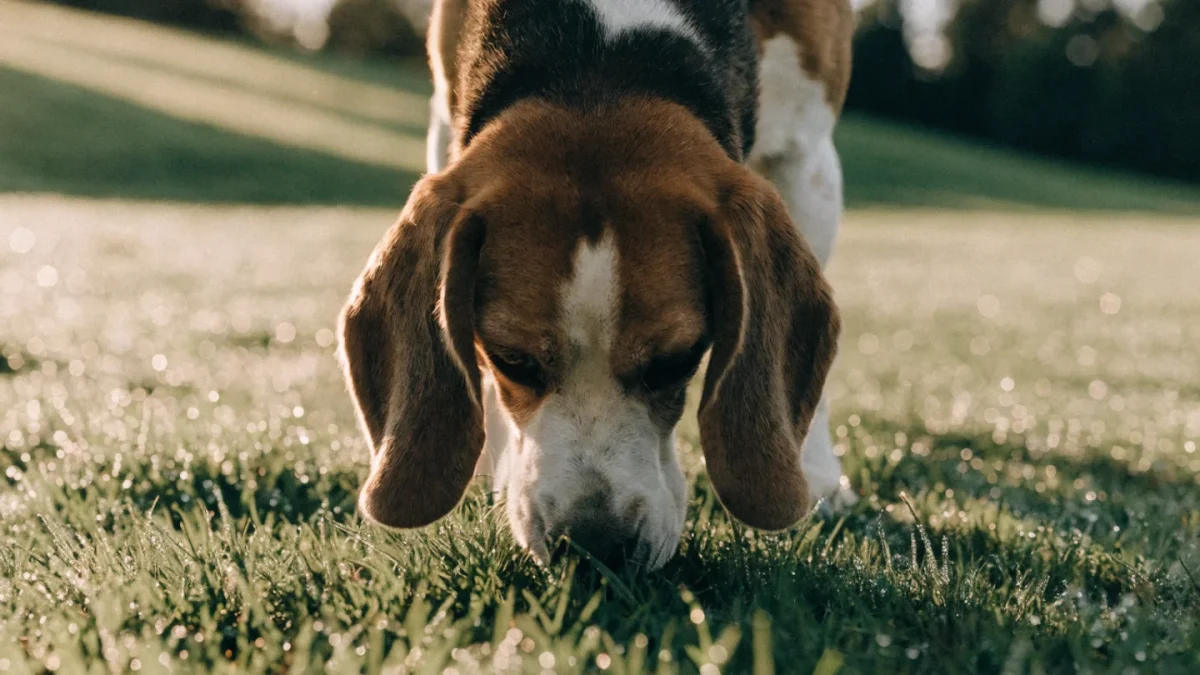
Watch a beagle on a walk, and you'll see something fundamentally different from how a retriever or a shepherd moves through the same space. Those breeds look up — scanning the environment, checking in with their handler, reading social cues. A beagle looks down. Its head drops the moment it hits grass, and the tail goes up like a metronome keeping time with whatever scent trail has captured its attention.
This isn't a preference. It's architecture. Beagles belong to the scenthound group, bred over centuries specifically to track quarry by ground scent rather than sight. The long, low-set ears aren't ornamental — they sweep air from the ground up toward the nostrils. The moist, broad nose leather maximizes scent particle capture. Even the loose skin around the face helps trap scent molecules close to the olfactory apparatus.
For the beagle as a complete breed, this olfactory wiring defines everything. When a beagle latches onto a scent trail, its brain enters something close to a flow state. Auditory input — including your frantic recall commands — gets deprioritized. The dog isn't ignoring you out of spite. Its neural resources are allocated elsewhere, processing a stream of chemical information that you and I will never experience.
This is why experienced beagle owners don't take off-leash recall personally. The dog heard you. It registered the command. It then made a cost-benefit calculation and decided that the rabbit trail was a better use of its cognitive bandwidth. That decision-making pattern runs through every aspect of beagle temperament.
Independent, Not Disobedient
The word "stubborn" comes up in almost every conversation about beagles, and it deserves honest examination rather than the usual hand-wave about hounds being "free-spirited."
Beagles were bred to work in packs, covering ground for hours while hunters followed on foot. There was no handler standing nearby giving moment-to-moment commands. The dogs made their own decisions — which trail to follow, when to give tongue, when to cast wider to relocate a lost scent. A beagle that stopped tracking every time a distant human yelled would have been culled from the breeding program centuries ago.
That working independence is exactly what modern owners experience as stubbornness. A beagle evaluates whether compliance serves its current interests, and if the answer is no, it simply doesn't comply. Not with aggression. Not with anxiety. Just a calm, unhurried refusal that drives obedience-oriented owners to distraction.
Compare this to a border collie, which finds the act of complying with human commands intrinsically rewarding, or a golden retriever, which orients its entire emotional state around handler approval. The beagle has no such wiring. It likes you — probably loves you — but it doesn't need your approval the way a herding breed does. Affection and obedience are separate categories for a hound.
This doesn't mean beagles can't be trained. They learn quickly, often faster than their owners realize. The gap is between understanding and choosing. A beagle that has mastered "stay" will execute it reliably when there's a strong enough motivator. Remove the motivator, and the command becomes a suggestion.
Pack Dogs to the Core
Beagles hunted in groups of a dozen or more for centuries, and that pack heritage shapes their social behavior in ways that are both charming and demanding.
On the charming side: beagles get along with nearly everyone. Other dogs, cats they've been raised with, strangers at the door, children pulling their ears — the default beagle response to social contact is enthusiastic acceptance. They rarely show same-sex aggression, they defer rather than escalate in conflict situations, and they tend to integrate into multi-dog households without the dominance negotiations that some breeds require.
On the demanding side: a dog bred to spend every waking hour surrounded by packmates does not handle isolation well. A beagle left alone for eight or ten hours daily will express its distress audibly, persistently, and at a volume that travels through walls. Separation anxiety is common in the breed, and it manifests as sustained howling, destructive chewing, and escape attempts that would impress a tunneling engineer.
The pack mentality also means beagles are followers as much as they are independent. They take cues from the emotional state of the household. A calm, consistent home produces a calmer beagle. A chaotic, high-tension environment amplifies the breed's more anxious tendencies.
The Voice
No honest discussion of beagle temperament can skip the vocalization issue.
Beagles produce three distinct sounds. The standard bark is sharp and carries well. The bay — that long, melodic "aroo" — is the signature hound voice that hunters relied on to locate their pack at a distance. The howl is deeper, sustained, and can reach neighbors several houses away.
They bay when they detect a scent. When they see another dog. When they hear a siren. When they're bored. When they want attention. When they're experiencing an emotion that, as far as anyone can determine, is simply the joy of making noise.
This is not a behavior problem that training can eliminate. You can manage triggers, you can reduce frequency with consistent work, but you cannot undo centuries of selective pressure that rewarded the loudest, most persistent voices. A quiet beagle is a sleeping beagle.
For owners in detached homes with tolerant neighbors, the bay is manageable — even endearing, once you develop an ear for what each vocalization means. For apartment dwellers, it is a genuine deal-breaker that no amount of wishful thinking will solve.
With Children
Beagles have a well-earned reputation as family dogs, and it holds up under scrutiny better than similar claims about many popular breeds.
Their sturdy, compact build tolerates the accidental roughness of young children better than fragile toy breeds. Their pack orientation leads them to treat children as members of their social group rather than as competitors. Their food motivation — while it creates management challenges — makes them remarkably patient with kids who are learning to interact with animals, because a child offering a treat is a child worth tolerating.
The realistic caveat: beagles and toddlers create a specific logistical challenge around food. A beagle will take food from a child's hand, from a high chair tray, from a dropped snack on the floor — not with aggression, but with the speed and determination of an animal that has evolved to seize caloric opportunities. Families with young children need systems to manage this, because a beagle that learns to mug a toddler for crackers becomes a persistent problem.
What Most People Get Wrong
The biggest misconception about beagle temperament is that their friendliness equals ease. People see the wagging tail, the soft eyes, the reasonable size, and conclude that beagles are simple, uncomplicated pets.
They are not. They are complex animals whose behavioral needs are specific and non-negotiable. They need companionship — real, sustained presence, not just a person who sleeps in the same house. They need olfactory stimulation, not just physical exercise. They need owners who interpret independence as a feature rather than a defect.
The second misconception is that beagles are "just small dogs." Their exercise needs, mental stimulation requirements, and escape artistry are closer to what you'd expect from a working breed twice their size. The history of how beagles developed as tireless pack hunters over thousands of years explains why their energy and drive consistently surprise owners who chose the breed based on size alone.
Underestimating a beagle is the fastest path to a frustrated owner and a miserable dog.
The Right Temperament Match
A beagle's temperament fits best with people who find the breed's contradictions appealing rather than exhausting. The dog that leans against you on the couch but ignores you in the field. The dog that loves everyone but guards its food bowl with strategic intensity. The dog that can track a scent trail for hours but can't be trusted to come back when you call.
If you need a dog that hangs on your every word, this breed will disappoint you. If you enjoy living with an animal that has its own agenda, its own pleasures, and its own loudly expressed opinions — and if you have the secure fencing and patient humor to accommodate all of that — the beagle temperament is one of the most rewarding in the dog world.