

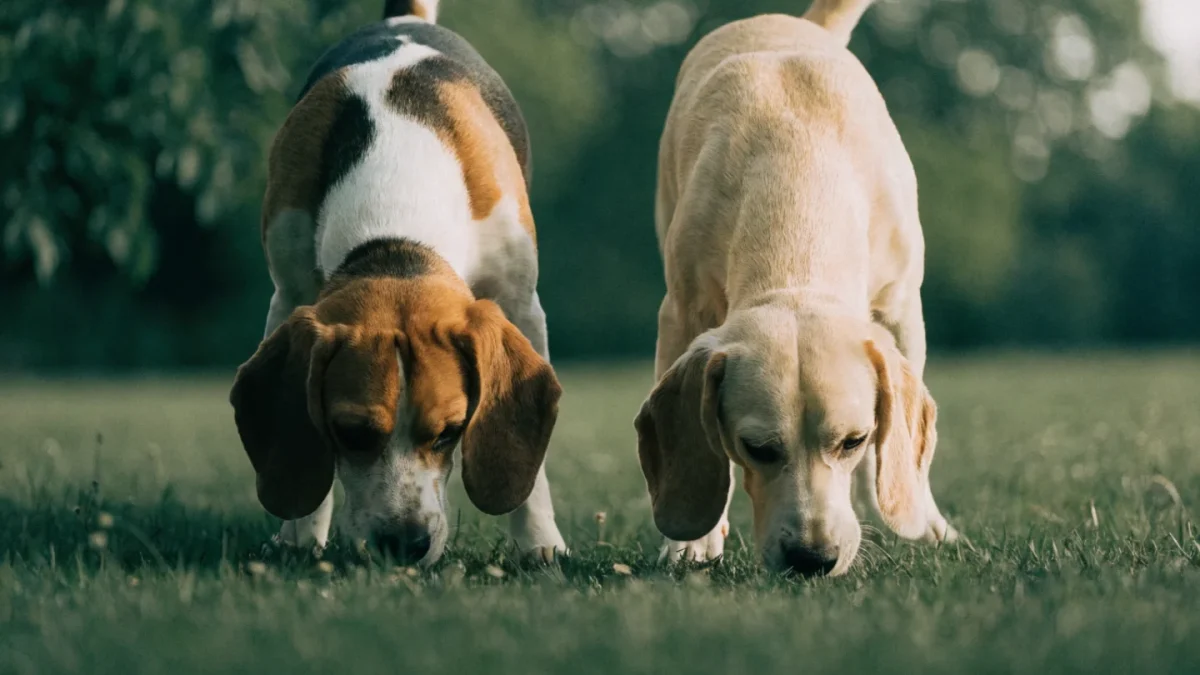
The lemon beagle looks almost like a printing error — pale gold where you expect black, white where you expect tan, the tricolor template erased back to something simpler. The genetics behind that pale coat are a perfect illustration of how dog color inheritance actually works: not a single gene switched on or off, but an interaction between multiple loci, each one constraining or enabling what the others can produce. A lemon beagle carries a recessive genotype at the extension locus that blocks eumelanin production entirely. No black pigment pathway. Whatever color the agouti locus would have produced in the tan points is still there — it just shows up across the whole coat instead of in patches, because there's no black to delineate it.
That's one piece of the beagle genetics story. The full picture includes coat color inheritance, the size variation between 13-inch and 15-inch types, the extraordinary olfactory apparatus that gives the breed roughly 220 million scent receptors, and a breed-specific condition — Musladin-Lueke Syndrome — that has its own distinct genetic basis. This article covers beagle genetics coat colors and the rest of it, without oversimplifying what's genuinely complex.
How Beagle Coat Color Works
Coat color in dogs is polygenic — controlled by the interaction of several independent genes rather than a single on-off switch. In beagles, the primary players are the E (extension), A (agouti), K (dominant black), B (brown), and S (white spotting) loci. Each locus has multiple possible alleles, and the combination across all loci determines the final color pattern.
The Tricolor Foundation
The classic tricolor beagle — black saddle or blanket over the back, tan on the face, legs, and chest, white on the feet, chest blaze, and tail tip — is the pattern most people associate with the breed. Genetically, this requires the dominant E allele at the extension locus (which allows eumelanin production), an agouti pattern at the A locus that produces the tan-point distribution, and white spotting from the S locus.
The black coloring in tricolors is eumelanin — the same pigment pathway that produces black in most mammals. The tan areas are phaeomelanin expressed in the agouti pattern. The white sections are areas where pigment cells are absent, controlled by the degree of white spotting the dog carries.
Newborn tricolor beagles often appear predominantly black and white, with the tan areas developing and expanding as the puppy matures over the first year. This surprises first-time beagle owners who expect the adult color pattern to be present at birth. The beagle breed guide notes this developmental color change as a common point of confusion.
Lemon and Red Variants
Lemon beagles — the pale gold and white dogs that are among the breed's most visually distinctive colorations — carry two copies of the recessive e allele at the extension locus (genotype e/e). This recessive combination prevents the production of eumelanin (black/brown pigment) in the coat, leaving only phaeomelanin to express. The result is a dog with no black hair at all, ranging from pale cream to deep gold depending on the intensity of phaeomelanin expression.
Red and white beagles represent a deeper expression of phaeomelanin. The underlying genetic mechanism is similar to lemon — recessive e/e at extension, or in some cases, a combination of A-locus alleles that minimizes the dark saddle — but modifier genes intensify the phaeomelanin tone from gold toward a richer reddish-brown.
The distinction between "lemon" and "red" is partly genetic and partly a registration convention that varies between breed registries. Some kennel clubs classify both under the same color code, while others distinguish them based on the depth of pigmentation.
Chocolate and Dilute Patterns
The B locus controls whether eumelanin appears as black or brown (chocolate/liver). Beagles carrying two copies of the recessive b allele produce brown eumelanin instead of black, resulting in a chocolate tricolor with corresponding brown nose leather and lighter eye color.
The D (dilute) locus modifies pigment toward a softer, washed-out version. Blue beagles — genetically black with dilution — carry two copies of the recessive d allele, appearing silvery-gray where a standard tricolor would be black. Dilute colors are uncommon in the breed and can be associated with color dilution alopecia (CDA), a genetic condition linked to the MLPH gene that causes hair thinning and skin flaking in dilute-coated dogs. Beagles are among the breeds in which CDA has been documented (VCA Animal Hospitals; Welle et al., Veterinary Dermatology, 2009), though precise prevalence data within the breed remain limited.
The White Tip
Nearly every beagle has a white tail tip, regardless of overall color pattern. This was selectively bred for a practical reason: hunters needed to track their hounds through tall grass and underbrush, and a visible white flag at tail height made locating a dog in heavy cover considerably easier. The white tip is controlled by white-spotting alleles, and its near-universal presence in the breed reflects how strongly it was selected for over centuries.
Size Genetics
Most breed registries recognize two beagle size varieties: under 33 centimeters and 33 to 38 centimeters at the shoulder. Size in beagles is polygenic, with the IGF1 (insulin-like growth factor 1) gene playing a significant role. Research published in Science (Sutter et al., 2007) identified a single IGF1 haplotype as a major determinant of small body size across domestic dog breeds, accounting for roughly 15% of size variation between breeds. Subsequent studies have confirmed that approximately 20 genes regulate body size in dogs, with IGF1 predominating across the size spectrum. The difference also reflects breeding purpose: field beagles tend to be leaner with longer legs, while show beagles are stockier with more substance.
The extinct Pocket Beagles of the Tudor era, standing under 23 centimeters, likely carried an accumulation of small-size alleles diluted out of modern populations. Attempts to recreate Pocket Beagles through modern selective breeding have been controversial, as extreme size reduction frequently introduces health problems.
The Olfactory Genome
The beagle's roughly 220 million olfactory receptors — against the human count of approximately 5 million — represent the breed's most consequential genetic feature.
Dogs carry roughly 800 to 1,200 functional olfactory receptor genes (varying by study and breed), compared to roughly 400 in humans. In scent-specialized breeds like the beagle and bloodhound, both the number of functional receptor genes and receptor cell density in the nasal epithelium appear elevated compared to breeds not selected for scenting work. As the beagle history article traces, 2,500 years of tracking selection concentrated these olfactory genes to the point where they shape every behavioral trait owners encounter.
Breed-Specific Genetic Conditions
Musladin-Lueke Syndrome (MLS)
MLS is a connective tissue disorder that exists only in beagles. It's autosomal recessive — a dog must inherit one copy of the mutant allele from each parent to be affected. Carriers (one copy) are clinically normal.
Affected dogs show taut, thick skin with reduced elasticity; stiff, upright outer ears (unlike the typical beagle's long, floppy ear); restricted joint mobility; and a characteristic tip-toe gait. The condition varies in severity, and mildly affected dogs can live relatively normal lives, though severely affected individuals face significant quality-of-life issues.
A DNA test for MLS has been available since 2010, and responsible breeding programs use it to ensure that two carriers are never bred together. The test is straightforward, affordable, and should be part of any pre-breeding screening for the breed.
Factor VII Deficiency
Beagles carry a breed-specific blood clotting disorder caused by a deficiency in Factor VII, one of the proteins in the coagulation cascade. It's autosomal recessive, and DNA testing is available. Most affected dogs show only mild bleeding tendencies and live normal lives, but the condition becomes significant during surgery or trauma. Pre-surgical screening is advisable for beagles without known Factor VII status.
Epilepsy
Idiopathic epilepsy has a recognized genetic component in beagles, though the specific genes involved are still being researched. The condition typically appears between six months and three years of age. A familial pattern is evident — beagles from lines with epilepsy are more likely to produce epileptic offspring — but the inheritance pattern appears to be complex (polygenic) rather than simple Mendelian.
What the Genetics Tell Us
The beagle's genome is a record of what humans valued in this breed over millennia — scenting power above all, followed by pack temperament, vocal communication, and a compact, durable body. Coat color, while visually interesting, was never a primary selection target. "Any hound color" was the standard for a reason: the breeders who shaped this breed cared more about what the nose could do than what the coat looked like.
Understanding beagle genetics helps owners make informed decisions — about color expectations in a litter, about health screening, and about why their dog behaves the way it does. The genes that make a beagle track a scent trail for miles are the same genes that make it ignore your recall command. That's not a bug in the software. It's the entire point of the program.