

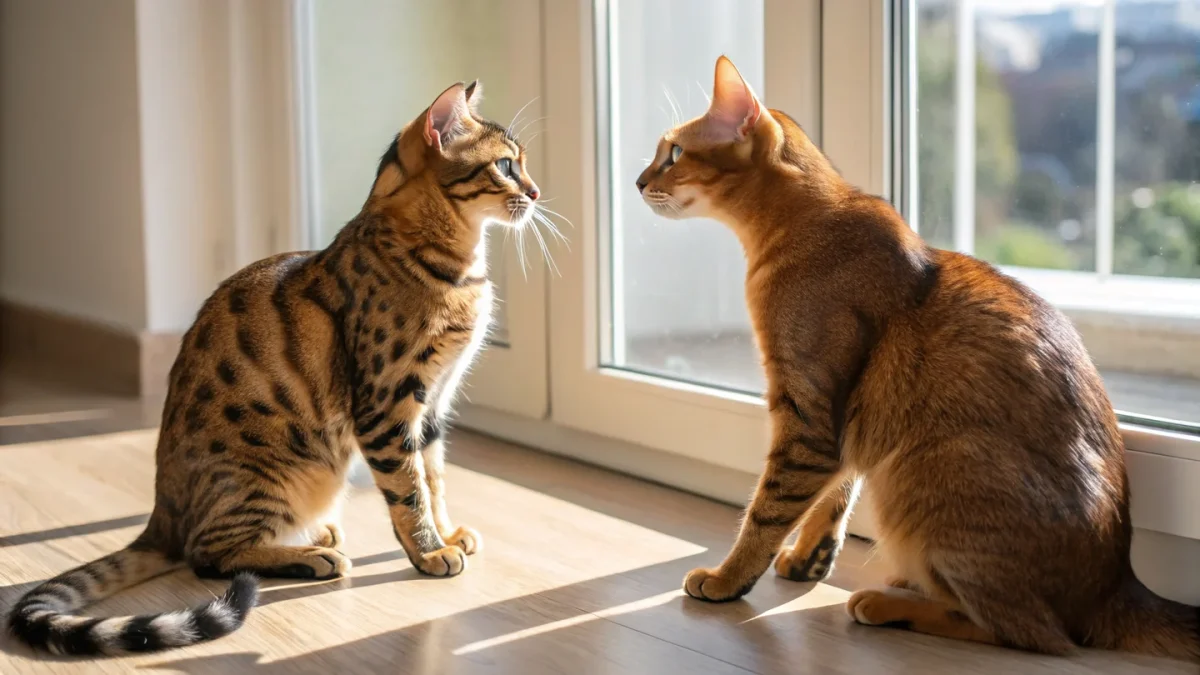
Pick either of these breeds on impulse without understanding what high-energy actually means in a domestic cat and you'll spend the first year surprised. Both Bengals and Abyssinians are active in a way that casual breed descriptions often understate. "Playful" and "curious" don't quite capture what it's like to have either of these animals in your home — "athletic and opinionated about everything" is closer.
The cat breed comparison guide covers how to evaluate these variables systematically.
Quick Comparison
| Trait | Bengal | Abyssinian |
|---|---|---|
| Build | Medium-large, muscular, heavy | Small-medium, slender, lithe |
| Coat | Short, spotted or marbled, glittery sheen | Short, ticked tabby, warm gold/ruddy tones |
| Origin | Asian leopard cat × domestic hybrid | Ancient domestic — likely Ethiopian/North African roots |
| Energy | Very high | Very high |
| Prey drive | Very high | High |
| Vocalization | Moderate (chirps, trills) | Moderate |
| With strangers | Variable | Generally friendly, curious |
| Water interest | Common | Variable |
The Bengal: Spotted with Ambitions
The Bengal's wild-cat heritage — the result of domestic cat crosses with the Asian leopard cat, developed systematically from the 1960s and 1970s onward — shows most clearly not in the coat but in the prey drive. The Bengal breed profile covers generations, legal considerations, and the full range of what the hybrid heritage actually means in a domestic setting. A Bengal in a house with small pets (birds, fish, small rodents) is a management problem, not a solvable one. The drive is genuine.
The coat is the breed's most immediately striking feature: the spots or marble pattern has a quality sometimes called "glitter" — an iridescent quality in direct light that no other domestic breed has to the same degree. It's genuinely beautiful.
Activity-wise, Bengals need physical outlets at a level that can surprise new owners. Jumping, running, climbing, hunting. An environment that doesn't offer sufficient physical engagement leads to redirected energy: counter-surfing, pulling at things, creating chaos in areas they've decided are interesting. They're also famously good at opening doors and accessing areas they've been locked out of.
The Abyssinian: Ancient Athlete
The Abyssinian is one of the oldest cat breeds, and the one that most closely resembles the cats depicted in ancient Egyptian art — the slender build, large ears, and ticked tabby coat match well. Here's the thing, though — genetic research actually contradicts the Egyptian story. A 2008 genomic study on cat breed ancestry traces Abyssinian lineage to Southeast Asia and Europe, not Egypt. The Egyptian name comes from where the first imported cats were sourced in the 1800s, not from the breed's actual genetic roots. The Abyssinian breed profile covers the ticked coat genetics, origin theories, and the full ownership picture in detail.
The personality is active and social in a way that's more balanced than the Bengal's. Abyssinians are curious and athletic without the same concentrated prey intensity. They adapt to strangers more readily than many high-energy breeds. They're not lap cats — too much is happening in the world for sitting still to be a priority — but they're warm and genuinely sociable.
The ticked coat (each hair banded in alternating light and dark) gives the breed a warm, glowing appearance that photographs beautifully. Maintenance is minimal — a short coat with low shedding.
What Most People Get Wrong
About Bengals: The wild-cat aesthetic is appealing; the assumption that "wild-looking" means "independent" is a common mistake. Bengals need significant human engagement and environmental enrichment. Left alone with a boring environment, they create their own entertainment.
About Abyssinians: They look delicate. They are not. Abyssinians are durable, fast, and more energetically demanding than their slight build suggests.
The Verdict
Choose the Bengal if you want a visually striking, highly athletic cat, have the space and setup for serious physical enrichment, don't have small pets at risk from high prey drive, and find the challenging engagement of a smart, slightly wild-natured animal rewarding.
Choose the Abyssinian if you want a highly active, athletic cat that is consistently more sociable with strangers and visitors, more manageable in terms of prey drive, and better suited to households with other cats or family activity.
Both are not for people who want a quiet, low-demand companion. Both are extraordinary animals for owners who meet their needs.