

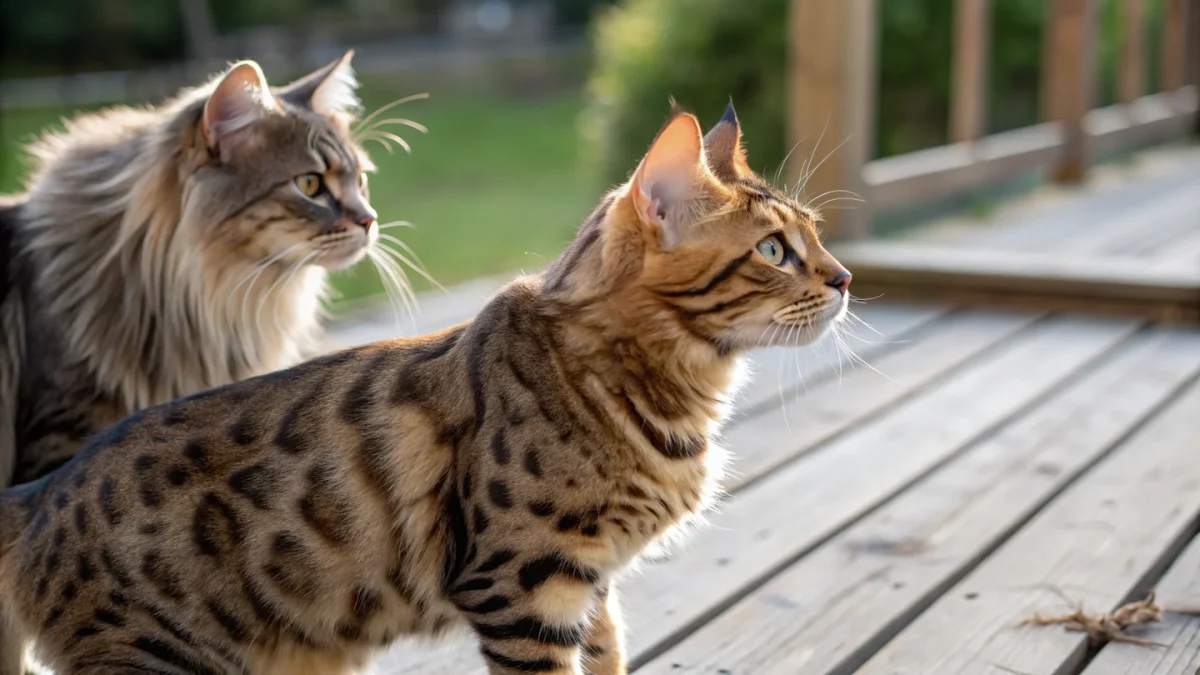
Both breeds show up on "active cat" lists. Both are large. Both attract people who want a substantial, engaging companion rather than a passive one. But side-by-side, the Bengal and Maine Coon are very different propositions — one suited to a much broader range of households than the other.
The cat breed comparison guide explains how to evaluate these differences. For the complete Maine Coon breed guide, that article covers everything specific to that breed.
Quick Comparison
| Trait | Bengal | Maine Coon |
|---|---|---|
| Build | Medium-large, muscular, lean | Very large, long, substantial |
| Coat | Short, spotted/marbled, low-shed | Long, shaggy, requires regular brushing |
| Prey drive | Very high | Moderate |
| Energy | Very high | Medium-high |
| Vocalization | Moderate (chirps) | Moderate (trills) |
| With small pets | High risk | Generally manageable |
| With children | Variable — better with older children | Excellent |
| Grooming | Minimal | Weekly+ |
| Family suitability | Experienced cat owners preferred | Wide household compatibility |
What Separates Them Most
It's the prey drive and the energy ceiling. Maine Coons are active in an engaging, manageable way — they want to play, they want to interact, but a good session satisfies them. The activity is in the context of the household. Bengals operate at a higher intensity, and their prey drive means that energy has a target-acquisition quality — they're not just playing, they're hunting. The full Bengal breed profile covers generations, hybrid heritage, and the enrichment setups that actually satisfy them. Small pets in a Bengal household (birds, rodents, fish) are at genuine risk.
Maine Coons, by contrast, have been documented coexisting reasonably well with smaller animals in multi-pet households, though supervision is still sensible.
The Maine Coon is also simply more accommodating of varied households — children of different ages, other cats, dogs, variable schedules. They're adaptable. Bengals have more specific requirements: sufficient physical space, substantial enrichment, and owners experienced enough to understand and meet the breed's needs without becoming frustrated.
The Coat Difference
Bengals barely need grooming — a short coat with low shedding and an iridescent quality that requires nothing more than the occasional pass with a grooming glove. The coat is genuinely one of the most beautiful in the domestic cat world.
Maine Coons need regular brushing — weekly minimum, more during shedding seasons. The long coat can mat if neglected, though the texture is more forgiving than a Persian's.
The Verdict
Choose the Maine Coon if you want a large, active, playful companion that suits a wide range of households, handles children and other animals well, and provides genuine engagement without the Bengali prey-drive intensity. The Maine Coon is one of the most broadly suitable breeds for active families.
Choose the Bengal if the spotted coat is genuinely important to you, you have the experience and space to meet their needs, don't have small pets at risk, and find the challenging-but-rewarding quality of a slightly wild-natured animal appealing rather than stressful.
The Maine Coon is the more versatile recommendation. The Bengal is the more specific one — extraordinary in the right conditions, mismatched in the wrong ones.