

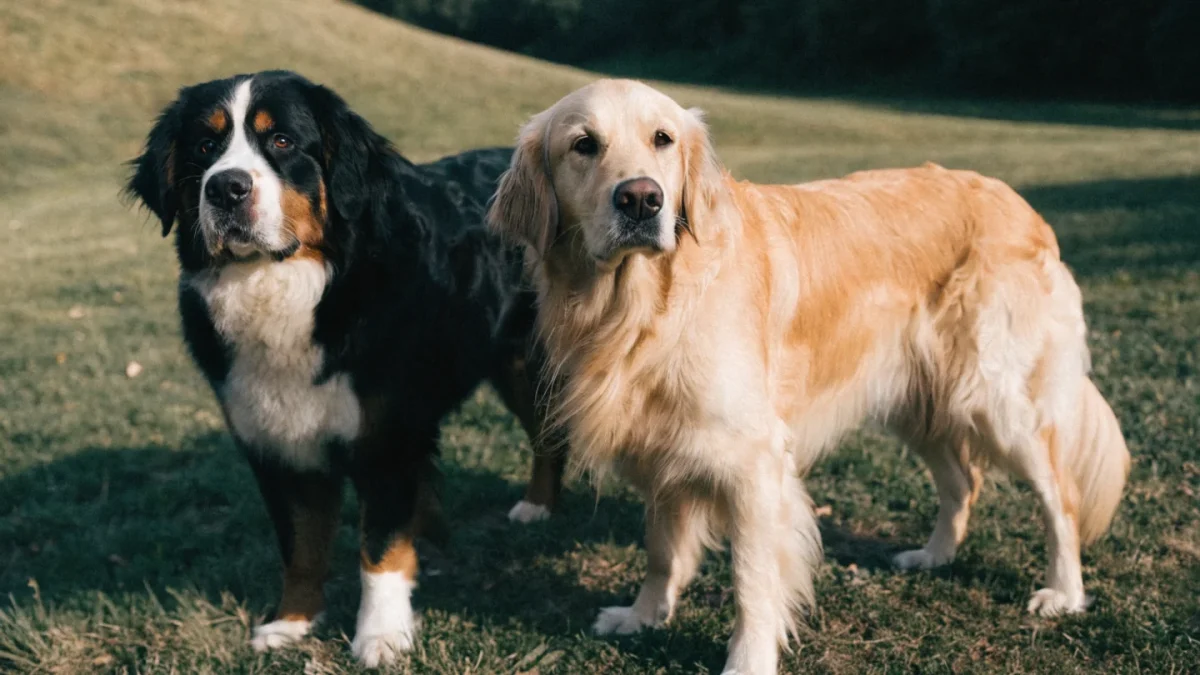
The Golden Retriever was purpose-built to retrieve waterfowl in the cold, wet Scottish Highlands. The Bernese Mountain Dog was a Swiss farm dog used for drafting (pulling carts), herding cattle, and guarding farmsteads in the canton of Bern. One is a sporting dog. The other is a working dog. Both ended up on "best family dog" lists, which tells you something about how powerfully temperament trumps original function in pet homes.
These breeds attract similar families — people who want a large, gentle, beautiful dog that's good with kids. But the practical realities of living with each are very different. For the full comparison framework, see the breed comparisons guide.
Size and Build
| Trait | Bernese Mountain Dog | Golden Retriever |
|---|---|---|
| Height (male) | 64–70 cm | 58–61 cm |
| Height (female) | 58–66 cm | 55–57 cm |
| Weight (male) | 39–52 kg | 30–34 kg |
| Weight (female) | 36–48 kg | 25–29 kg |
| Build | Heavy, broad, powerful | Moderate, athletic |
The Bernese is a substantially larger dog — often 15 to 20 kg heavier than a Golden. That size difference affects everything from food costs to vehicle requirements to the physical challenge of managing the dog on leash or lifting it onto an exam table.
Temperament
Both breeds are gentle, affectionate, and good with children. The difference is in social energy.
Golden Retrievers are extroverts. They love everyone immediately and enthusiastically. A Golden greets strangers like long-lost friends and rarely meets a person or dog it doesn't like. This social openness makes them easy to take places but useless as watchdogs.
Bernese Mountain Dogs are friendlier than most large working breeds but more reserved than Goldens. They're affectionate with family, polite with strangers (rather than ecstatic), and generally calm in the home. Berners have a quiet dignity that contrasts with the Golden's exuberant everything-is-wonderful energy.
Young Goldens are notably more rambunctious than young Berners. The Bernese matures faster emotionally, while the Golden often acts like a puppy well into its third year.
Exercise
Goldens need 60 to 90 minutes of structured daily exercise and remain active well into their senior years. They want to retrieve, swim, run, and work.
Bernese Mountain Dogs need 45 to 60 minutes of moderate daily exercise. They enjoy walks and moderate hikes but aren't built for sustained high-intensity activity. Their heavy bone structure and size make them less suited to running and agility. They overheat faster than Goldens, limiting warm-weather activity.
The Berner is the better choice for moderately active owners. The Golden is the better choice for genuinely active owners.
Grooming
Both have long double coats that shed heavily. The Bernese coat is thicker and coarser — a tricolor (black, white, rust) coat that mats more easily around the ears and feathering. Brushing three to four times per week is standard, with daily sessions during coat blows.
The Golden coat is slightly easier to manage but still demands three to four weekly brushings and produces significant shedding year-round. Both breeds will cover your home in fur.
Neither should be shaved. Both need attention to feathering behind the ears, on the legs, and on the tail.
Health — The Defining Difference
This is where the comparison gets difficult.
| Health Factor | Bernese Mountain Dog | Golden Retriever |
|---|---|---|
| Top concern | Histiocytic sarcoma, other cancers | Cancer (hemangiosarcoma, lymphoma) |
| Lifespan | 6–8 years | 10–12 years |
| Cancer rate | Very high | Very high |
| Joint issues | Hip/elbow dysplasia (common) | Hip/elbow dysplasia (common) |
| Bloat risk | Moderate to high | Low to moderate |
Both breeds have devastating cancer rates. But the Bernese Mountain Dog's lifespan is among the shortest of any breed — 6 to 8 years average. Histiocytic sarcoma, a particularly aggressive cancer, disproportionately affects Berners and is the leading cause of death. Many Bernese Mountain Dog owners lose their dogs before age seven.
The Golden Retriever's cancer rate is also high (approximately 60% of deaths), but the breed lives 10 to 12 years on average — giving you roughly four more years with the dog. That difference is enormous in practical and emotional terms.
Both breeds face hip and elbow dysplasia at high rates. Both should have parents screened through orthopedic evaluation programs.
Which Fits Your Life?
Choose the Bernese Mountain Dog if you want a calm, dignified, gentle giant for a moderately active household, prefer a more reserved temperament, and can emotionally and financially prepare for a short lifespan and high cancer risk. Loving a Berner means accepting that you'll probably have less time than you want.
Choose the Golden Retriever if you want a more energetic, socially outgoing family dog with a longer expected lifespan, and you're prepared for the grooming and exercise commitments of an active sporting breed. The Golden still faces serious health challenges, but you're likely to have more years together.
Neither breed is wrong. They're different answers to the same question: "What big, gentle dog is good with my family?" The honest factor that separates them most isn't temperament — it's time.
For the Golden compared against its closest rival, see the Golden Retriever vs Labrador Retriever breakdown. For a complete profile of the Bernese Mountain Dog — its Swiss draft-dog history, histiocytic sarcoma risk, and what the short lifespan means in practical ownership terms — the Bernese Mountain Dog breed guide covers the breed in full. For an encyclopedic look at the Golden Retriever's Scottish Highland origins, cancer research, and training profile, the Golden Retriever complete breed guide provides the full reference.