

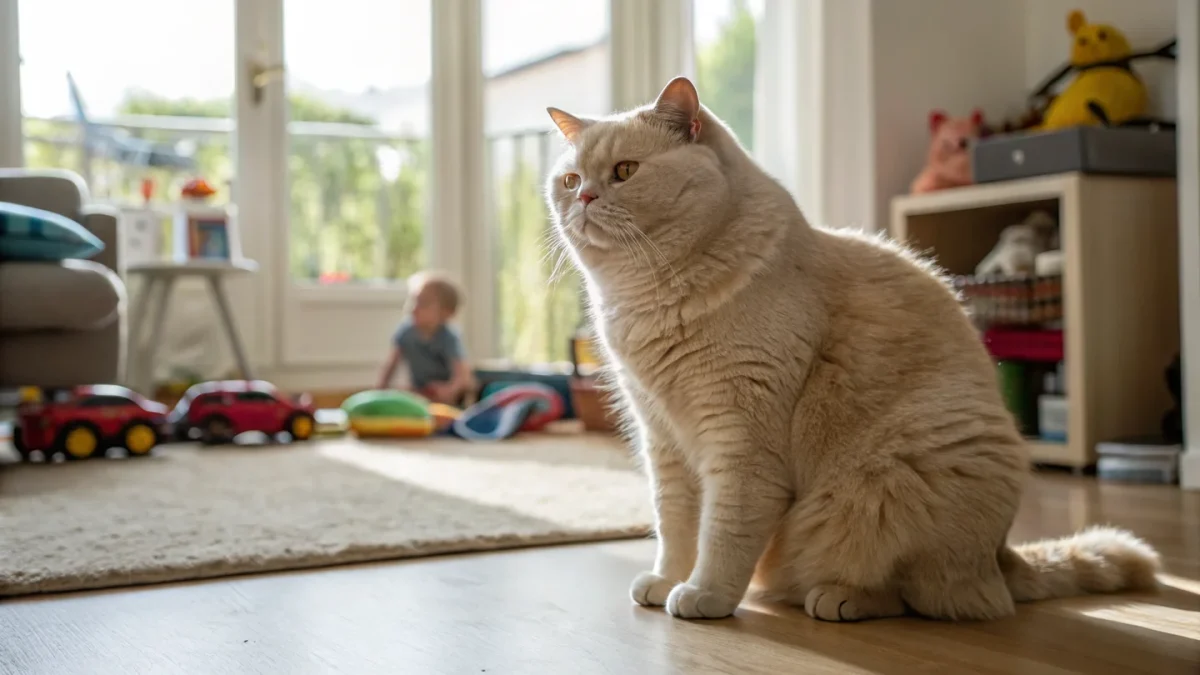
Children and cats can be a wonderful combination — or a stressful one. The difference usually comes down to two things: choosing a breed with genuine tolerance for the unpredictability of young people, and teaching children how to interact with animals respectfully. No breed is guaranteed to thrive in a chaotic household regardless of its reputation, but some are considerably better equipped than others.
For the broader decision framework, choosing the right cat breed for your household covers all the variables that matter. This list focuses specifically on breeds with the specific traits that hold up well with children.
What Makes a Cat Good with Children?
Before the breed list, the relevant traits: patience with unpredictable handling, physical sturdiness (not fragile), low defensive aggression, adaptability to noise and activity, and recovery from startling. Breeds that score well on these aren't inherently "better" cats — they're specifically suited to the family environment.
1. Ragdoll
The Ragdoll's defining trait — going limp when held — reflects a genuine tolerance for physical handling that is exceptional among cats. The Ragdoll breed profile covers size, color varieties, and the HCM health screening that responsible breeders conduct. They rarely show defensive aggression, rarely scratch, and take the unpredictable energy of children in stride. They're people-following cats who adapt well to households with lots of activity and movement.
The caveat: Ragdolls are not indefinitely patient if a child is truly rough. Proper handling should still be taught. But as a breed, they provide more tolerance than almost any other.
2. Maine Coon
Maine Coons are physically robust (important when small hands grab awkwardly), playful enough to genuinely engage with children's energy, and gentle-natured without being fragile. Their size means they're less easily hurt by accidental rough handling than smaller breeds. They're adaptable, sturdy, and social — ticking most of the family-cat boxes. The Maine Coon breed profile covers size ranges, the semi-long coat's grooming needs, and the breed's documented history as a working and companion cat in North America.
They do need regular grooming, which can actually become a family activity.
3. Birman
The Birman's combination of gentle temperament, moderate energy, and tolerance for being held makes them consistently good with families. They're not as physically robust as Maine Coons, but they're patient and warm without the Ragdoll's extreme placidity. A Birman in a busy family tends to find a rhythm of engagement and rest that works for everyone.
4. Abyssinian
The Abyssinian is the active-family choice. They won't sit still for cuddling, but they'll play enthusiastically, explore alongside children, and provide the interactive energy that some children want from a cat. The tradeoff is that they're not cuddlers — an Abyssinian won't sit in a child's lap while they watch a film. They'll be off doing something more interesting.
Best for families where children want an active companion, not a lap cat.
5. Siberian
Siberians are sturdy, gentle, and more tolerant than many large breeds. They adapt to active households and handle children well. The plus for allergy-sensitive families: a 2017 genetic study in Veterinary Sciences found that some Siberians carry mutations in the genes coding for Fel d 1 — the primary cat allergen — that measurably reduce its production. It's not universal, and levels vary a lot even between littermates, but it's a documented enough effect that allergy-sensitive families specifically ask breeders about it.
6. Tonkinese
The Tonkinese is less well-known than breeds higher on this list but deserves consideration. They're playful, social, and genuinely family-oriented — active without the Bengal's intensity, warm without the Siamese's demanding vocalization. They fall between Siamese and Burmese in personality (which reflects their historical development as a cross between the two).
What to Avoid With Young Children
- Persian: Sensitive to rough handling, daily grooming requirement, flat-face health concerns
- Russian Blue: Shy with unfamiliar people, stresses in chaotic environments
- Scottish Fold: Joint condition makes vigorous physical interaction potentially painful
- High prey drive breeds with small children: Not a breed issue per se, but management consideration
The Honesty Note
The single most important variable in cat-family success is not breed — it's how children are taught to interact. A well-supervised interaction between a child and a "less family-friendly" breed can be wonderful; an unsupervised interaction between a child and a "family breed" can end poorly. Teaching children to approach cats calmly, not chase, not pick up without invitation, and to read the cat's body language is foundation work that breed choice builds on.