

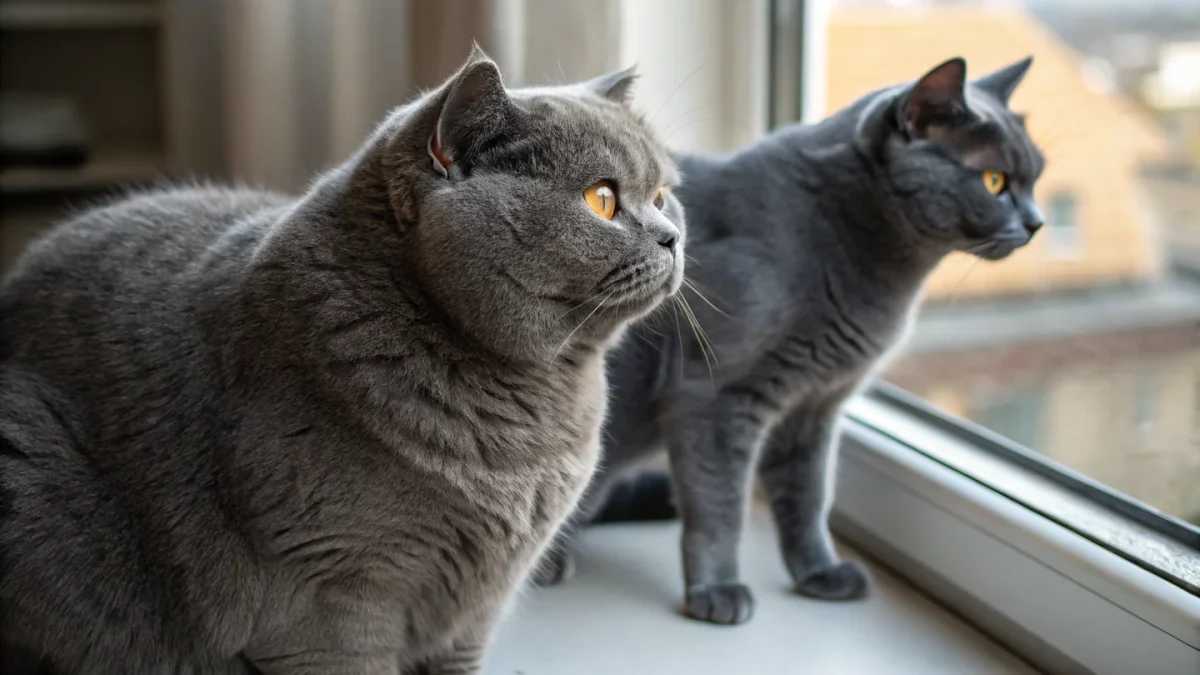
Two blue cats, two quiet temperaments, two easily confused breeds. The British Shorthair and the Russian Blue are regularly considered as alternatives to each other, and on a checklist basis they look similar: both calm, both low-vocalization, both manageable coats, both good for quieter homes. But spend a day with each and the differences become obvious.
The cat breed comparison guide covers the full framework for evaluating similar breeds.
Quick Comparison
| Trait | British Shorthair | Russian Blue |
|---|---|---|
| Build | Stocky, rounded, dense | Slender, elegant, fine-boned |
| Coat | Short, plush, dense | Short, double-layer, silvery-tipped |
| Energy | Low-medium | Low-medium |
| Vocalization | Very quiet | Quiet |
| With strangers | Calm, accepts new people readily | Shy, withdraws initially |
| Loyalty to family | Affectionate but not clingy | Intensely bonded, reserved with others |
| Independence | High | Moderate-high |
| Adaptability | Excellent | Moderate — sensitive to change |
The British Shorthair: England's Stalwart
The British Shorthair is one of the oldest documented pedigree cat breeds — the British Shorthair breed profile covers the full historical record — with roots tracing to Roman-era cats brought to Britain centuries ago, later refined through systematic breeding in the late 19th century. Harrison Weir, who organized the world's first cat show at Crystal Palace in 1871, was among the breed's early advocates.
The personality is fundamentally solid. British Shorthairs are self-sufficient without being distant, affectionate without being demanding, and adaptable without needing constant reassurance. They handle visitors, new environments, and changes in household routine with equanimity. They rarely initiate conflict with other animals and adapt well in multi-pet households.
What they're not is lap cats in the devoted, follow-you-everywhere sense. They will sit near you. They may sit on you. But they do this on their own schedule and don't particularly appreciate being picked up or cuddled against their will — a trait that surprises owners expecting something more demonstrative.
The Russian Blue: The Reserved Loyalist
The Russian Blue's deeper origins are genuinely uncertain — the Archangel Isles population supposedly behind the breed left no written record of its own, so that part is folklore and sailor-legend more than documented history. What is documented: cats under the name "Archangel Cat" were competing in early English cat shows by the 1870s and 80s, shown alongside other solid blue breeds before earning a class of their own. Past the show record, the trail goes cold. What's clear is that the modern breed was developed from a narrow genetic base following World War II, with some lines including crosses to Siamese, which accounts for certain type variations between bloodlines. The Russian Blue breed profile covers the hypoallergenic claims, double-coat structure, and what the ownership experience actually looks like.
The personality is distinctive: warm and loving to their own family, genuinely shy with strangers. A Russian Blue in a house of guests is often invisible — retreated under the bed or to a high shelf, waiting for the commotion to pass. But with the people they know and trust, they are devoted, gentle, and quietly communicative. They notice routines, they notice changes, and they find comfort in predictability.
The silvery double coat is low-maintenance but does go through seasonal shedding phases. The green eyes — one of the breed's most striking features — tend to be particularly vivid against the blue-grey coat.
What Most People Get Wrong
British Shorthair: People expect a cuddly lap cat based on the round face and plush appearance. British Shorthairs are affectionate on their own terms, which may be less demonstratively warm than expected. They're excellent companions; they're just not constantly seeking physical closeness.
Russian Blue: The shyness with strangers often gets misread as the cat having a difficult personality. In reality, a Russian Blue in a stable home with its trusted people is one of the more reliably warm breeds available — the shyness is social selectivity, not general unfriendliness.
The Verdict
Choose the British Shorthair if you want a calm, adaptable companion that handles varied household activity without stress, gets along with visitors and other animals without ceremony, and requires little in the way of constant attention or reassurance. Excellent for: families, multi-pet homes, busy households.
Choose the Russian Blue if you want an intensely bonded companion who is devoted to your household specifically, thrive in a quieter, more stable environment, and don't regularly host gatherings where the cat will be surrounded by unfamiliar people. The Russian Blue rewards patient, consistent ownership with deep loyalty. Excellent for: quieter households, people working from home, single-cat homes where the owner is the cat's entire world.
Both are excellent breeds. The British Shorthair is the more versatile choice. The Russian Blue is more rewarding in the right context.