

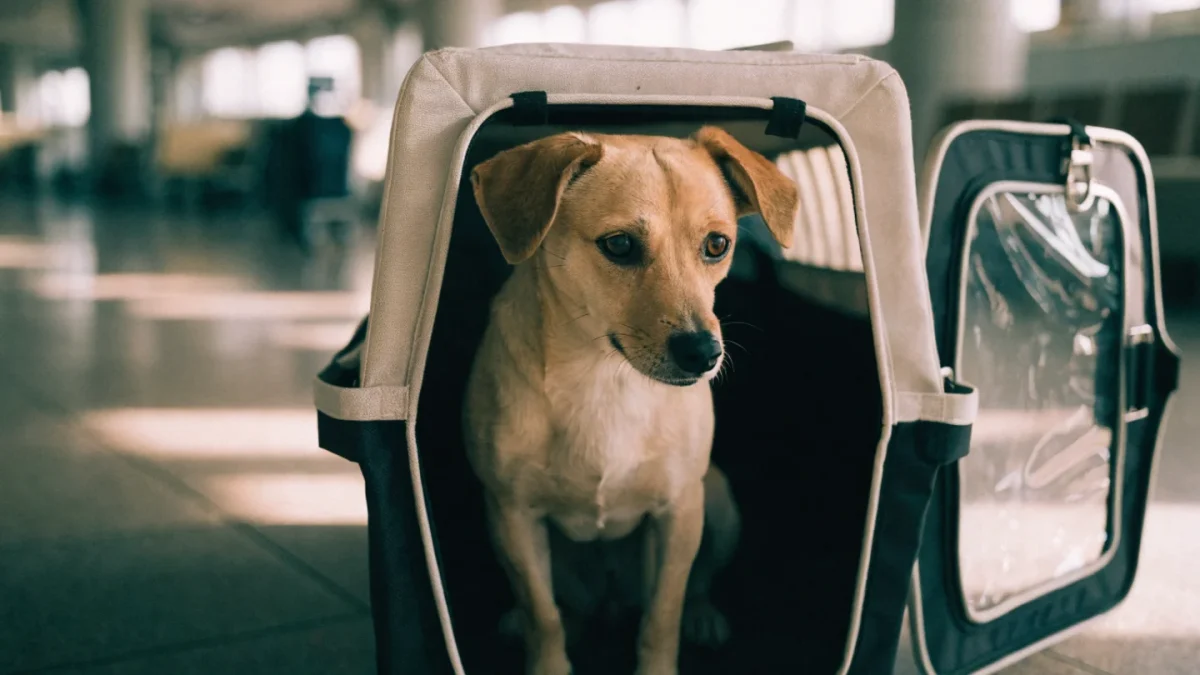
If your pet can go in-cabin, put them in-cabin. That's the short version.
But most people asking this question aren't asking it because they have a clear choice. They're asking because their dog is 14 kg, or their cat is flying internationally, or they've gotten conflicting information from three different airline websites. So let's actually walk through this.
The cabin vs. cargo question matters more than people think — not just for convenience, but for your pet's welfare on what could be the most stressful day of their life.
Who Can Fly in-Cabin
In-cabin travel is an option when:
- Your pet fits in an airline-approved soft-sided carrier
- The carrier fits under the seat in front of you (dimensions vary by airline — confirm before buying a carrier)
- Your pet plus carrier combined weight is under the airline's limit (typically 8-10 kg)
- Your pet's breed isn't restricted (most restrictions affect brachycephalic breeds)
If you have a small cat or a small dog — roughly under 6 kg of animal — in-cabin is usually on the table. Larger dogs, with very few exceptions, go in cargo.
What In-Cabin Actually Looks Like
Your pet rides under the seat in front of you in a soft-sided carrier for the duration of the flight. They don't leave the carrier. You can't take them out to comfort them, put them on the seat beside you, or walk them down the aisle (yes, people have tried).
The carrier counts as your personal item or carry-on, depending on the airline. You'll need to declare the pet when booking — in-cabin spots are limited, often just a couple per flight, and they fill up.
At security, you'll remove your pet from the carrier, carry them through the body scanner yourself, and put the carrier through the X-ray machine separately. Practice this at home before you go if your cat is likely to bolt when held outside their carrier. Fig once made a break for it during a security check at a small regional airport and I aged approximately five years in thirty seconds.
The experience is actually pretty manageable. Your pet is close to you, the environment is temperature-controlled, and you can talk to them throughout. Most animals settle after the initial alarm of takeoff.
What Cargo Actually Looks Like
Cargo — also called "checked pet" or "manifest cargo" depending on the airline — means your pet travels in the pressurized, temperature-controlled hold of the aircraft. Not in an uncontrolled luggage area. Modern cargo holds for pets are pressurized and maintained within acceptable temperature ranges.
That said, "acceptable" isn't "identical to the cabin." And the handling process is different:
- Your pet checks in at a special counter, often away from regular check-in
- They're loaded as cargo, which means handlers who aren't specifically your pet people
- On connecting flights, they're unloaded and reloaded — another handling event, another unfamiliar environment
- You can't see them or interact with them for the duration of the flight and boarding/deplaning process
For healthy, calm larger dogs traveling on direct flights with good temperature conditions, cargo is done safely all the time. Many dog owners do it routinely. But it's objectively higher-stress and higher-risk than in-cabin, and those risks compound with connections, extreme weather, and anxious animals.
A Side-by-Side Comparison
| Factor | In-Cabin | Cargo |
|---|---|---|
| Size limit | Small pets only (~8-10 kg with carrier) | Larger pets possible |
| Monitoring | You're present the entire flight | No access until arrival |
| Stress level | Generally lower | Generally higher |
| Temperature control | Same as cabin | Maintained but variable |
| Connection risk | Minimal | Compounds with each transfer |
| Brachycephalic pets | Often allowed with restrictions | Often prohibited |
| Cost | Per-flight fee (typically lower) | Per-weight fee (varies widely) |
Breeds That Need Special Consideration
Snub-nosed breeds — English bulldogs, French bulldogs, pugs, Boston terriers, Persian cats, Himalayan cats, and others with compressed airways — are a genuine concern in cargo specifically. At altitude, in stress, their ability to thermoregulate and breathe efficiently is reduced. Many airlines have banned these breeds entirely from cargo holds. In-cabin, with you present and the ability to intervene if something goes wrong, the risk calculation is different.
If you have a brachycephalic pet, this should absolutely be part of your airline research before booking. And a conversation with your vet before any air travel is worth having.
When Cargo Is the Only Option (Making It Safer)
If your pet has to go in cargo, here's how to reduce the risk:
Book direct flights. Every transfer introduces another handling event and another chance for temperature exposure or delays. This is the single most important thing you can do.
Time your flight thoughtfully. Early morning or evening in summer to avoid extreme heat. Midday in winter in cold climates. Temperature is the biggest variable in cargo safety.
Use a properly sized hard-sided carrier. It needs to be large enough for your pet to stand, turn around, and lie down. Proper ventilation on all sides. Mark it clearly with your contact information, "LIVE ANIMAL," and an arrow indicating which end is up.
Skip locks. Use zip ties or the airline-approved claw latches — emergency personnel need to be able to open the carrier quickly.
Don't sedate without vet guidance. Sedation in cargo is controversial and many airlines prohibit it. Some pets do benefit from anti-anxiety medication (not sedation), but this requires a vet conversation well in advance and a trial run at home first.
For detailed preparation on the dog side, preparing your dog for their first flight covers the behavioral prep that applies whether your dog is going in-cabin or cargo. And if you're still working through the broader logistics, the complete guide to flying with pets has the full framework.
Frequently Asked Questions
Is cargo actually dangerous for pets?
It has more risk factors than in-cabin, and incidents do occur — especially with brachycephalic breeds, extreme weather, and poorly managed connections. But for healthy, appropriately sized pets on direct flights with careful preparation, cargo is done safely every day. The statistics are much better than the horror stories suggest. That said, if in-cabin is available to you, take it.
Can a large dog fly in-cabin if I buy an extra seat?
No. Extra seats are for humans. Airlines will not allow a large dog to occupy a passenger seat. In-cabin pet travel is strictly limited to pets that fit in an approved carrier under the seat.
My pet is just over the weight limit. Is there any flexibility?
No. Airlines are consistent about this at check-in. A carrier that doesn't fit under the seat or a combined weight over the limit will result in your pet being either refused boarding or reclassified as cargo. If you're borderline, check the exact specifications carefully and err on the side of caution.
Do airlines check the size of the carrier at the gate?
Many do, yes. Airport gate agents have been known to measure carriers or require pets to be visible in them. Don't assume you can get away with an oversized carrier. You may end up having your pet rerouted to cargo unexpectedly.
What happens to cargo pets on long layovers?
This varies by airline and airport. On short connections, your pet stays in the carrier in a secure area. For longer layovers, some airlines have pet relief facilities or holding areas. This is worth researching specifically for your route — it's one of the reasons direct flights are strongly preferred for cargo travel.