

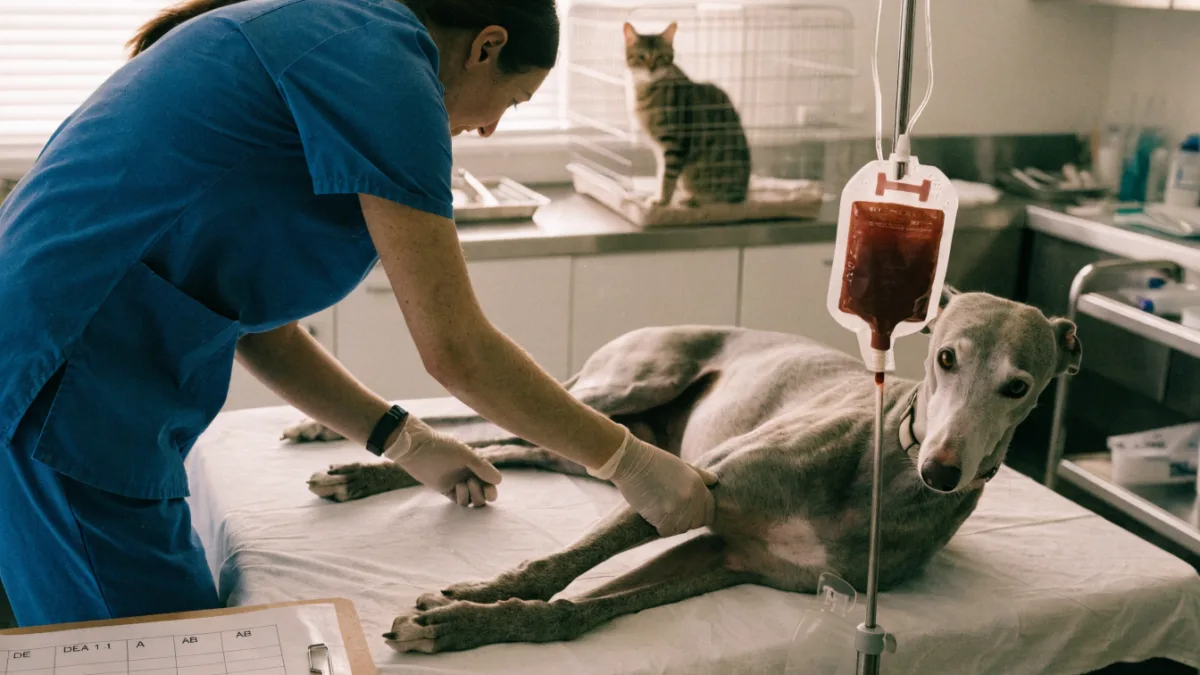
Consider a Tuesday evening emergency: an eight-year-old Labrador named Beau arrives with severe internal bleeding from a ruptured splenic tumor. The first thing needed — even before surgery — is blood. Lots of it. Beau had lost a dangerous amount, and without a transfusion he wouldn’t survive the anesthesia. A unit of DEA 1.1 negative blood comes out of the bank, goes up on the IV pole, and flows into his cephalic vein. Within an hour, his gums have shifted from a ghostly white back to a healthy pink. He goes home four days later. The reason that transfusion worked so smoothly, without anyone needing to crossmatch or even know Beau’s exact blood type? That comes down to something fascinating about canine physiology — and it’s a luxury we simply don’t have with cats.
Why Dogs Have It Relatively Easy
If you remember anything from high school biology, you probably know that human blood types fall into the ABO system, and that O-negative blood is the universal donor type — the one emergency rooms reach for when there’s no time to test. Dogs operate on a completely different system, and honestly, it’s both more complex and more forgiving than ours.
Dogs have more than a dozen different blood group systems, collectively known as DEA (Dog Erythrocyte Antigen) types. The most significant one for transfusions is DEA 1, which is further broken down into subtypes like DEA 1.1, 1.2, and 1.3. Of these, DEA 1.1 is the one that causes the most trouble if you get it wrong — it’s the “antigen” (a protein marker on the surface of the red blood cell) that a recipient’s immune system is most likely to recognize as foreign.
Here’s where dogs differ from us, and from cats: they are not born with naturally occurring antibodies against other blood types. This means that if a dog receives a first-time transfusion from a donor whose blood type doesn’t match theirs, their immune system hasn’t yet learned to attack those unfamiliar cells. The transfused blood can do its job — carrying oxygen, restoring blood volume — and buy the dog time. The immune system will eventually notice the intruders, usually within a week or so, and quietly clear them out. But there’s typically no immediate, catastrophic reaction.
This is why a DEA 1.1 negative dog is considered a universal donor in canine medicine. If a donor lacks the DEA 1.1 antigen entirely, the recipient’s immune system has nothing to react against on that critical first pass. I could hang that unit on Beau without knowing his blood type because the blood came from a dog who was DEA 1.1 negative. The risk of an acute (sudden and severe) reaction was extremely low.
But “Universal” Doesn’t Mean Reckless
I should be clear about something. The fact that dogs can usually tolerate a first-time, unmatched transfusion doesn’t mean we’ve stopped being careful. Veterinary medicine has evolved significantly on this point, and I’ve genuinely changed my own practice over the past decade.
When I was early in my career, the standard approach was: if the dog has never had a transfusion before, just check whether the donor is DEA 1.1 negative, hang the blood, and move on. We now know that’s not always enough. Dogs can still experience delayed hemolytic reactions — where the immune system destroys the transfused cells days later — or react to antigens in other DEA systems that we didn’t screen for. Recent clinical guidelines from transfusion medicine specialists, including the work of researchers like Vap and colleagues, emphasize a principle they call “doing no harm.” The recommendation now leans toward comprehensive blood typing and crossmatching (testing donor and recipient blood together in the lab) for all transfusions, not just repeat ones.[1]
That said, in a true emergency — like Beau’s case — the DEA 1.1 negative designation remains a genuinely powerful tool. The risk-benefit calculus favors acting quickly. But whenever possible, we crossmatch.
Why Cats Are an Entirely Different Story
If dogs are the forgiving patients when it comes to transfusions, cats are the ones that keep veterinarians up at night. And the reason comes down to one critical physiological difference: cats are born with naturally occurring antibodies against blood types other than their own.
Let me unpack what that means. In humans, if you have type A blood, your immune system learned at some point to produce antibodies against type B antigens. If you’ve never been exposed to type B blood, the antibody levels are relatively low — but they’re there, ready and waiting. Cats take this to an entirely different level.
The feline blood system is elegantly simple in naming — cats have types A, B, and AB — but dangerously complex in practice. Here’s the breakdown:
- Type A is the most common blood type in most cat populations worldwide. Type A cats have low levels of anti-B antibodies, meaning a mismatch here is less likely to cause an immediate disaster (though it’s still not ideal).
- Type B is less common overall but more prevalent in certain breeds — Abyssinians, British Shorthairs, Devon Rexes, and some Persian lines, for instance. Type B cats have very high levels of anti-A antibodies. If you give a Type B cat even a small amount of Type A blood, the reaction can be violent and fatal within minutes.
- Type AB is the rarest of the three. AB cats lack both anti-A and anti-B antibodies, making them theoretical universal recipients. However, clinical guidelines still recommend transfusing AB cats with Type A blood rather than B, because the body handles A antigens more gracefully.[2]
The key phrase here is “naturally occurring.” A cat doesn’t need to have had a previous transfusion, a pregnancy, or any prior exposure to develop these antibodies. They’re present from kittenhood. This means that if I take Type A blood and give it to a Type B cat, that cat’s immune system will recognize the foreign cells instantly and mount what we call an acute hemolytic transfusion reaction — the immune system attacks and ruptures the transfused red blood cells in real time. The cat can go into shock, experience severe pain, and die despite treatment.
There is no such thing as a universal feline donor blood type. Let me say that again, because it matters: cats do not have a universal blood donor. Every single feline transfusion requires blood typing and crossmatching. No exceptions.
I’ll never forget a case from a colleague’s practice. A client brought in a three-year-old British Shorthair named Maisie who was severely anemic from a flea-borne parasite called Mycoplasma haemofelis. The clinic was short-staffed that night, the in-house blood typing kit had expired, and a well-meaning technician suggested just using blood from a clinic cat who’d donated before. My colleague, thank goodness, said no. She waited the extra fifteen minutes for a fresh typing kit. Maisie turned out to be Type B — the rare type for her breed but not unheard of. The clinic’s donor cat was Type A. Had they gone ahead with the transfusion, Maisie likely would have died on the table.
The New Frontier: The Mik Antigen
As if feline blood wasn’t complicated enough, researchers recently identified an entirely new feline blood group system called Mik. This means that even if a cat is perfectly matched for A, B, or AB, they can still have a transfusion reaction if there’s a Mik incompatibility between donor and recipient.[3] This discovery has been a wake-up call for the profession. It reinforces why crossmatching — not just typing — is essential for cats. Typing tells us about A, B, and AB. Crossmatching catches everything else, including Mik incompatibilities that typing alone would miss.
The good news is that point-of-care testing has improved dramatically in recent years. In-clinic blood typing kits are now faster and more accurate than ever, meaning most practices can determine a cat’s blood type within minutes rather than sending samples to an outside lab and waiting hours for results. This has been genuinely lifesaving for emergency medicine.
The Xenotransfusion Debate: When Dog Blood Goes Into a Cat
There’s a practice in veterinary medicine that sounds like science fiction but has real historical precedent: transfusing dog blood into a cat. This is called xenotransfusion — “xeno” meaning across species — and it’s one of the most debated topics among veterinary specialists today.
Picture an emergency scenario. A cat arrives at a clinic at two in the morning, bleeding internally from rodenticide toxicity (rat poison). The clinic has no feline blood in stock. The nearest feline donor is an hour away, and the cat may not survive that long. But they have dog blood — canine units are easier to stock because dogs are larger, donate more volume per session, and there are more canine blood banks operating.
In this situation, some veterinarians will make the call to use dog blood as a temporary bridge. And it can work — for a short window. The canine red blood cells will circulate in the cat’s bloodstream and carry oxygen, buying precious time. But here’s the catch: the cat’s immune system recognizes dog blood as profoundly foreign, and it will begin destroying those cells aggressively within about four to seven days. The transfusion is a stopgap, not a solution.
The real danger comes with a second xenotransfusion. After the first exposure, the cat’s immune system has produced massive numbers of antibodies against canine red blood cells. If that same cat ever receives dog blood again — even months or years later — the reaction is almost always fatal. This is why any cat who has received a xenotransfusion must be permanently identified in their medical record, and every future veterinarian needs to know that history.
The ethics here are genuinely complex. Is it better to let a cat die when canine blood could buy them a few critical days? Or is it irresponsible to perform a procedure that creates a ticking immunological time bomb? Most specialists I know reserve xenotransfusion for true life-or-death situations where no other option exists, and they counsel owners extensively about what it means for the cat’s future. Nobody takes it lightly.
What Makes a Good Blood Donor — and Why We Desperately Need More
I want to end with something practical, because the biggest challenge in veterinary transfusion medicine isn’t the science. It’s supply. There is a critical, ongoing shortage of donor blood for pets. Every veterinary blood bank I know operates with a constant deficit of available units, especially for cats.
If you’ve ever wondered whether your own pet could be a blood donor, here’s what clinics and blood banks typically look for:
- Weight: Dogs generally need to weigh at least 25–30 kg (55–65 pounds), depending on the program. Cats usually need to be at least 4–5 kg (9–11 pounds) and lean enough that the weight isn’t from excess fat.
- Age: Donors should be young adults — usually between one and seven years old for dogs, and one to eight for cats. They need to be fully grown but not senior.
- Health status: Up to date on vaccinations, free of parasites, on regular flea and tick prevention, and with no history of serious illness. Bloodwork must be normal, and they’ll be screened for infectious diseases that can be transmitted through blood.
- Temperament: This is huge. A blood donation takes 15–30 minutes and requires the animal to sit still — often without sedation. Cats, in particular, need to be remarkably calm and cooperative. A fearful or aggressive animal isn’t a good candidate, and no reputable program will sedate a cat for donation because the sedation risks outweigh the benefits.
- Good veins: It sounds simple, but visible, accessible veins make the process safer and less stressful. Phlebotomists (the technicians who draw blood) look for animals with easily palpable jugular veins.
If your pet meets these criteria, I’d encourage you to look into local blood donor programs. Many clinics and blood banks offer perks like free annual bloodwork, free vaccinations, or pet food in exchange for regular donations. But honestly, most donors’ owners I’ve met do it for a simpler reason: they like knowing that their animal is helping save other animals’ lives. One donation can help multiple patients — a single unit of blood can be separated into red blood cells and plasma, extending its reach.
The next time you’re at your veterinarian’s office, ask whether they run a blood donor program or know of one nearby. Feline donors are especially needed — because cats don’t have a universal donor type, blood banks need to stock multiple types to ensure that every cat, regardless of their blood group, can receive a safe transfusion. Your cat’s fifteen minutes in a donation chair could genuinely be the reason another cat goes home to their family instead of not making it through the night. In veterinary medicine, the blood on the shelf is the difference between panic and calm, between grief and relief. And that shelf is only as full as the community of donors who keep it stocked.
Sources
- [1] — dvm360.com
- [2] — petbloodbankuk.org
- [3] — facebook.com