

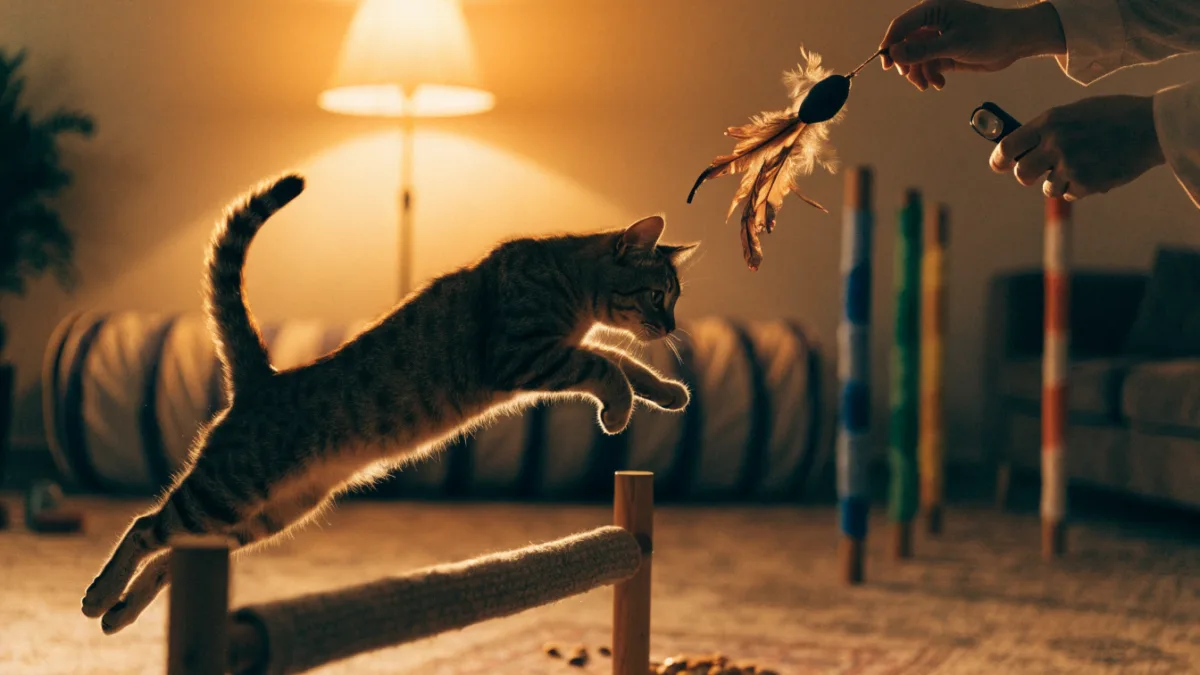
I’ll be honest with you. The first time someone told me they were running their cat through an agility course, I laughed. Not politely, either. I’m talking a full belly laugh, the kind where you have to set your coffee down. Cats? On command? Jumping through hoops and weaving through poles on purpose?
I was wrong. And after watching a friend’s Siamese absolutely fly through a tunnel and clear a hurdle like it was nothing, I shut my mouth and started paying attention.
Animal agility has exploded in recent years. What used to be a dog-only domain now includes a growing community of cat handlers who are proving every single day that felines can train, compete, and genuinely enjoy the sport. But here’s the thing — agility for dogs and agility for cats are not the same sport with different animals. They’re fundamentally different games that happen to share some equipment. Let’s break down what makes each one tick.
The Myth That Just Won’t Die
Let’s address the elephant in the room. Or rather, the cat in the course.
The most common thing I hear when I bring up cat agility is some variation of “you can’t train a cat.” I used to believe this myself. It’s one of those cultural assumptions that gets repeated so often nobody questions it. But experienced trainers have successfully trained multiple cats — one handler I read about in the [1] noted she had five cats running courses competitively. Five.
The myth persists because people approach cats the way they approach dogs, hit a wall, and conclude the cat is untrainable. What’s actually untrainable is that approach. Cats aren’t broken dogs. They’re a completely different animal with completely different wiring, and once you respect that, the training opens up.
How Dog Agility Actually Works
Canine agility is the version most people recognize. You’ve probably seen clips on social media or caught a competition on television. A handler guides their dog through a timed course of obstacles — jumps, tunnels, weave poles, A-frames, seesaws — using body language, voice cues, and the bond they’ve built through training.
Foundations Before Flash
Here’s where a lot of owners go wrong, and I see it constantly. They watch an advanced competition, get inspired, buy some PVC jumps, and immediately start asking their dog to sequence obstacles. It doesn’t work that way. It’s like trying to run a marathon because you watched one on TV.
Foundation training is everything in dog agility. Before your dog ever touches a real obstacle, they need solid recall, impulse control, body awareness, and a understanding of how to learn. A recent [2] focused entirely on what comes after the basics — but the presenter made it clear that without those basics, there’s nothing to build on.
I worked with a Border Collie mix last year whose owner had skipped foundations and gone straight to sequencing. The dog was fast, sure. She was also blowing past jumps, crashing into the A-frame, and completely ignoring her handler’s cues. We spent six weeks going back to basics — flatwork, shadow handling, one jump at a time. The speed came back. But now it had direction.
The Handler’s Role
In dog agility, you’re a teammate. You run alongside your dog, sometimes cutting across the course to position yourself for the next sequence. Your shoulders, your feet, your eyes — all of it communicates to your dog where to go next. The handler who stands still is the handler whose dog goes off course.
The partnership is what makes the sport addictive. You and your dog are reading each other in real time, adjusting to each other’s movement. When it clicks, it feels like telepathy.
How Cat Agility Flips the Script
Now we get to the fun part. Because cat agility looks similar on the surface — obstacles, courses, ribbons — but underneath, everything works differently.
Voluntary Participation or Nothing
The single most important thing to understand about cat agility is that you cannot make a cat do anything. Dogs will often push through uncertainty because they want to please you. Cats will look at you like you’ve lost your mind and walk away to groom themselves.
This isn’t a flaw. It’s just how cats operate. As the [3] point out, cats respond beautifully to training when it’s built on patience and voluntary participation. Force a cat and you’ve lost them. Maybe forever.
Cat agility handlers understand this at a deep level. They don’t run alongside their cats. They don’t issue commands the way dog handlers do. Instead, they use a target stick or a toy on a string to lure the cat through the course, often from a distance. The cat follows the target because following the target leads to something they want. It’s a negotiation, not a directive.
Tournament Structure: Basic and Advanced
Feline agility competitions are organized into two main levels. The Basic level introduces cats to the obstacles and the concept of moving through a full course. Think of it as the on-ramp. The cat learns that the tunnel is safe, the hurdle is manageable, and the weave poles are an interesting puzzle to solve.
The Advanced level is where things get serious. Courses become complex, sometimes timed, with difficult obstacle combinations that require real precision and focus from the cat — and real skill from the handler keeping that target moving smoothly.
The Cat Fanciers’ Association has formalized all of this with official rulebooks, standardized obstacle specifications, and titles cats can earn. This isn’t a backyard hobby anymore. It’s a recognized competitive sport with a growing community.
Motivation: The Big Divide
If you remember one thing from this article, let it be this: dogs and cats are motivated by fundamentally different things.
Dogs run agility courses for you. I don’t mean they don’t enjoy it — most working and sporting breeds genuinely light up on course. But a huge part of what drives them is your praise, your excitement, your approval. When your dog nails a contact, the first thing they do is look at you. “Did you see that? Was that good?”
Cats do not care about your approval. I say this with love, but it’s true. A cat on an agility course is there for one reason: because the course leads to a reward they consider worth the effort. High-value treats, a favorite toy, targeted play — these are the currencies that buy feline cooperation.
This means your training approach has to shift completely. With a dog, your energy and enthusiasm can carry a session. With a cat, you need to think like a casino designer. Make the payoff clear, make the path engaging, and let the cat decide they want to play.
Clicker Training: The Universal Translator
This is where clicker training becomes essential, especially for cats. A clicker marks the exact moment the cat does the right thing — clears a hurdle, enters a tunnel, touches a target. That precise marker bridges the communication gap between species.
“Yes, THAT. That’s what I want. Here’s your reward.”
Clicker training works for dogs too, but for cats it’s almost non-negotiable. Without a clear marker, cats get confused about what earned the treat, and a confused cat is a cat who leaves the training session. If you’re starting from scratch, pick up a clicker training starter kit and begin with simple behaviors before you ever introduce obstacles.
Is Agility Right for Your Animal?
There’s an ongoing debate in the animal welfare community about whether agility — particularly in busy, loud competition environments — is enriching or stressful. It’s a fair question.
For dogs, the answer depends on the dog. A confident, athletic dog who loves having a job? Agility can be life-changing. An anxious dog who stresses in crowds? You might be better off setting up a few jumps in your backyard and keeping competition off the table.
For cats, the stress question is even more relevant. Show environments are loud, unfamiliar, and full of dogs. Some cats thrive. Many don’t. The training process itself — the mental and physical stimulation of learning obstacles at home — is almost universally beneficial. But competition? That’s a conversation between you and your cat. Watch their body language. Respect their limits.
Enrichment isn’t about ribbons. It’s about giving your animal a life that engages their brain and body. If that means competitive agility, great. If it means a DIY course in your living room with a clicker and a bag of treats, that’s just as valid.
The takeaway here is bigger than agility. Whether you share your life with a dog, a cat, or both, the most valuable skill you can develop is the ability to see the world through their eyes. Dogs want to work with you. Cats want to work with you on their terms. Both species are smarter, more capable, and more adaptable than most people give them credit for. The more we understand what actually motivates them — not what we wish motivated them — the deeper the relationship gets.
And for the record? I don’t laugh at cat agility anymore. I’ve seen what a motivated cat can do on a course. Some of them would give my best agility dogs a run for their money.
Sources
- International Association of Animal Behavior Consultants journal — journal.iaabcfoundation.org
- professional webinar on agility foundations — youtube.com
- veterinary behavior specialists at Vet Specialists of Connecticut — facebook.com