

You know that specific, slightly tense moment when you’re sitting on the couch, you look up, and your cat is staring at you from across the room? They aren’t doing anything. They’re just… existing. And staring. Unblinkingly.
If you’re used to dogs, your first instinct might be to smile, widen your eyes, and stare right back to show them you’re paying attention to them. If you do that to a cat, congratulations: you have just initiated a dominance challenge, and your cat thinks you are being incredibly rude.
Olive, my perpetually unimpressed tortoiseshell cat, is a master of the across-the-room stare-down. For the first few months we lived together, I thought she just deeply disliked me. She would sit on the top tier of her cat tree, locking eyes with me like she was plotting my downfall. It wasn’t until I learned the crucial difference between a hard stare and a soft gaze—and the magic of the slow blink—that we finally started getting along.
The Mechanics of the “Cat Kiss”
For decades, cat lovers have called the slow blink a “cat kiss.” It’s that deliberate, agonizingly slow closing and opening of the eyes that cats do when they are lounging in a patch of sunlight or chilling on your lap. It turns out this isn’t just anecdotal cat-owner mythology. It’s hard science.
In 2020, researchers from the University of Sussex and Portsmouth University published a landmark study in the journal Nature that proved humans can actively use the slow-blink technique to communicate with cats. The researchers found a direct correlation between human slow blinking and feline receptiveness. Cats are statistically much more likely to approach a human who slow blinks at them.
To understand why this works, you have to look at the world from a prey animal’s perspective. Vision is a primary defense mechanism for cats. In the animal kingdom, a hard, direct, unblinking stare is exactly what a predator does right before they pounce. When a cat looks at you and closes their eyes for an extended period, they are engaging in a deliberate vulnerability. They are literally taking their primary defense mechanism—sight—and shutting it off. By doing this, they are signaling that they trust you not to eat them while their eyes are closed.
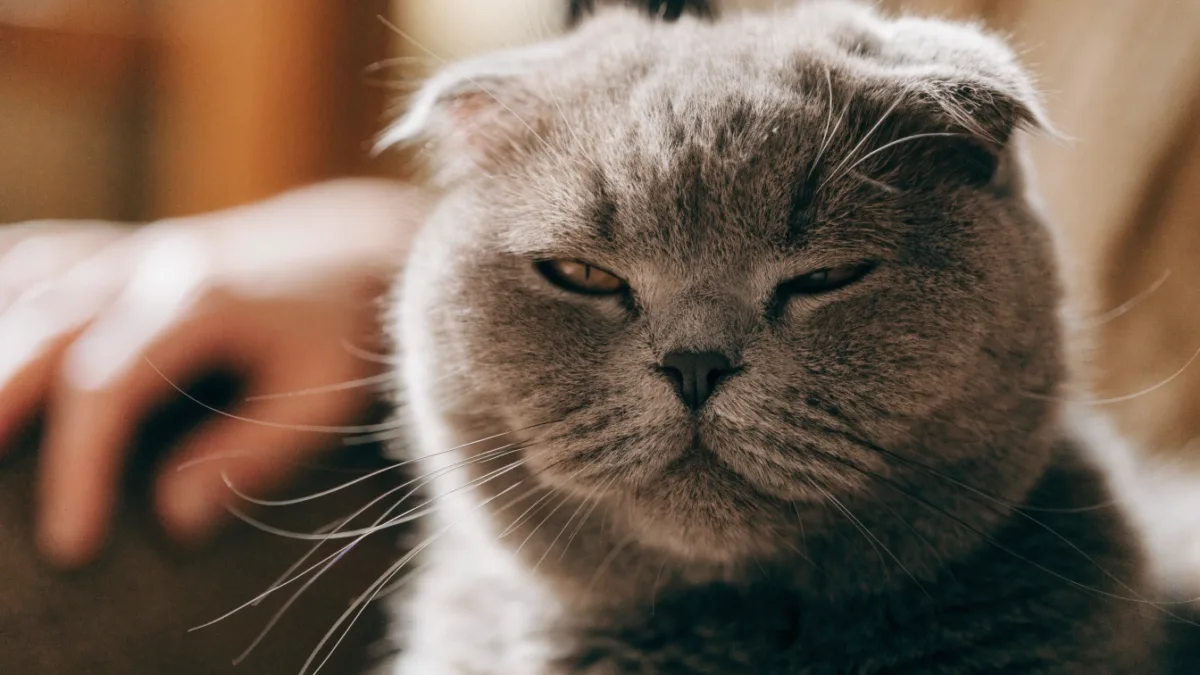
And when a cat is narowing their eyes and blinking slowly, it is a conscious communication of safety and relaxation. It isn’t a sign of fatigue or zoning out. They are telling you that they feel entirely safe in your presence.
The Predator Stare vs. The Soft Gaze
Because cats are both predators and prey, they are incredibly sensitive to body language. While your Golden Retriever might love it when you get right in their face and stare lovingly into their big, goofy eyes, your cat wants you to back up.
Certified cat behavior experts constantly remind us that to a cat, a direct, unblinking stare is perceived as a threat or a challenge. It raises their stress levels immediately. When you catch your cat looking at you from across the room, your natural human instinct to lock eyes and hold the gaze is actually a terrible idea.
How to Master the Soft Gaze
Instead of a hard stare, you want to cultivate a “soft gaze” when looking at your cat.
I learned this the hard way with Olive. Whenever she did something cute, I would whip my head around, stare directly at her, and probably make my eyes really wide. She would immediately tense up, flick her tail, and leave the room. I thought she was just being aloof. In reality, I was accidentally aggressive.
To do a soft gaze, look in your cat’s general direction rather than boring your eyeballs directly into theirs. Let your eyelids relax. Don’t snap your head toward them when they make a noise. If you happen to make direct eye contact, hold it only for a second or two, look away casually, and then look back. This tells your cat, “I see you, but I am not a mountain lion preparing to hunt you in the living room.”
Feline Slow Blinks vs. Canine “Soft Eyes”
If you have dogs, you might be reading this and thinking, “Wait, my dog does a slow blink, too.” And you aren’t wrong, but the mechanics and meaning behind the gesture differ wildly between species.
Dogs, along with horses and other highly social prey animals, rely heavily on the “soft eye” to build trust. If you’ve ever watched a well-trained dog in the park, you might notice the handler making eye contact with the dog. While dogs do look to humans for guidance, what they are actually comfortable with—and what they use to show relaxation—is a softening of the eyelids and a relaxed facial posture. They avoid hard, direct stares, turning their heads slightly away or softening their gaze to show they are not a threat. With dogs, it’s more about the relaxation of the facial muscles and overall body language rather than a deliberate, theatrical closing of the eyes.
Cats, on the other hand, have weaponized the blink. They use it as an active communication tool over distances. Applying the “slow blink” technique to all animals is a highly debated topic among behaviorists. If you try to engage in a slow-blinking contest with a rabbit or a horse, you aren’t going to get very far. Prey animals rely on physical proximity, the angle of your approach, and a general soft gaze. Cats, being ambush predators, use the deliberate blink as a targeted signal to de-escalate tension.
Is it Really Love, or Just Science?
There is an ongoing debate in the behavioral science community regarding how much we should anthropomorphize—or humanize—animal behavior.
When we call the slow blink a “cat kiss,” some strict behaviorists will roll their eyes. They argue that we should simply define it as a “relaxation signal” rather than equating it to human romantic or platonic affection. And honestly? Both sides are right.
Olive doesn’t love me in the way a human loves another human. She doesn’t think I’m her soulmate. But when she is curled up next to my laptop, looks up at me, and does that long, slow blink, she is telling me that she is relaxed, she feels safe, and she isn’t preparing to defend herself against me. To a cat, that is the highest compliment you can receive. It’s an evolutionary badge of honor. You have tricked a tiny apex predator into thinking you are a safe piece of furniture.
How to Reciprocate: The Feedback Loop
If your cat initiates a slow blink, you should absolutely mimic the behavior by blinking slowly back. This creates what behaviorists call a mutual feedback loop of trust. It’s a literal conversation.
If you want to initiate the loop to win over a shy or new cat, the steps are simple:
- Find a cat who is awake but resting.
- Make soft eye contact. Do not lean forward aggressively.
- Slowly close your eyes, keeping them closed for a full second or two.
- Slowly open your eyes and look away.
- Wait.
If the cat is open to communication, you will often see them replicate the exact same sequence back to you. If you’re trying to befriend a feral cat, a stray in your neighborhood, or just a friend’s skittish kitty, this is your most powerful tool. Stop trying to coax them with high-pitched baby talk and a looming posture. Just sit down, get on their level, and blink at them.
From Domestic Shorthairs to Big Cats
While this research pertains strictly to our domestic house cats (Felis catus), the fascinating part of this body language is that it scales up. Keepers at wildlife sanctuaries and zoos have noted for years that wild felids—like lions, tigers, and leopards—use similar eye-contact avoidance and blinking signals in captivity. If a tiger gives you a hard stare, it’s a threat. If a tiger looks at you and slowly closes its eyes, it is signaling a de-escalation of aggression. (And just to be crystal clear: even if you master the feline slow blink, interacting with wild big cats is never safe. You cannot out-blink a tiger.)
Ultimately, understanding how animals use eye contact builds a bridge between our two species. Dogs wear their hearts on their sleeves, practically vibrating with joy when we simply look at them. Cats require us to learn a new language. They require us to pay attention to the micro-expressions, the relaxed ears, and the gentle lowering of the eyelids.
The next time you catch your cat staring at you from the bookshelf, don’t panic. Don’t freeze, and definitely don’t stare back. Just look at them, softly close your eyes, and trust that they understand exactly what you mean.