

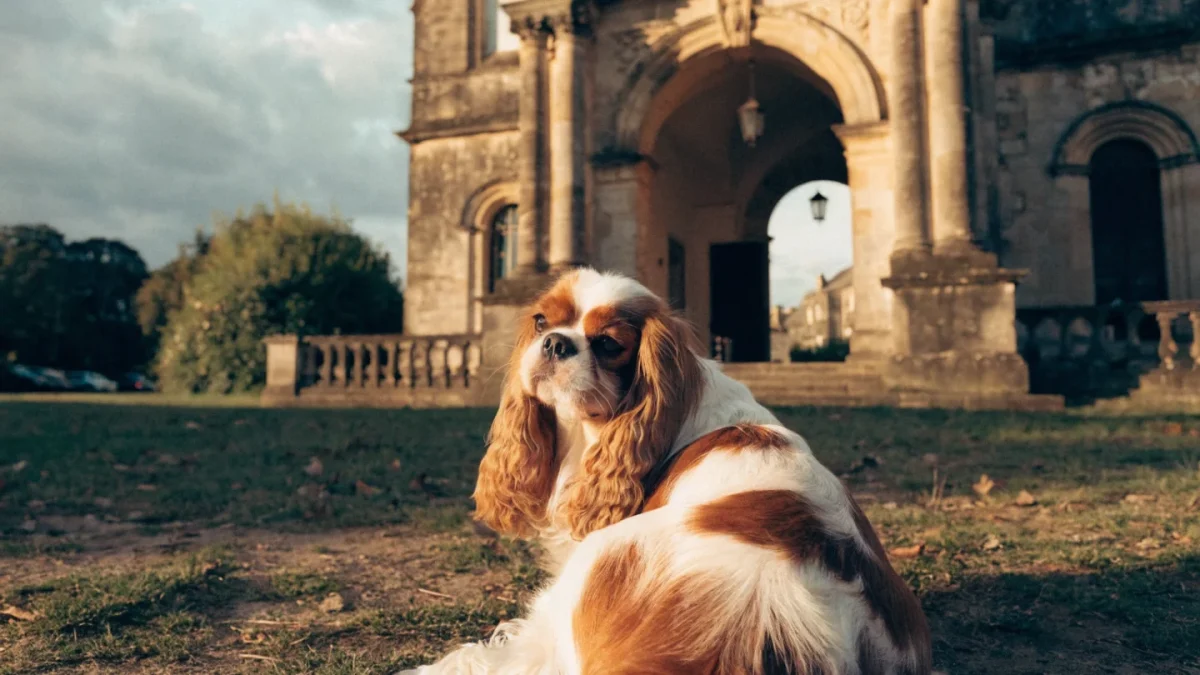
Mary, Queen of Scots, was executed at Fotheringhay Castle on February 8, 1587. When the executioner lifted her skirt to remove her garters, a small spaniel emerged from the folds of the queen's dress, where it had been hiding against her body throughout the entire ordeal. The dog refused to leave its mistress. Accounts from the period describe it crouching beside her and being removed only with difficulty.
That image — a toy spaniel so bonded to its owner that it accompanied her to the scaffold — captures something essential about this breed's history. The Cavalier King Charles Spaniel descends from centuries of dogs bred to do exactly one thing: be inseparable from the person they belonged to. The story of how that breed nearly disappeared, was deliberately transformed into something unrecognizable, and then was painstakingly restored is one of the most unusual in canine history.
The Court Spaniels: 1500s to 1700s
Small spaniels appear in European art from at least the early 1500s. Titian's Venus of Urbino (1538) includes a small sleeping dog widely interpreted as a toy spaniel. By the mid-1500s, these dogs were established fixtures of royal and aristocratic households across England and the continent.
Their function was companionship, but they also served as living heating pads. In an era before central heating, toy spaniels were kept specifically to warm laps and beds. The term "comforter spaniel" appears in period writings — small dogs whose primary role was physical warmth and emotional comfort. Some sources suggest they were also believed to draw fleas away from their owners, though the effectiveness of this as a pest control strategy seems questionable at best.
The Stuart Dynasty and Royal Obsession
The breed's association with the Stuart monarchs cemented its identity. Charles I kept spaniels throughout his reign, and they appeared alongside him in Anthony van Dyck's court portraits. But it was Charles II whose name became permanently attached to the breed.
Charles II's relationship with his spaniels was, by multiple contemporary accounts, extreme. Samuel Pepys — a meticulous diarist and navy administrator — wrote repeatedly about the king's dogs. His most famous entry, from 1667, describes Charles playing with his spaniels at the council table during a discussion about the Dutch raid on the Medway, one of the worst military disasters of the king's reign. The council was dealing with a burning fleet. The king was dealing with his dogs.
The often-cited "royal decree" allowing King Charles Spaniels into any public place, including Parliament, may or may not have been a formal proclamation. Its historical documentation is thin. But the sentiment it represents — that these dogs went everywhere with the monarch — is well established by the diaries, paintings, and household records of the era.
After Charles II's death in 1685, the spaniels remained fashionable. The Duke of Marlborough's Blenheim Palace became a significant breeding center, particularly for the chestnut-and-white variety that would eventually carry the palace's name. Sarah Churchill, Duchess of Marlborough, reportedly pressed her thumb against the heads of pregnant spaniels as a nervous habit — a folk explanation for the "Blenheim spot," a chestnut marking sometimes found on the crown of the skull in Blenheim-colored dogs.
The Victorian Transformation
Then the breed changed. Dramatically.
During the 1800s, fashion in toy dogs shifted toward flat faces. The Pug — imported from China and enormously popular in Victorian Britain — set the aesthetic standard. Breeders of King Charles Spaniels began crossing their dogs with Pugs and, likely, Japanese Chin to produce a shorter muzzle, a more domed skull, and larger, more prominent eyes.
By 1900, the King Charles Spaniel looked nothing like the dogs in Van Dyck's paintings. The muzzle had been compressed. The skull had rounded. The eyes had become more prominent and forward-facing. The dogs in the old portraits — with their flatter skulls, moderate muzzles, and almond-shaped eyes — had effectively been bred out of existence.
This wasn't a gradual drift. It was active selection for a specific look, driven by show ring preferences and the broader Victorian obsession with exaggerated physical features in dogs. The original type, the one that had sat on Stuart laps and been painted by Dutch masters, was gone.
Roswell Eldridge and the Breed Reborn
In 1926, an American dog fancier named Roswell Eldridge traveled to England and was dismayed by what he found at the Crufts dog show. The King Charles Spaniels on display bore no resemblance to the dogs he had seen in historical paintings. He decided to do something about it.
Eldridge offered a prize of twenty-five pounds — a substantial sum in 1926 — at Crufts for the best dog and best bitch of "Blenheim Spaniels of the Old Type, as shown in the pictures of Charles II's time, long face, no stop, flat skull, not inclined to be domed, with a spot in the centre of skull." He funded the prize for five consecutive years.
The response was initially mocked. Established King Charles Spaniel breeders viewed the flat-faced type as the correct one and considered Eldridge's preference retrograde. But a few breeders took up the challenge, selecting for the longer muzzle and flatter skull described in Eldridge's criteria.
Eldridge died in 1928, just two years into the prize period. He never saw the breed he helped create reach maturity. But the breeders he inspired had already organized. In 1928, the Cavalier King Charles Spaniel Club was founded in Britain. The name "Cavalier" — referencing the Royalist supporters of Charles I — was chosen to distinguish the revived type from the established flat-faced King Charles Spaniel.
From Revival to Recognition
Early Years: 1928 to 1945
The early Cavalier breeding program worked with a tiny pool of dogs. Breeders selected individuals from King Charles Spaniel litters that showed the longer muzzle and flatter skull, essentially pulling the old type back out of a population that had been bred away from it for over a century. The founding population was small — necessarily so, since these dogs were atypical specimens within an established breed.
This founding bottleneck would have consequences. The genetic consequences of the breed's small founding population are still shaping the breed's health challenges today.
The breed was granted recognition by the Kennel Club in Britain in 1945. Registration numbers grew steadily through the postwar decades. By the 1960s and 1970s, the Cavalier had become one of the most popular toy breeds in Britain.
International Spread
The breed reached other countries at different rates. Cavaliers arrived in the United States in the 1950s, but breed enthusiasts deliberately delayed seeking full recognition to maintain control over breeding standards. The breed club in the United States initially resisted inclusion in the registry system, preferring to manage its own stud book. Full recognition didn't come until 1995 — one of the last major breeds to receive it.
This delayed recognition was a conscious strategy to prevent the rapid overbreeding that had damaged other popular breeds. Whether it succeeded is debatable. The breed's popularity surged after recognition, and with popularity came the breeding volume that concentrates genetic problems.
A Breed Defined by Its Past
The Cavalier temperament that centuries of court life produced is a direct inheritance from this history. Four hundred years of selection for closeness, warmth, and human attunement created a dog whose emotional architecture is built around a single relationship. The Stuart spaniels that sat at council tables and hid in queens' dresses were the same dogs, in essence, that climb onto your lap today and refuse to leave.
The history also explains the breed's vulnerability. The Victorian transformation and the subsequent revival both involved genetic bottlenecks. The Cavalier was pulled from a small subset of an already small breed, then expanded rapidly from that narrow base. The health conditions that define the breed today — mitral valve disease and syringomyelia — are, in part, the price of that history.
Understanding where the Cavalier came from is essential to understanding what the breed is. The Cavalier King Charles Spaniel breed guide covers what that means for ownership today.
Frequently Asked Questions
Are Cavalier King Charles Spaniels and King Charles Spaniels the same breed?
No. They share ancestry but diverged in the 1920s when breeders deliberately restored the longer-muzzled type seen in historical paintings. The King Charles Spaniel (English Toy Spaniel in some countries) retains the flat face and domed skull created during the Victorian era. The Cavalier is slightly larger, has a longer muzzle, and a flatter skull. They are registered as separate breeds with separate breed standards.
Why was the Cavalier King Charles Spaniel one of the last breeds recognized in the United States?
Breed enthusiasts in the United States deliberately delayed seeking full recognition. They maintained their own registry and stud book to preserve control over breeding standards and prevent the rapid overbreeding that often follows official recognition and the popularity surge it brings. Full recognition came in 1995, but the breed had been present in the country since the 1950s.
Did King Charles II really issue a decree about his spaniels?
The story of a royal decree permitting King Charles Spaniels into all public places, including Parliament, is widely repeated but thinly documented. Contemporary sources confirm that Charles II was deeply attached to his spaniels and kept them with him constantly, including during state business. Whether this was ever formalized as an actual decree is uncertain. The story may be an embellishment of a well-documented reality — that the king simply brought his dogs everywhere and no one was in a position to object.