

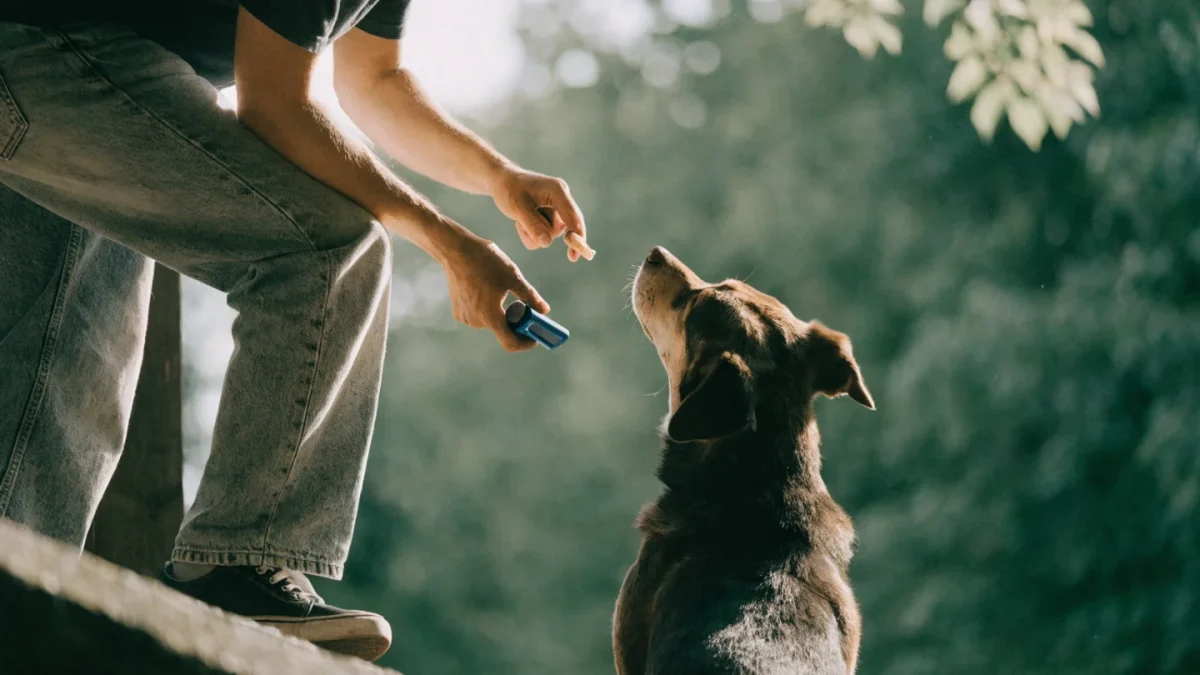
The clicker looks like a small plastic noisemaker. What it actually is: a communication tool with extraordinarily precise timing.
Most trainers give feedback in natural language — "good boy!" — with all the variability that entails. The exact moment of "good" varies by syllable, by speed of speech, by tone. The dog is trying to decode which microsecond of behavior produced the outcome.
The click is always the same. It takes the same fraction of a second. It is perfectly reproducible. That precision is what makes it useful.
Loading the Clicker
Before the clicker means anything, it's just a sound. You need to give it meaning.
Loading is simple: click once, immediately (within a second) give a treat. Repeat 15-20 times in quick succession. Do this across two or three sessions.
You'll know the clicker is loaded when you see the dog's head whip toward you or their eyes brighten the moment they hear the click. The click has become a conditioned reinforcer — it predicts the treat reliably enough that it produces a pleasure response on its own.
Once the clicker is loaded, the click marks the behavior. The treat confirms and rewards it. The dog learns: that sound means I just did the thing correctly.
How to Use It
The click marks the precise moment of the behavior — not after, not before. The exactness is the whole point.
Example: you're teaching sit. The dog begins to lower their hindquarters. The moment their bottom touches the ground: click. Treat immediately after. The dog is learning that the sound (and the treat) corresponds exactly to the moment of sitting.
Compare to verbal praise: "Good—" — by the time the word is out, the behavior has changed. "G" starts at the right moment but "-ood" is delivered while the dog is already thinking about the next thing.
When to Click and When Not to
Click once per behavior. Not "click click click" to express enthusiasm — that muddles the signal. One click, one treat, move on.
Don't click if you're not prepared to treat. The click is a promise. Breaking the promise by clicking without treating will degrade the conditioned reinforcer over time.
Stop clicking for a behavior once the behavior is established and you're transitioning to a verbal cue only. Once the dog understands "sit" means the click-and-treat are coming, use the word to predict the cue. The clicker can then be reserved for teaching new behaviors.
What If You Don't Have a Clicker?
The clicker is great but not essential. Any consistent marker works — a pen click, a short mouth sound ("yes!"), a short sharp word. The value is in the consistency and the loading process, not in the specific tool. See marker training and timing for how to build any marker.
Many professional trainers use a verbal "yes" as a primary marker because it's always available. The clicker is more precise; the verbal is more portable.
What to Train First
After loading, start with behaviors the dog already does: sit, watch. Click when they do them naturally. Then start shaping behaviors from scratch — see shaping vs. luring vs. capturing for the different teaching methods.