

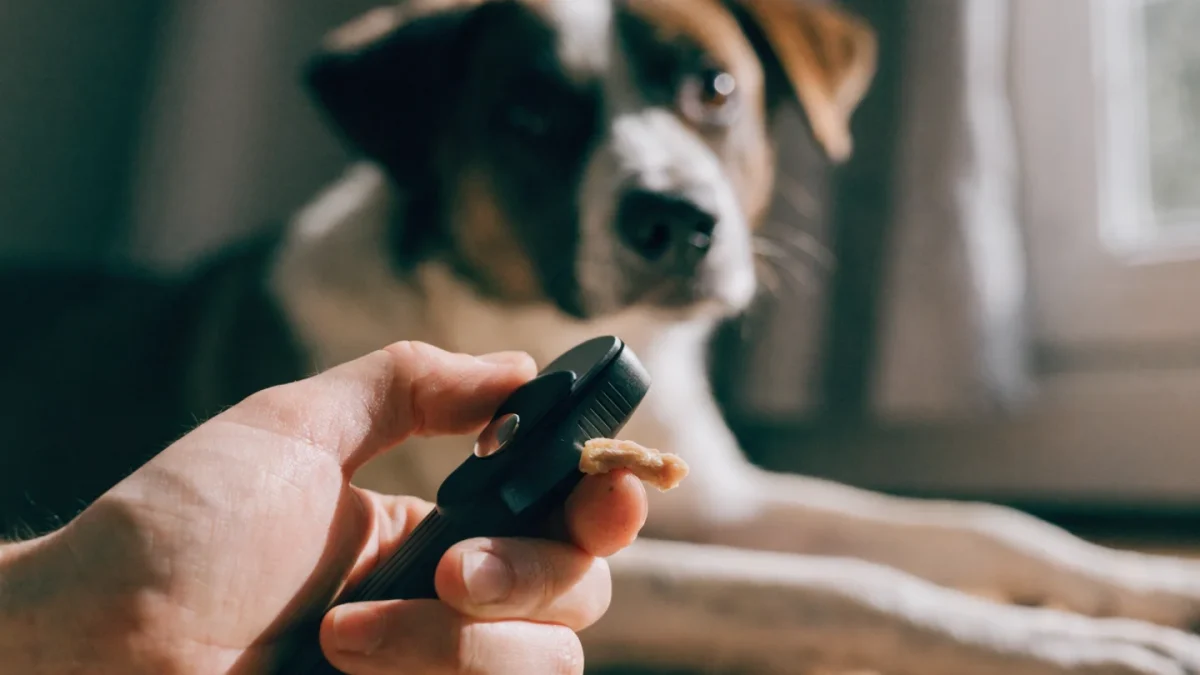
Here's a problem that comes up constantly in training: the dog does the thing, you want to reward them, but by the time the reward arrives — the treat is out of your pocket and in front of their nose — something else has happened. The dog has stood up, looked away, done something slightly different. What are you actually rewarding?
This is the timing problem that markers solve.
What a Marker Does
A marker is a signal that communicates: "the behavior you just did in this exact moment is what produced the outcome." It bridges the gap between the behavior and the reward delivery.
Without a marker: behavior → delay → reward. The dog has to guess what in the last 2-3 seconds earned the treat.
With a marker: behavior → marker (instant) → treat. The marker tells the dog exactly what moment is being reinforced. The treat can take a second to arrive because the marker already told the dog everything.
The technical term is "conditioned reinforcer" or "bridging stimulus" — the marker has been conditioned to predict reward, so it has reinforcing value on its own at the moment of delivery, even before the primary reward arrives.
The Two Types of Markers
Precision marker (terminates the behavior). A clicker click or "yes" that signals: "you're done, the behavior is complete, reward is coming." After this, the dog can move. Used for discrete behaviors: sit, touch, retrieve.
I cover this in more depth in my piece on shaping vs. luring vs. capturing.
Continuation/duration marker. "Good" or another word used while the behavior is ongoing: "good, good, good" during a stay tells the dog they're still in the right behavior, reward is coming soon but stay there. Not a termination signal — the behavior continues.
Both are useful. Mixing them up is where handlers go wrong: clicking during a stay (termination marker) tells the dog they're released from the stay.
The Timing Window
In classical conditioning, the conditioned stimulus (marker) must precede or coincide with the unconditioned stimulus (food) for the association to form. A marker delivered after the food appears doesn't work.
In operant conditioning, the behavior → marker window is ideally less than one second. A 2009 study on dogs found that as owners delayed their response to a completed behavior, accuracy dropped and dogs needed more repeated commands to comply — even at delays under two seconds. That's the research backing up what trainers have known for years: delays between behavior and marker significantly reduce the precision of what's being reinforced.
Practically: if you see the dog sit and you click a full second later while they're already sniffing the ground, you've marked the sniff. Get faster.
Building Your Timing
Timing is a trainable skill for humans, not an innate talent. Practice with a ball — drop the ball, click the moment it hits the ground. This gives you feedback without involving a dog.
Video review of training sessions (even just phone video) is extremely useful for seeing where your timing is drifting. You'll often think you're clicking faster than you actually are.
See clicker training for dogs for the practical application of this in the training context.