

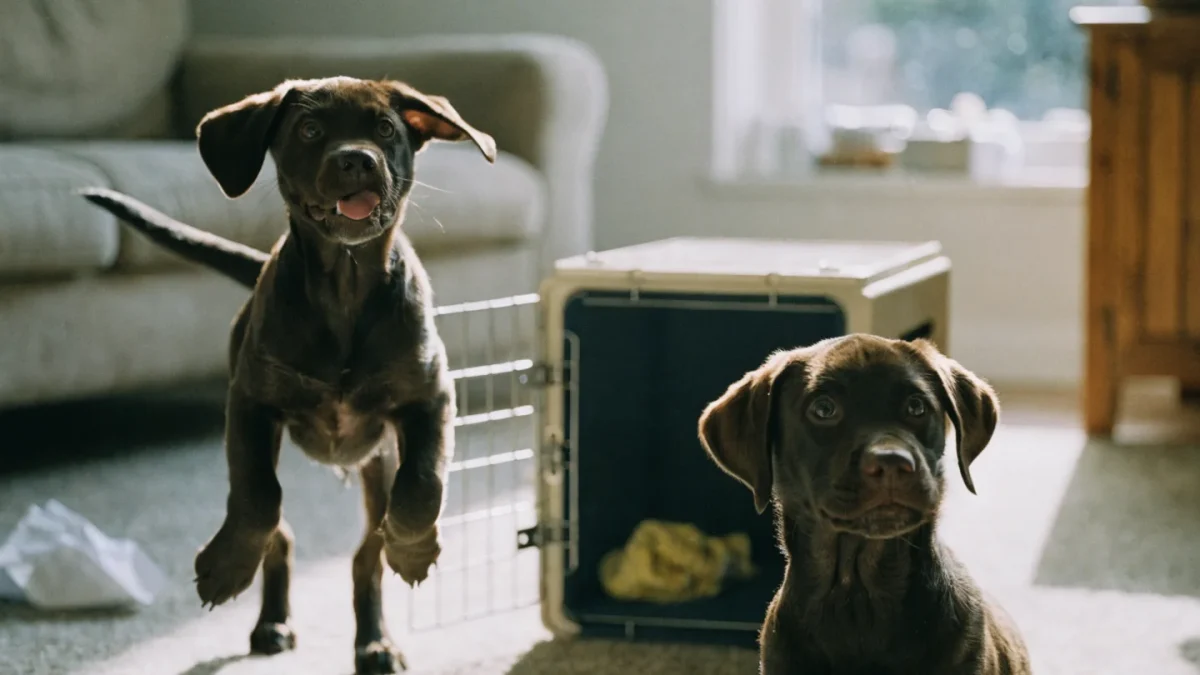
Standard crate training is about making the crate neutral — not scary, not punishing, just fine. Crate games go further: they make the crate the most exciting place in the room.
The difference shows up when you open the crate door. With standard training, the dog goes in because you've asked. With crate games, the dog sprints for the crate because that's where good things happen.
1. The Treat Toss Game
The simplest and most effective starting game.
Toss a treat into the back of the crate. Dog follows it in. Dog comes back out. Toss another treat. Dog runs back in.
No cue needed at first. You're just creating a pattern: run in, good things happen. Repeat 10-15 times per session. Add a verbal cue ("crate," "kennel," "go in" — whatever you'll use) once the dog is enthusiastically running in on their own.
Build on this by varying what goes in: treats, small toys, kibble scatter. The crate should constantly be discovered as having something good inside.
2. The Jackpot Game
Load the crate with treats — drop a handful inside while the dog isn't watching, then casually open the crate door and act like nothing unusual is happening. When the dog goes in to investigate and finds the jackpot, it creates a powerfully positive memory.
Do this periodically — not so often that the dog always finds food inside (the unpredictability of occasionally finding something is part of what makes the game compelling).
3. The Door Open/Close Game
Build calmness around the door with this game:
Dog goes in. Give treat. Close door halfway. Give treat. Open door. Give treat. Dog can exit or stay. If stays, treat. Close door all the way briefly. Give treat through door. Open door.
The goal is the dog learning that the door moving is not an event worth worrying about — it opens and closes without anything bad happening.
4. The Stay Game
Once the dog is comfortable being inside:
Dog goes in. Give treat. Ask for a sit or down inside. Treat. Wait for 5 seconds. Treat. 10 seconds. Treat. 30 seconds. Treat.
You're building voluntary duration inside the crate with treats and attention from you. The dog learns that staying in is highly rewarding.
5. Meal Time as a Game
Every meal can be a crate game. Instead of just placing the bowl, toss a few pieces of kibble inside, let the dog get them, toss a few more, let them get those. Build up to placing the whole bowl inside.
Food motivation makes every meal a crate reinforcement session without any extra effort.
Connecting to the Bigger Picture
Crate games work because they build impulse control — the dog learns to regulate their enthusiasm and work with you rather than just bolting for the crate frantically. Over time, a cue-trained entry is actually calmer and more reliable than a purely enthusiasm-driven one. (See also: how to introduce a puppy to a crate the right way.)
The crate training foundation article has the full systematic process that these games sit inside.
Ten minutes a day of crate games in the first few weeks pays dividends for years. A dog that genuinely loves their crate is a dog that travels well, recovers from surgery quietly, and gives you management options when you need them.