

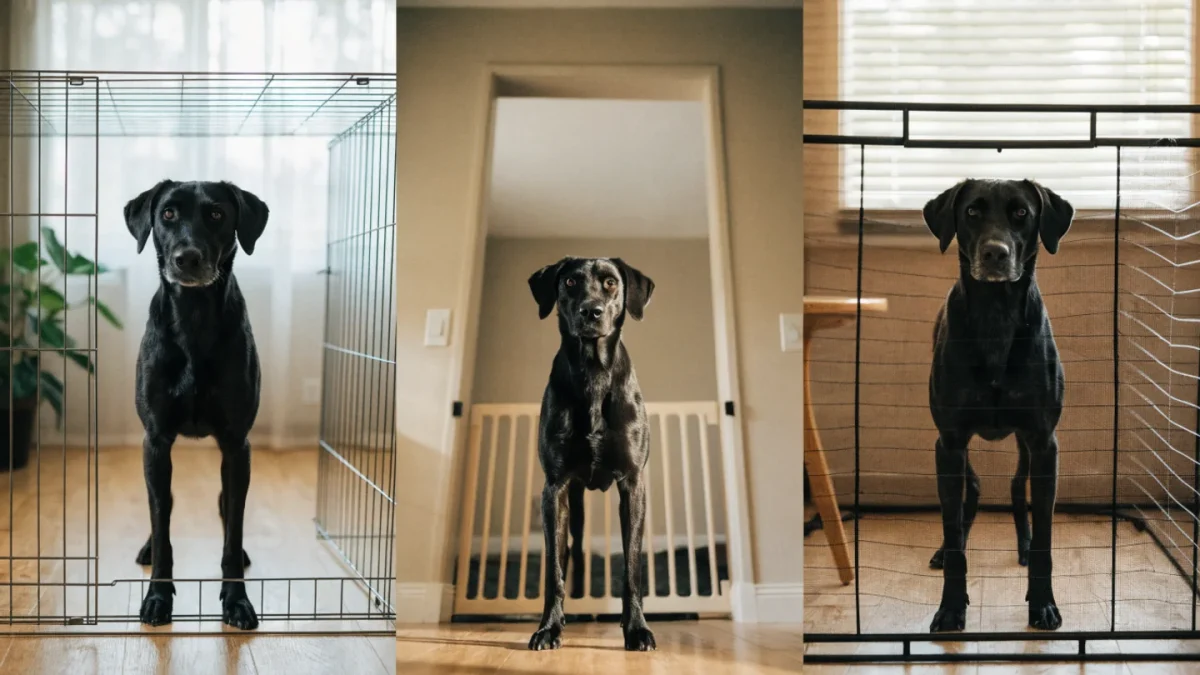
Containment is one of the most practical management tools for dogs — especially young dogs and new dogs. But not all containment serves the same purpose, and using the wrong type can undermine training goals.
Crates
Best for: House training, sleep, short unsupervised periods, travel, dogs in recovery.
A crate is a small, enclosed space. The dog is contained to exactly where they are — can't move beyond the crate dimensions.
The key advantage for house training: dogs won't soil their sleeping space if the crate is properly sized. This instinct is why crates are so effective for house training puppies.
The main limitation: it's not appropriate for extended time (see the duration guidelines in the crate training guide). A dog in a crate for 8 hours is not having their needs met.
Exercise Pens (Playpens)
Best for: Longer unsupervised periods, puppies that need to be contained but can't stay in a crate all day, providing a safe play area.
An exercise pen is a freestanding enclosure — typically 8 panels forming a large confined area. The dog has room to move, stretch, play, and eliminate in a designated area. They can't access the rest of the house, but they have space.
Exercise pens are useful for working owners who can't provide midday crate breaks. The pen can include the crate, a water bowl, a pad for elimination, and toys — the dog has what they need for a longer unsupervised period.
The trade-off: no house training benefit. The dog can eliminate in the pen and isn't building the impulse control that crate training builds. Pens are management, not training.
Baby Gates
Best for: Limiting room access, keeping dogs out of specific areas, managing multi-pet households, expanding freedom incrementally.
A baby gate doesn't confine a dog — it just limits where they can go. The dog has full freedom within one room (or set of rooms).
Gates work well for dogs that are past the crate stage but not quite ready for full house freedom. Expanding freedom from crate → one gated room → two gated rooms → full house is a common and effective progression.
Gates are also useful for separating dogs, keeping a dog out of a baby's room, or blocking stairways.
The limitation: gates are only as effective as the dog's size and jumping ability. A determined dog can knock over or jump a standard baby gate. (See also: dog training tools and equipment.)
Using Them Together
The most practical approach for young puppies combines all three:
- Crate for sleeping and short supervised absences
- Exercise pen (attached to or surrounding the crate) for slightly longer unsupervised periods
- Baby gates to keep the puppy in the main family area without full house access
As the puppy matures and earns trust, the pen can be removed, then the gate boundaries can expand.
Don't view containment as one-size-fits-all. The right tool depends on the problem you're solving and where the dog is in their training. Use crates for house training and sleep, pens for longer periods, and gates for graduated freedom expansion.