

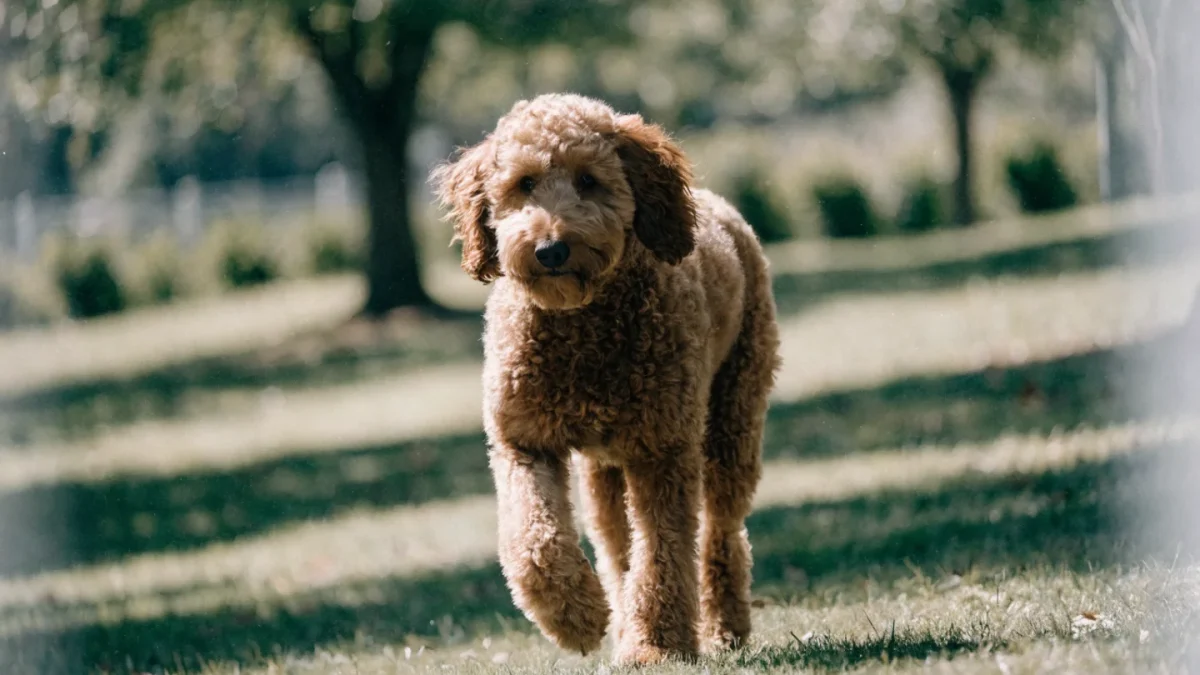
Wally Conron has said publicly that he regrets creating the Labradoodle. The man who made the first intentional cross that launched the designer dog industry watched it spin into something he didn't recognize — a multi-billion-dollar market of poorly screened litters, celebrity endorsements, and "hypoallergenic" claims that don't hold up — and said so. That's worth sitting with before we get into the genetics, because the Labradoodle story isn't a success story with complications. It's a cautionary tale with an unusually self-aware narrator.
I've covered the designer dog market for most of my career. I've talked to the breeders producing responsible crosses with health testing, written assessments, and genuine breed knowledge. I've also talked to families who paid four thousand dollars for a Goldendoodle puppy with hip dysplasia, a wavy shedding coat (not the curly low-shed coat they were sold), and a temperament nobody screened. Both exist. The difference between them is exactly what gets lost when "designer dog" becomes a category instead of a decision — so let's be precise about what these dogs actually are and what the science says about them.
What "Designer" Actually Means
A purebred dog comes from a closed gene pool. Breeding two Golden Retrievers produces Golden Retriever puppies with predictable characteristics because the genetic variation has been narrowed through generations of selective breeding to a standard. A designer dog is the intentional mating of two different purebred breeds. The result is genetically a first-generation (F1) cross — and the predictability that defines purebred dogs largely doesn't apply.
An F1 Labradoodle will be some combination of Labrador and Poodle traits, but which combination is unpredictable. Within a single litter, you can get puppies with flat, shedding coats (Labrador-like), curly non-shedding coats (Poodle-like), and everything in between. Size, temperament, energy level, and health profile are all variable. This is basic genetics: when you combine two different gene pools, the offspring represent a shuffle of both decks.
Multigenerational crosses (F1b, F2, F3, etc.) are attempts to increase consistency by breeding designer dogs to each other or back to one parent breed. An F1b Goldendoodle (Goldendoodle x Poodle) has more Poodle genetics and a higher probability of a low-shedding coat. But multigenerational crossing without health testing and structural standards is not "creating a breed" — it's breeding without the framework that purebred breeding, at its best, provides.
The Hybrid Vigor Argument
The most common claim about designer dogs is that they're "healthier than purebreds" due to hybrid vigor (heterosis). This claim deserves careful unpacking because it's partly true, partly misleading, and frequently used as a marketing tool.
What hybrid vigor actually is: When two genetically distinct populations are crossed, the offspring may show increased fitness because they're less likely to be homozygous (carrying two copies of the same allele) for recessive genetic diseases. In simple terms: if both parents carry different genetic weaknesses, the offspring may dodge both.
Where the claim holds: F1 crosses between genetically distinct breeds may indeed have lower rates of certain recessive conditions that require two copies of a defective gene (like PRA in some breeds). A 2013 study from UC Davis analyzing over 27,000 dogs found that purebred dogs were more likely to have certain genetic disorders than mixed breeds, though the effect was condition-specific — some conditions showed no difference between purebreds and mixed breeds.
Where the claim breaks down: Hybrid vigor doesn't protect against dominant genetic conditions, polygenic conditions (like hip dysplasia), or conditions common to both parent breeds. Crossing a Golden Retriever (high cancer risk, hip dysplasia) with a Poodle (hip dysplasia, Addison's disease, bloat) doesn't guarantee the offspring avoids either breed's problems — it means the offspring draws from both risk pools. Without health testing of parent dogs, "hybrid vigor" is hope, not science.
The Doodle Phenomenon
Poodle crosses dominate because the Poodle's low-shedding coat is the primary selling point. But an F1 Goldendoodle has roughly a 50/50 chance of a significantly shedding coat. The "guaranteed hypoallergenic" marketing is not supported by genetics.
What You're Actually Paying For
Designer dogs often sell for prices matching well-bred purebreds, but without the standardized health testing framework. No major kennel club recognizes Doodles, so there's no evaluation standard. Some designer dog breeders health-test both parents and stand behind their dogs. Many breed for volume and marketing. The question is whether your specific breeder operates with the same rigor as a responsible purebred breeder. For context, understanding how breeds are created and the breed group system explains the framework designer dogs exist outside of.
Frequently Asked Questions
Are designer dogs healthier than purebreds?
Not automatically. First-generation crosses may have reduced risk for certain recessive genetic conditions, but they can inherit health problems from both parent breeds, and conditions like hip dysplasia, cancer, and cardiac disease aren't eliminated by crossbreeding. Health depends primarily on whether the parent dogs were health-tested, not on whether the offspring is purebred or crossbred. A well-bred purebred from health-tested parents is likely healthier than a designer cross from untested parents.
Are Labradoodles and Goldendoodles really hypoallergenic?
No dog is truly hypoallergenic. Allergens come primarily from proteins in saliva, urine, and dander — not from hair itself. Poodle-type coats may trap dander closer to the body, reducing airborne allergen exposure, but this effect varies between individual dogs. In F1 crosses, coat type is unpredictable — some puppies will inherit a Poodle-like coat, others won't. If allergies are a serious concern, spend time with the specific individual dog before committing, regardless of breed or cross.
Will designer dogs ever become recognized breeds?
Possibly, but it requires decades of consistent, standardized breeding. A breed isn't just a cross — it's a genetically consistent population that breeds true (producing offspring that reliably resemble the parents). This requires multiple generations of selective breeding with health testing, structural standards, and temperament evaluation. The Australian Labradoodle is the furthest along this path, with some organizations working toward breed recognition through multigenerational programs. Most designer crosses are still too genetically variable to meet breed recognition criteria.