
I know what agility looks like on screen — dogs flying through tunnels, handlers sprinting alongside, courses that look like organized chaos. That's the end product. Where it starts is much more boring, and that's a good thing.
The first day I put my dog on an agility field, we didn't do any agility. We walked around the equipment. I let her sniff the tunnel, step on the contact equipment with all four feet, approach the jump standards with bars on the ground. No rushing, no running. Just familiarity.
That's the actual beginning of agility.
What Agility Actually Requires
At its core, agility is obstacle navigation guided by handler cues. The dog needs to read where you're going and execute the obstacle sequence correctly. The handler needs to be in the right place at the right time sending clear directional information.
That requires three foundations before obstacle training ever begins:
- Handler focus — the dog must want to work with you and read your body language
- Drive and arousal management — the dog needs enough enthusiasm to work fast, but not so much they lose accuracy
- Body awareness — dogs need to know where their back feet are for contacts, weaves, and tight turns
If those three things aren't there, agility training is frustrating for both of you.
Prerequisite Skills
Before introducing equipment, make sure your dog has:
- A solid recall in moderately distracting environments
- Ability to focus on you for 30+ seconds
- Some exposure to novel surfaces, sounds, and environments
- Basic impulse control (not lunging at everything interesting)
A strong advanced obedience foundation isn't required to start foundation agility, but dogs with solid obedience usually progress faster because handler relationship and responsiveness are already there.
Foundation Skills Before Obstacles
Targeting: Teach your dog to touch your hand, a stick, or a small target disc with their nose. This becomes how you guide them through courses and around turns. Target training builds naturally into agility handling.
Drive-building: Play short, enthusiastic tug or toy games. Build the dog's motivation to work. Agility rewards typically shift from food to toys and play at higher levels because food-delivery during a course run isn't practical.
Rear-end awareness: Teach your dog to put their back feet on a low platform or step on an upside-down bowl. This sounds trivial — it's not. Dogs that understand their back end navigate contacts (the yellow zones at the bottom of equipment) with much more precision.
Directional cues: Basic left, right, go-on (forward), and come (toward handler). These become course navigation at full speed. Teaching them now in low-distraction settings makes them reliable later when the dog is excited on a course.
Introducing Equipment
Start with the easiest, lowest-pressure obstacles.
Tunnel: Set it short and straight. Let your dog walk through, then run through. Add curve gradually. Most dogs love tunnels once they've done it a few times.
Jump standards (bar on the ground): Walk your dog over a bar lying flat on the ground. Build to a very low jump. Do not raise jump height until growth plates are closed — ask your vet when that is for your dog's size.
Pause table: Teach your dog to jump onto a platform and hold a sit or down. Uses your mat work or duration work from basic training.
Contact equipment (A-frame, dog walk): Introduce on the lowest height possible. Use a "hit the zone" marker to reward back feet landing in the yellow contact area. This precision takes months to develop reliably — don't rush it.
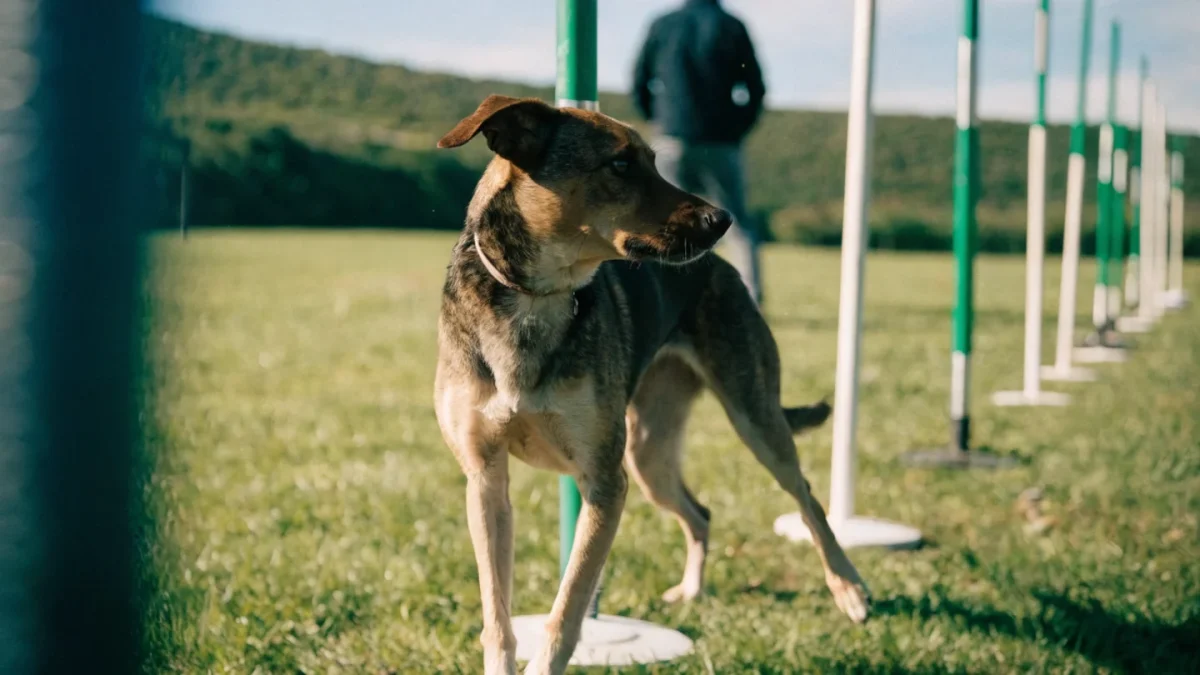
Weave poles: The hardest obstacle in agility and the last one most trainers introduce. Start with widely spaced channel poles and teach your dog to drive through the channel, then gradually close the gap.
Chaining behaviors together — learned in basic training — is exactly what courses require: sequences of obstacles executed in the right order from handler guidance alone.
When to Join a Class
As soon as you have the foundation skills, find a beginner agility class. Working with an experienced instructor on equipment is safer than figuring it out alone, and it dramatically speeds up progress.
Look for classes that use positive training methods and that emphasize foundation work before full courses. A good instructor will ask about your dog's background and adjust accordingly.
What to Realistically Expect in Year One
Foundation skills: 1-3 months. Obstacle confidence on all equipment: 3-6 months. First simple sequences: 4-8 months. Running a full short course: 6-12 months. Competing in a beginner trial: typically 12-18 months for many dogs.
That's a rough guideline — some dogs move faster, some slower. The dogs I've seen stall out are usually the ones whose handlers rushed past foundation work.
FAQ
What age can a dog start agility?
Foundation skills, targeting, and tunnel work can begin at any age. Formal jumping should wait until growth plates close — roughly 12 months for small breeds, 16-18 months for large breeds, up to 24 months for giant breeds. A vet or orthopedic specialist can advise on your specific dog.
What's the best breed for agility?
Border Collies and Australian Shepherds dominate competitive agility, but almost any breed can participate for fun. Mixed breeds compete in most organizations. Drive and handler focus matter more than breed.
How much space do I need to practice agility at home?
For foundation work and a few basic obstacles, a standard backyard works fine. Tunnels, jump standards with low bars, and a pause table take relatively little space. Full course work requires a larger area, which is usually why people join training clubs.