

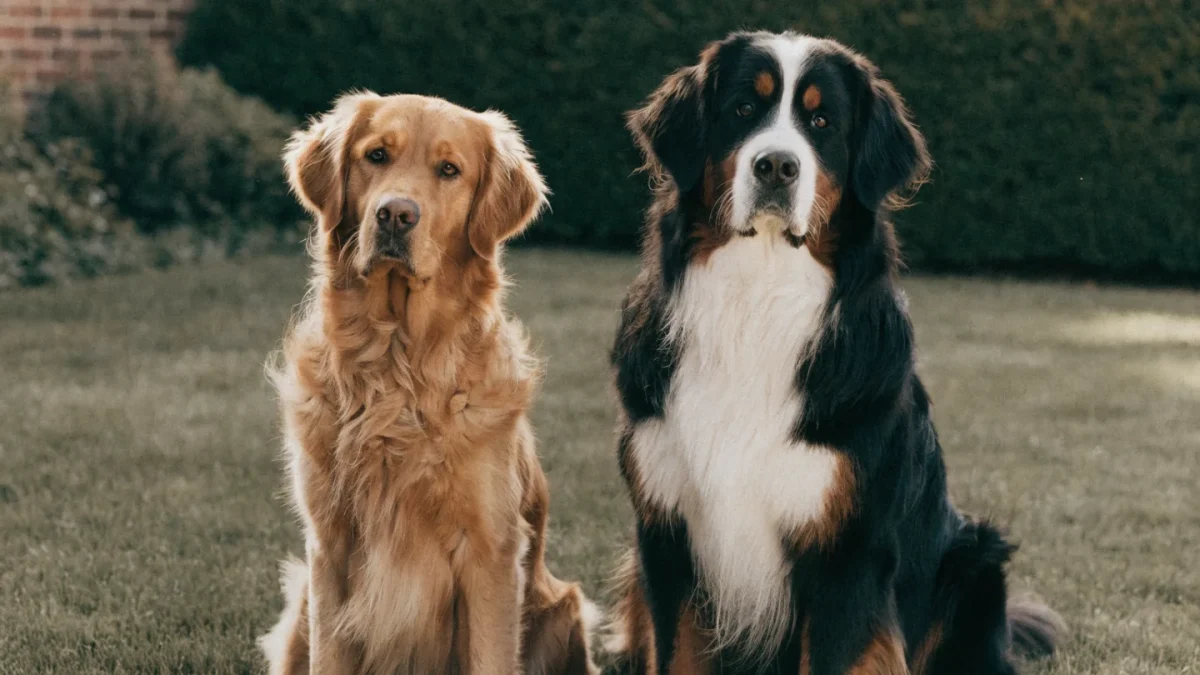
The Bernese Mountain Dog spent centuries hauling milk carts and guarding farms in the Swiss canton of Bern. The Golden Retriever was developed in the Scottish Highlands during the 1860s for waterfowl retrieval. One worked in Alpine meadows pulling loads and watching over livestock. The other worked in Highland marshes bringing back downed birds. Both ended up as beloved family dogs — gentle, affectionate, good with children. But the gap between them in practical ownership terms is wider than their shared reputation suggests, and the hardest part of this comparison involves lifespan.
Size and Build
| Trait | Golden Retriever | Bernese Mountain Dog |
|---|---|---|
| Height (male) | 58-61 cm | 64-70 cm |
| Height (female) | 55-57 cm | 58-66 cm |
| Weight (male) | 30-34 kg | 39-52 kg |
| Weight (female) | 25-29 kg | 32-43 kg |
| Build | Athletic, balanced | Heavy-boned, sturdy, powerful |
The Bernese is substantially larger and heavier. A 50 kg Berner takes up more space, eats more food, and costs more at the veterinarian than a 30 kg Golden. The size difference matters for vehicle transport, living space, and physical handling — particularly when the dog is elderly or injured and needs to be moved.
Temperament
Both breeds are gentle, patient, and family-oriented. The differences are in energy and social style.
Golden Retrievers are enthusiastic. They greet everyone with undifferentiated joy, they're always ready for the next activity, and they mature slowly — expect puppy behavior well into the third year. Their energy is persistent and can be exhausting for owners who expected a calm family dog. Goldens are calm dogs that happen to need a lot of exercise before they display that calm.
Bernese Mountain Dogs are gentle by default. They're affectionate without being demanding, patient with children to a remarkable degree, and significantly calmer in the house than Goldens at the same age. Where a two-year-old Golden is still bouncing off walls, a two-year-old Berner is often settled and measured. Berners are attached to their family but handle brief solitude better than many breeds — they don't tend toward separation anxiety the way Goldens can.
With strangers, Goldens are an open door. Berners are more reserved — friendly when introduced but not rushing to greet everyone. That slight reserve comes from their watchdog heritage; they assess before welcoming.
Exercise Needs
Golden Retrievers need 60 to 90 minutes of structured daily exercise. Retrieving games, swimming, hiking, and active training satisfy their sporting dog drive.
Bernese Mountain Dogs need 30 to 60 minutes. Moderate walks and gentle play suit them. They enjoy cool-weather hiking and pulling activities (carting is a natural breed sport), but they're not endurance athletes. Their large frame and heavy bone mean sustained high-impact exercise stresses joints — particularly problematic in a breed already predisposed to orthopedic issues.
Heat tolerance differs meaningfully. Goldens handle moderate warmth adequately though their thick coat makes hot weather uncomfortable. Berners, with their heavy black coat and larger body mass, overheat significantly faster. In warm climates, the Bernese requires careful management during summer months.
Grooming
Both shed heavily. Both have thick double coats that blow out twice annually. If fur on every surface is a dealbreaker, neither breed belongs in your home.
Goldens need brushing three to four times weekly, with daily sessions during coat blows. The feathering on legs, chest, and tail tangles if neglected.
Berners also need three to four times weekly brushing. Their longer coat and heavier undercoat produce even more volume during shedding events than Goldens. The black fur is also more visible on light-colored furniture and clothing, which is a cosmetic nuisance rather than a real problem — but it's one Berner owners mention frequently.
Health and Lifespan
This is the most important section of this comparison, and honesty requires directness.
Golden Retrievers have high cancer rates. A 1998 health survey by the Golden Retriever Club of America found cancer accounted for 61.4% of deaths in the breed. Hip dysplasia, elbow dysplasia, progressive retinal atrophy, heart disease (subvalvular aortic stenosis), and hypothyroidism are additional concerns. Average lifespan: 10 to 12 years.
Bernese Mountain Dogs have among the shortest lifespans of any breed. Average lifespan is approximately 6 to 8 years. Cancer — particularly histiocytic sarcoma, a rare and aggressive cancer in most breeds but devastatingly common in Berners — is the primary driver. Epidemiological research has found that at least 55% of Bernese Mountain Dog deaths are associated with malignant tumors, with histiocytic sarcoma alone affecting roughly 25% of the breed (Abadie et al., Journal of Veterinary Internal Medicine, 2009). Hip dysplasia, elbow dysplasia, progressive retinal atrophy, and bloat are also prevalent.
The lifespan difference is the central question in this comparison. A Golden Retriever from health-tested lines might give you 12 years. A Bernese Mountain Dog from the same caliber of breeding might give you 7. For some families, the Berner's temperament and gentle nature are worth the shorter partnership. For others, the math doesn't work. Neither answer is wrong — but the question must be faced directly before making a decision.
Living Situation
Both breeds are house dogs. Both want to be with their families. Both adapt to suburban living with yard access.
Goldens are more adaptable to varied living situations, including apartments with dedicated exercise routines. Berners, due to their larger size and heat sensitivity, are more comfortable in cooler climates with indoor and outdoor access. A Berner in a hot-climate apartment is a struggling dog.
Both breeds do well with children and other pets. Berners are slightly more tolerant of chaos due to their calmer baseline energy, but Goldens are more forgiving of inconsistent routines.
Who's the Right Fit
Choose the Golden Retriever if you want a longer partnership, a more active exercise companion, and a dog that integrates socially with virtually anyone. You'll manage heavy shedding and the breed's cancer predisposition, but the odds of a decade-plus together are reasonable.
Choose the Bernese Mountain Dog if temperament is your priority over longevity, you live in a cooler climate, prefer a calmer daily pace, and can make peace with a shorter expected lifespan. The Berner's gentle, patient nature is genuinely special — many owners say they'd never choose a different breed despite knowing the heartbreak that comes with the timeline.
Both breeds bring warmth to a family. The decision is whether you optimize for years together or quality of temperament during the years you get. For more comparisons, see our breed comparisons guide. For dedicated breed profiles, the Golden Retriever complete breed guide covers the breed's Scottish Highland origins and cancer predisposition, while the Bernese Mountain Dog breed guide examines the breed's Swiss draft history and the histiocytic sarcoma statistics that define its health story.