

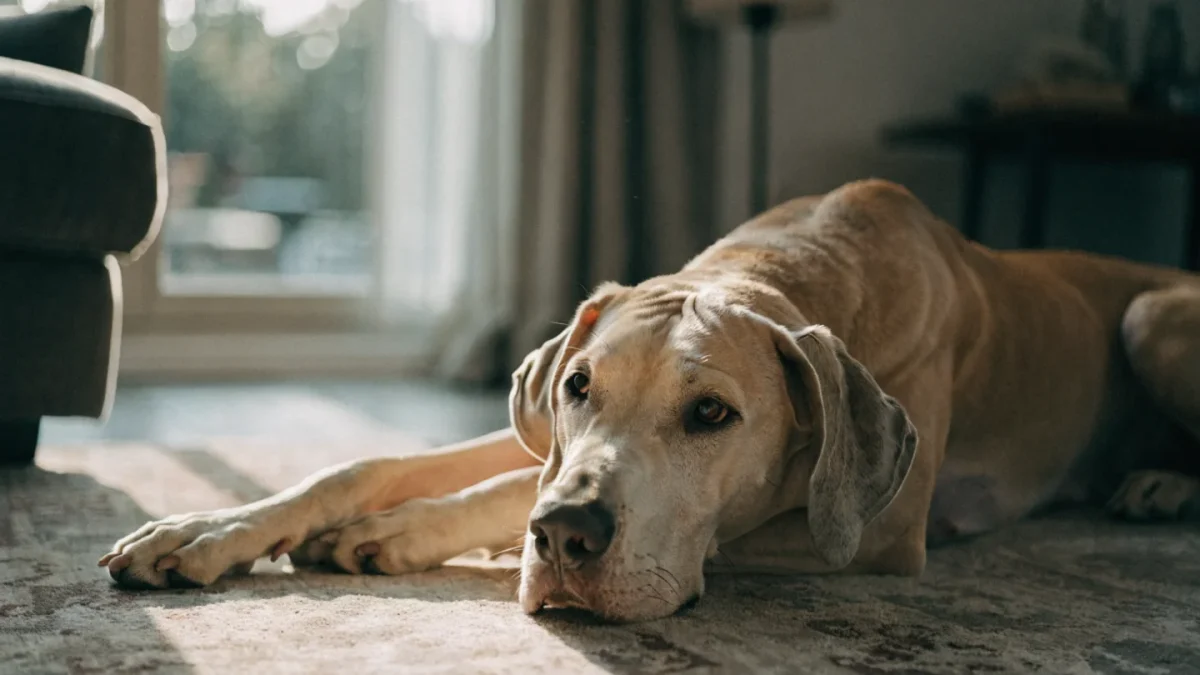
After a decade of researching and writing about breeds, I've found that the most persistent great dane misconceptions myths tend to involve a simple error: confusing size with behavior. People look at an 80 cm tall dog and make assumptions about aggression, energy, space requirements, and appetite that don't match the actual animal. Here are five that come up repeatedly — and what the reality looks like.
1. "Great Danes Are Aggressive Because of Their Size"
Completely backwards. Modern Great Danes have been selectively bred away from aggression for well over a century. The temperament that defined the breed's boar-hunting era was deliberately removed through generations of breeding for companionship.
Behavioral surveys consistently place Great Danes among the least aggressive large breeds — lower than many breeds half their size. The visual deterrent is real, but the animal behind it is typically calm and more interested in leaning against your legs than confronting anyone. Aggression is not a breed trait. It's one of the things specifically bred out of them.
2. "They Need Massive Amounts of Exercise"
Intuitively, it seems like the tallest breed should need the most exercise. It doesn't work that way. Great Danes are moderate-energy dogs that thrive on 30 to 60 minutes of daily activity — a fraction of what breeds like Border Collies, German Shorthaired Pointers, or Australian Shepherds require.
The breed was built for sprinting after boar, not trotting for hours. Long-distance running and multi-hour hikes stress joints and heart beyond what the breed was designed to handle. Many adults peak in enthusiasm within 15 minutes of a walk and spend the rest communicating they'd prefer to be lying down.
What they do need is mental stimulation. A bored Great Dane at counter height is a recipe for household chaos.
3. "They Can't Live in Apartments"
They absolutely can — and many do. The assumption that a giant breed requires a giant home overlooks a basic fact about Great Dane behavior: these dogs spend a remarkable portion of their day sleeping or resting. An adult Great Dane on an average day is essentially a very large, warm piece of furniture that occasionally moves to a different comfortable surface.
What matters isn't total square footage but practical layout — room to lie down fully extended, turn around, and move between rooms. An apartment with a dedicated owner who provides adequate walks and companionship works as well as a house with a yard and an absent owner. The practical challenges (tail-height furniture clearance, drool, neighbor awareness) are manageable for owners who plan ahead.
4. "They Eat an Unbelievable Amount of Food"
Great Danes eat more than a Chihuahua. They eat less per kilogram of body weight than most people assume. Giant breeds have a slower metabolic rate per unit of body mass compared to small and medium breeds. A 70 kg Great Dane does not eat seven times as much as a 10 kg dog — it eats roughly two to three times as much.
Typical adult intake is 6 to 10 cups daily, split between at least two meals. The annual food cost is higher, but what actually costs significantly more is veterinary care, medications dosed by body weight, and specialized equipment. The more important food issue isn't quantity — it's management around bloat risk: multiple smaller meals, no exercise around mealtimes, controlled water intake.
5. "They're Danish"
They're not. The name "Great Dane" traces to the French naturalist Buffon, who labeled the breed Grand Danois in the 18th century, likely after misidentifying its origin. The breed was developed in Germany from crosses of English Mastiff-type dogs, Greyhounds, and Irish Wolfhounds, beginning in the 1500s. Germany declared the Deutsche Dogge — German Mastiff — as its national breed in 1876 and has never been particularly happy about the English-speaking world's insistence on calling the breed Danish.
This one matters beyond trivia because it obscures the breed's actual history — three centuries of deliberate German breeding that transformed a boar-hunting dog into one of the gentlest companion breeds in existence. Knowing the real origin story gives owners a much better understanding of why their dog behaves the way it does.