

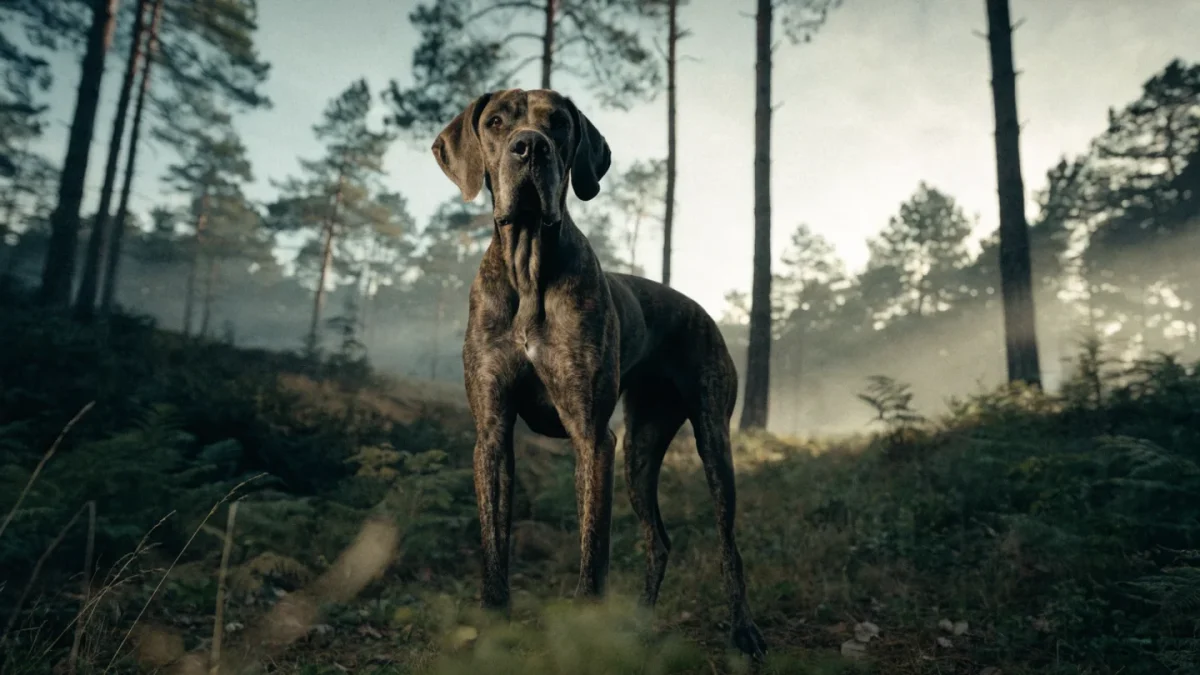
The most misleading thing about the Great Dane is its name. The breed has virtually nothing to do with Denmark. It's German — developed, standardized, and nationally claimed by Germany — and the fact that the English-speaking world still calls it a "Dane" is one of those historical accidents that stuck around long enough to become permanent.
Understanding great dane history origins means untangling three centuries of name changes, cross-border confusion, and a dramatic transformation from one of Europe's most formidable hunting dogs into one of the world's most affectionate companion breeds.
The Boar Hound Era: 1500s to 1700s
The breed's working roots trace to the German states of the 16th century, where nobility needed a dog capable of hunting European wild boar — an animal that routinely exceeded 200 kg and fought back with tusks that could disembowel a horse. The dogs bred for this work needed speed to chase, power to hold, and courage that bordered on recklessness.
German breeders crossed several existing types to produce their Englische Docke (English Mastiff-type dogs) with Greyhound-type sighthounds and likely Irish Wolfhounds. The Mastiff contribution brought mass and jaw strength. The sighthound genetics contributed speed, leg length, and a leaner build that allowed sustained running through dense forest. The result was a tall, powerful dog with enough speed to close ground on a fleeing boar and enough strength to seize it by the ears and pin it until the hunter arrived.
These early boar hounds looked considerably different from today's Great Danes. Historical descriptions and period artwork depict them as heavier, more muscular, and shorter-muzzled than the modern breed — closer in build to a large, rangy Mastiff than the elegant animal we recognize today. They were functional dogs built for violent work, and their temperament reflected that purpose.
Boar hunts were elaborate affairs involving dozens of dogs, beaters, and mounted hunters. The boar hounds worked in packs, wearing padded armor to protect their chests and necks from tusk injuries. Casualty rates among the dogs were high. The survivors were valued enormously — and the best of them were brought indoors.
The Kammerhunde Transformation: 1600s to 1800s
The shift from hunting field to bedroom happened gradually but was already well underway by the mid-1600s. The finest boar hounds — the ones with the best conformation and, importantly, the calmest dispositions — were selected as Kammerhunde, or "chamber dogs." These animals lived inside the estates of German aristocracy, slept in their owners' bedrooms, and served dual roles as personal bodyguards and status symbols.
The Kammerhunde wore elaborate gilded collars lined with velvet padding. Period paintings show them lounging alongside nobility in domestic scenes, their massive frames draped across furniture with the same casual entitlement that Great Dane owners will recognize immediately today.
This transition period is where the breed's modern temperament was forged. Dogs selected for indoor living needed to be calm around people, tolerant of handling, and non-reactive in domestic environments. Aggressive, hyperactive, or noise-sensitive animals were unsuitable for the chamber and were either returned to the hunting pack or excluded from breeding. Over generations, this selection pressure shifted the breed's behavioral baseline from intense hunting drive to calm companionship.
By the 1700s, boar hunting with dogs was declining across much of Europe as firearms improved and wild boar populations dropped. The Great Dane's working purpose was fading, but its secondary role as a prestige companion was growing. The breed was increasingly kept for appearance and temperament rather than function.
The Name Problem
The English name "Great Dane" can be traced to the French naturalist Georges-Louis Leclerc, Comte de Buffon. In his Histoire Naturelle, published between 1749 and 1788, Buffon described a large dog he encountered and labeled it Grand Danois — "Big Danish." Why he associated the dog with Denmark remains unclear. He may have encountered the breed during travels in Denmark, or he may have confused it with another large Danish breed. The name migrated into English as "Great Dane" and stuck despite having no geographic accuracy. For more, see Newfoundland.
The Germans were not amused. By the 1870s, German breeders were actively pushing to establish the proper German name. In 1878, a committee of judges and breeders in Berlin formally proposed Deutsche Dogge — German Mastiff — as the breed's official designation. Germany's national breed club, the Deutsche Doggen Club, was founded in 1888 and continued to use the German name.
Different countries adopted different naming conventions. Most German-speaking and many European countries use Deutsche Dogge or a direct translation. The English-speaking world stubbornly retained "Great Dane." Italy uses Alano (from the ancient Alan people who bred large dogs). The name fragmentation persists today and remains a source of mild irritation among breed historians who feel the German origin deserves recognition in the breed's common name.
Standardization and the Modern Breed: 1876 to 1920s
Germany declared the Deutsche Dogge its national breed in 1876 — a significant political and cultural statement during a period of German national consolidation. The first formal breed standard was drafted in 1880 at a dog show in Berlin, establishing the physical parameters that would guide breeding for the next century and a half.
The early standard described a dog that was taller and more elegant than the boar hounds of the previous century but still retained visible working structure. The color patterns recognized in the standard — fawn, brindle, blue, black, harlequin, and mantle — were codified during this period, though informal color breeding had been practiced for much longer.
The breed reached North America in the late 1800s. The first Great Dane breed club in the United States was established in 1889, making it one of the older single-breed clubs in the country. Early American Great Danes were imported primarily from German breeding stock, and the breed built a steady following among wealthy households that could accommodate a dog of this size.
Through the early 20th century, the breed continued its evolution away from working type and toward companion animal. Heads became more refined, chests deepened, and temperaments softened further. The breed's function was now almost entirely companionship and show, and the physical standard reflected that shift.
Post-War Development and Modern Population
The two World Wars devastated European breeding stock across many breeds, and Great Danes were no exception. Many German breeding programs were destroyed, and post-war reconstruction of the breed drew on whatever surviving lines were available — sometimes with reduced genetic diversity.
The breed's popularity in North America grew steadily through the mid-20th century, accelerated by media appearances that established the Great Dane as a recognizable pop culture figure. By the 1960s and 1970s, the breed had a solid, if niche, following among owners who appreciated giant breeds.
Modern breeding trends have pushed Great Danes toward ever-greater height and heavier bone, a trajectory that some breed historians and veterinary researchers view with concern. The Great Dane breed guide addresses the health consequences directly: the inverse relationship between body size and longevity means that breeding for increasing size may be actively shortening lifespans. The tallest Great Danes today are considerably taller than those of a century ago, and the breed's average lifespan has likely decreased over the same period, though comprehensive historical lifespan data from the early 1900s is limited and direct comparisons remain difficult to confirm rigorously.
The Breed's Legacy
What makes the Great Dane's history remarkable is not just its longevity or its geographic origins but the completeness of its reinvention. Very few breeds have undergone a transformation as total as the one separating a 16th-century boar hound from a 21st-century couch companion. The physical changes are visible — the modern dog is taller, more refined, and less muscularly dense than its ancestors. But the temperament change is even more dramatic. A dog bred to charge at an armed, aggressive wild animal with lethal tusks became a dog that leans against its owner's legs and sighs when it's time to go outside.
That transformation wasn't accidental. It was three centuries of selective breeding with an increasingly specific goal: make this dog gentle enough to sleep in your room. The German breeders who made those selections couldn't have imagined the breed's current reach, but the decisions they made — choosing the calm puppy over the bold one, the house dog over the field dog — echo in every Great Dane that climbs onto a couch today.
Frequently Asked Questions
Why is the breed called "Great Dane" if it's from Germany?
The name traces to the French naturalist Buffon, who labeled the breed Grand Danois in his Histoire Naturelle (1749-1788), likely after encountering the dog in or near Denmark and misattributing its origin. The English translation "Great Dane" stuck permanently. The breed's actual German name is Deutsche Dogge (German Mastiff), and Germany formally adopted this name in 1878. Most non-English-speaking countries use either the German name or a local variant that acknowledges the breed's German heritage.
Were Great Danes really used to hunt wild boar?
Yes, and the boar hunts were far more dangerous and elaborate than most people imagine. European wild boar were large, aggressive animals with razor-sharp tusks, and hunting them with dogs required packs of purpose-bred animals wearing protective armor. The boar hounds were trained to chase, seize, and hold the boar — usually by the ears — until the mounted hunter could deliver the killing stroke. Dog casualties were common. The bravest and most capable survivors were the ones selected for breeding, which shaped the breed's courage and physical power.
How different are modern Great Danes from the original breed?
Substantially different in both appearance and temperament. Original boar hounds were shorter, heavier, more muscular, and had shorter muzzles — closer to a Mastiff build. Modern Great Danes are taller, leaner, and more refined. The temperament shift is even more pronounced: boar hounds needed aggression, high prey drive, and physical courage. Modern Great Danes have been selected for calmness, low reactivity, and gentle companionship for well over a century. The core physical type — tall, deep-chested, powerful — is consistent, but the details have changed significantly.