

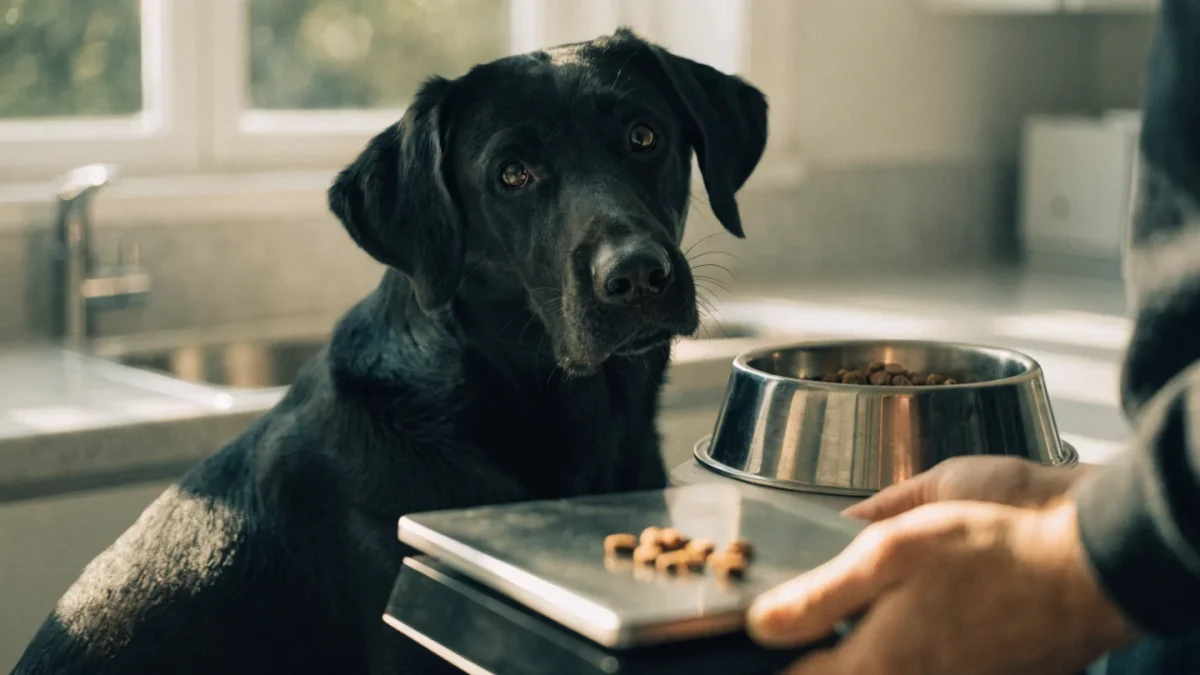
I had a client last year — a retired teacher who was meticulous about everything — come in with her eight-year-old beagle mix, Pickle. Pickle had gained three pounds in six months. That's a lot on a dog who should weigh around 22 pounds. The owner was genuinely baffled. She'd been following the bag guidelines exactly.
I asked her to show me the cup she used. It was a standard coffee mug.
The bag said "2 cups for a 20-25 lb dog." Her mug held about 1.3 cups of kibble by weight. She'd been underfeeding for years and suddenly switched to a different food with a different density. She thought she was still doing 2 cups. She wasn't.
This is actually one of the most common calorie-related conversations I have. Calorie needs are specific and individual. The bag guidelines are a starting point, not a prescription. And "cups" is a terrible unit of measurement for something as important as your dog's daily food intake.
The Math Behind Dog Calorie Needs
Dogs, like all mammals, have a resting energy requirement (RER) — the calories needed just to keep the body functioning at rest: heart beating, organs working, body temperature maintained. The formula commonly used is:
RER (kcal/day) = 70 × (body weight in kg)^0.75
That exponent is the tricky part. It's not linear — a 20 kg dog doesn't need twice the calories of a 10 kg dog. Body surface area (which drives heat loss and metabolic rate) scales differently than body mass. This is why feeding guides based on simple weight often overestimate calories for large dogs and underestimate for small ones.
From RER, you multiply by an activity factor to get daily energy requirement (DER):
- Inactive or sedentary adult, neutered: RER × 1.2–1.4
- Active adult, neutered: RER × 1.6–1.8
- Intact adult: RER × 1.8
- Puppy (4 months–1 year): RER × 2.0–3.0
- Pregnant: RER × 3.0 (late gestation)
- Lactating: RER × 4.0–8.0 depending on litter size (a commonly cited figure from veterinary nutrition references is approximately 4.8× RER for lactating females, scaling upward with larger litters)
- Working or high-performance dog: RER × 2.0–5.0
So for a 10 kg (22 lb) neutered adult dog with moderate activity:
RER = 70 × (10)^0.75 = 70 × 5.62 = approximately 394 kcal/day
DER = 394 × 1.6 = approximately 630 kcal/day
This is a starting estimate, not a guarantee. Individual metabolic rates vary by around 20% even within the same category — veterinary nutrition calculators and clinical nutrition references consistently note this degree of individual variation, driven by genetics, body composition, and subtle differences in activity intensity.
Why Bag Guidelines Often Miss the Mark
Bag feeding guides have a few structural problems.
First, they're usually expressed in volume (cups), not weight. Kibble density varies enormously between formulas — a "cup" of one kibble can differ by 50–100 calories from a "cup" of another. Weighing in grams is the only accurate method.
Second, the guidelines are typically calculated for the upper end of normal activity. Most pet dogs are neutered adults who sleep 12–14 hours a day and take one or two walks. These dogs often need 20–30% less food than the bag suggests.
Third, the guidelines don't account for treats. If your dog gets training treats, dental chews, table scraps, or "just a piece" of your food regularly, those calories add up fast. A standard commercial dental chew for a medium dog can be 60–100 calories. Given twice daily, that's 120–200 extra calories on top of meals.
I always ask clients to track treat calories for one week before we discuss whether a dog's food intake needs adjusting.
The Practical Approach: Body Condition Score
Because all these calculations carry meaningful individual variation, the most reliable method isn't starting with math — it's starting with your dog's body and working backward.
Body condition score (BCS) on a 9-point scale:
Score 1–3: Underweight. Ribs, spine, and hip bones visually prominent. Obvious loss of muscle mass. No fat covering.
Score 4–5: Ideal. Ribs palpable with minimal pressure, not visibly prominent. Waist visible when viewed from above. Slight abdominal tuck.
Score 6–7: Overweight. Ribs difficult to feel. Waist barely visible. Rounding over lumbar area. Abdominal tuck absent.
Score 8–9: Obese. Ribs not palpable under fat deposits. Massive fat deposits over lumbar area and base of tail. Obvious abdominal distension.
Most dogs I see in practice fall between 6 and 7. Most owners think their dog is a 5.
Once you know your dog's BCS, you can calibrate:
- BCS 4–5: maintain current intake
- BCS 6–7: reduce by 10–20%
- BCS 3: increase by 10–20%
- BCS 2 or lower, 8 or higher: veterinary guidance needed
Recheck BCS every 3–4 weeks and adjust as needed. This is more useful than any calculator because it's based on the actual dog in front of you.
Special Cases That Change the Equation
Neutered dogs. Spaying and neutering reduce metabolic rate by roughly 20–30%, and this change can happen within weeks of surgery. A study published in Frontiers in Veterinary Science (2020) documented a significant post-spay reduction in fasting metabolic rate in female dogs, and a comprehensive review in Nutrition Research Reviews (Cambridge) confirmed that caloric intake typically needs to be reduced 25–30% after gonadectomy. This is real and underappreciated. I see many owners who don't reduce food intake after their dog is spayed and then wonder why the dog gained weight over the following year. It's not about the surgery itself — it's the hormonal change affecting metabolism.
Senior dogs. Metabolic rate generally decreases with age, but not uniformly. Some older dogs become couch potatoes and need substantially fewer calories. Others with muscle wasting or hyperthyroidism actually need more. Don't assume a senior dog needs less food without checking BCS.
Very small breeds. Toy and small breeds have higher metabolic rates relative to their body weight and often need more calories per pound than the standard formula suggests. A 4 kg Chihuahua isn't just a scaled-down version of a 40 kg Labrador. Small breeds also tend to live longer and remain active well into old age, which complicates senior calculations.
High-activity dogs. Sled dogs in active racing conditions can burn 10,000–12,000 calories per day — a figure supported by published research, including a study in the Journal of Nutritional Science (Cambridge) that estimated daily energy expenditure of 9,000–13,800 kcal during a 1,000-mile race. That's a different world from a weekend hiking dog — but it illustrates that "active" is a spectrum. A dog who runs with their owner for an hour daily needs meaningfully more food than one who takes two leash walks. The formula accounts for this, but you have to be honest about which category your dog is actually in.
Calories in Common Foods and Treats
Approximate values, which vary by specific product:
- Dry kibble (adult maintenance): 300–400 kcal per 100g (roughly 330–450 kcal per cup)
- Wet/canned food: 80–120 kcal per 100g (approximately 150–250 kcal per standard can)
- Cooked chicken breast, no skin: ~165 kcal per 100g
- Cooked sweet potato: ~90 kcal per 100g
- Standard training treat (pea-sized): 3–8 kcal each
- Dental chew, medium dog size: 60–100 kcal each
- Slice of plain bread: ~70 kcal
These aren't exact — check the specific food's label — but they give a sense of where calories accumulate.
FAQ
Q: My dog is the "right" weight but always seems hungry — am I underfeeding?
Possibly, but more often no. Some dogs are hardwired food-seekers regardless of intake. Beagles, Labradors, and Pugs are notorious examples — they act starving when they're nutritionally fine. If BCS is 4–5 and the dog is otherwise healthy, hunger behavior is usually temperament, not genuine caloric deficit. Puzzle feeders and structured mealtimes help, since they slow eating and add mental engagement.
Q: Can I use an online calorie calculator?
Yes, with the caveat that they all produce estimates. The RER × activity factor formula is the same across reputable tools. The calculation is less important than what you do with it — use it as a starting point, then check BCS regularly and adjust. Don't treat a calculator result as the final word.
Q: Why does my vet want to know what treats I give?
Because treats are often invisible calories. Research shows that table scraps and treats average about 20% of total daily calories in many pet dogs — double the recommended 10% maximum — and that owners consistently underestimate this contribution. A 2024 WSAVA guidance document and UC Davis veterinary nutrition resources both document this gap between owner estimates and actual intake. Knowing the full caloric picture is necessary to give accurate feeding advice. If your dog is gaining weight on what appears to be an appropriate diet, the answer is almost always in the treat column.