

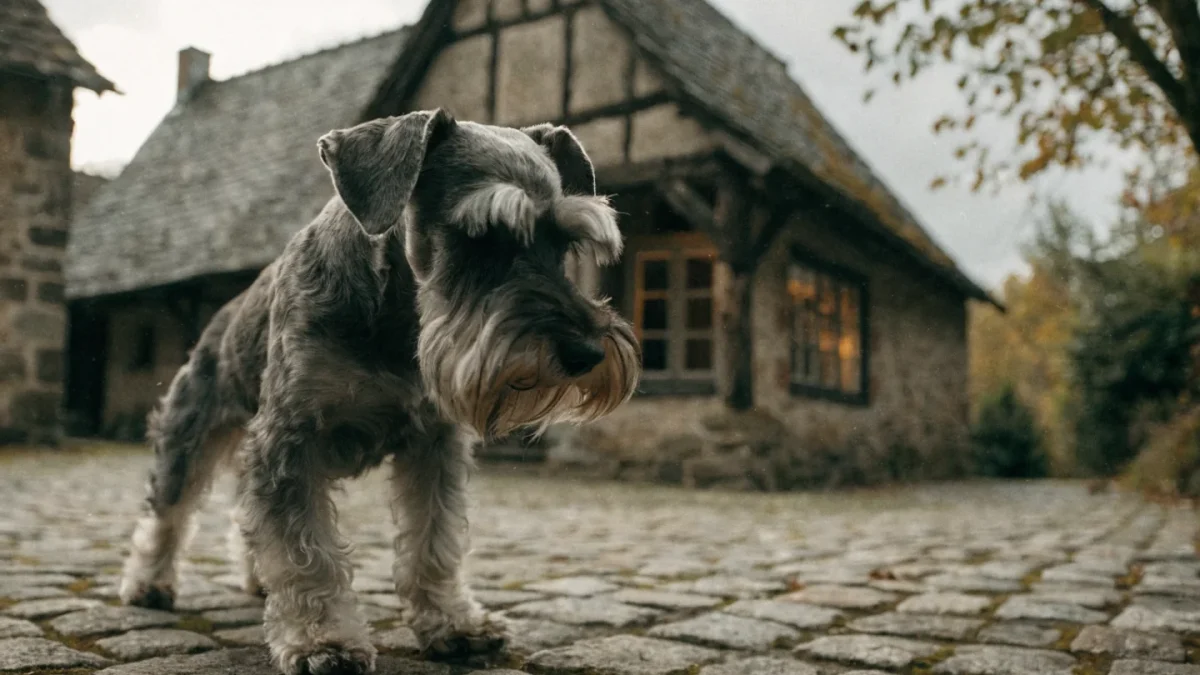
The word "schnauzer" comes from the German Schnauze, meaning snout or muzzle — a reference to the breed's most recognizable feature. But before the miniature schnauzer had a name, it had a job. In the grain barns and livestock pens of 19th-century Bavaria and Wurttemberg, farmers needed a rat-killing dog small enough to work inside tight agricultural spaces where the standard schnauzer couldn't follow. The solution was systematic breeding: take the established schnauzer and scale it down without losing the alertness, courage, or prey drive that made the original useful. For more, see Miniature Schnauzer.
That program, begun in the 1880s and spanning roughly two decades of selective crosses, produced a breed that would eventually outstrip its larger ancestor in popularity worldwide. The miniature schnauzer history origins trace a path from German working farms through European show rings, across the Atlantic to American suburbs, and into a global companion role that the breed's creators almost certainly never envisioned.
The Standard Schnauzer Foundation
Understanding the miniature requires starting with the standard. The standard schnauzer — known in Germany as the Mittelschnauzer — is one of the oldest identifiable German breeds. Depictions of sturdy, bearded dogs matching the schnauzer type appear in artwork from as early as the 15th century. Albrecht Durer included a schnauzer-type dog in his painting The Crown of Thorns (1501), and Lucas Cranach the Elder painted similar dogs in the same period.
By the 18th and 19th centuries, standard schnauzers were ubiquitous on German farms. They served triple duty: ratters in barns and granaries, watchdogs for the homestead, and reliable companions on market journeys where they guarded the farmer's cart and produce. The versatility was the point. German farmers didn't keep dogs for sentiment — every dog on the property earned its keep.
The standard schnauzer's defining traits — the harsh wiry coat, the distinctive beard and eyebrows, the alert and territorial temperament, the strong prey drive — were all functional. The coat resisted weather and vermin bites. The facial furnishings protected the muzzle during close-quarters ratting work. The temperament ensured the dog stayed on task and sounded the alarm when strangers approached.
Why Go Smaller?
The drive to miniaturize wasn't cosmetic. It was practical.
German agricultural buildings of the era included tight grain stores, cramped chicken coops, and narrow spaces between stacked provisions where rats nested. A standard schnauzer at 45 to 50 cm was too large to pursue rats into these confined areas effectively. Farmers needed the same dog — same drive, same coat, same courage — in a body that could work in spaces measuring 30 to 35 cm in diameter.
The alternative was keeping a separate small terrier breed alongside the standard schnauzer, which doubled feeding costs and complicated management. A single smaller schnauzer that could do both the ratting and the guarding work of its larger cousin was the more economical solution. German agricultural pragmatism, not aesthetic preference, drove the miniaturization project.
The Crosses
The miniaturization program centered on crossing standard schnauzers with smaller breeds that contributed size reduction while preserving as many schnauzer characteristics as possible. For more, see Miniature Schnauzer Temperament: Spirited, Smart, and Always On Alert.
The affenpinscher is the most consistently documented cross. These small German dogs — roughly 25 to 30 cm tall — shared the wiry coat texture and had their own strong prey drive. The cross reduced size while maintaining coat type and ratting instinct. The affenpinscher's contribution is visible in some miniature schnauzer traits: the slightly rounder eye, the compact foot structure, and elements of the facial structure.
Historical sources also reference crosses with miniature poodles, though this claim is debated among breed historians. If poodle crosses occurred, they likely contributed intelligence and trainability but may have temporarily softened the coat texture, requiring subsequent selection to restore the characteristic wire coat. Some researchers have suggested that small Pomeranian-type spitz dogs were also involved in early crosses, but documentation is sparse.
The breeding was not done by a single breeder or program. Multiple German breeders across southern Germany were working on size reduction simultaneously, using slightly different approaches and cross-breeds. The lack of centralized coordination in the early years means the exact genetic contributions remain partially unclear — the meticulous studbook-keeping that characterized some other German breed programs was less consistent here.
Formal Recognition
The first miniature schnauzer documented in a German studbook was a black female named Findel, born in 1888. The breed was classified initially as a size variety of the schnauzer rather than a separate breed — a classification that lasted decades in Germany and shaped how the breed was managed.
The Pinscher-Schnauzer Klub (PSK), founded in Germany in 1895, took responsibility for standards and registration for all schnauzer and pinscher breeds. Under the PSK's guidance, the miniature schnauzer was first exhibited as a distinct class at German dog shows in 1899. Early specimens were rougher and more variable than today's dogs — the breed type was still consolidating.
The first breed standard described a compact, sturdy dog with a harsh wire coat, and it emphasized functional traits: alertness, drive, and physical proportions suited to its working role. Cosmetic refinements — the precise head shape, the exaggerated furnishings, the strictly defined color patterns — would come later as the breed moved from farm to show ring.
Crossing the Atlantic
Four miniature schnauzers were imported to the United States in 1924. The breed's trajectory in North America diverged almost immediately from its German course. American breeders embraced the miniature schnauzer as a companion and show dog rather than a working ratter. The breeding emphasis shifted toward consistent appearance, refined temperament, and the dramatic facial furnishings that would become the breed's visual trademark.
The American Miniature Schnauzer Club was formed in 1933, and the breed was placed in the Terrier Group — a classification that acknowledged its ratting heritage and terrier-like temperament. In Germany and much of Europe, the breed remained grouped with pinschers and schnauzers rather than terriers, reflecting different perspectives on the breed's identity.
American breeding programs refined the breed's appearance significantly through the mid-20th century. The salt-and-pepper color became dominant, heads became more rectangular, and the grooming style — particularly the arching eyebrows and sculpted beard — became increasingly stylized. Show grooming transformed the miniature schnauzer's visual identity from scruffy farm dog to the polished, distinctive silhouette recognized worldwide today.
The Population Boom
Between the 1950s and 1970s, the miniature schnauzer's popularity exploded in the United States. Several factors converged: the breed's manageable size suited the postwar suburban lifestyle, its low-shedding coat appealed to house-proud families, and its distinctive appearance made it visually memorable in a crowded field of companion breeds.
By the mid-1970s, the miniature schnauzer had become one of the most popular breeds in the United States, consistently ranking in the AKC's top ten registrations. This surge in demand had consequences. Breeding volume increased dramatically, and not all breeders maintained health-testing standards. The genetic bottleneck that accompanies any rapid population expansion from a limited gene pool contributed to the breed-specific health predispositions — pancreatitis, urinary stones, eye conditions — that define the breed's health profile today.
The Breed Today
The miniature schnauzer now outnumbers both the standard and giant schnauzer by a wide margin in virtually every country where registration statistics are published. What began as a German farmer's practical solution to a rat problem has become a global companion breed found on every inhabited continent.
The working ratting role is essentially extinct. Some miniature schnauzers participate in earthdog and barn hunt competitions — organized sports that simulate the breed's original function in controlled, humane conditions — but these are recreational activities, not employment. The breed's alertness, vocal nature, and prey drive remain, detached from the context that created them and channeled into companion-dog life with varying degrees of success.
The gap between the 1888 barn ratter and the 2026 apartment companion is enormous in practical terms but surprisingly small in temperament. Spend a few minutes watching a miniature schnauzer fixate on a squirrel, announce a delivery truck, or patrol the perimeter of a backyard with dead-serious intensity, and you're watching the same behavioral program that served German farmers over a century ago. The job disappeared. The dog didn't change.