

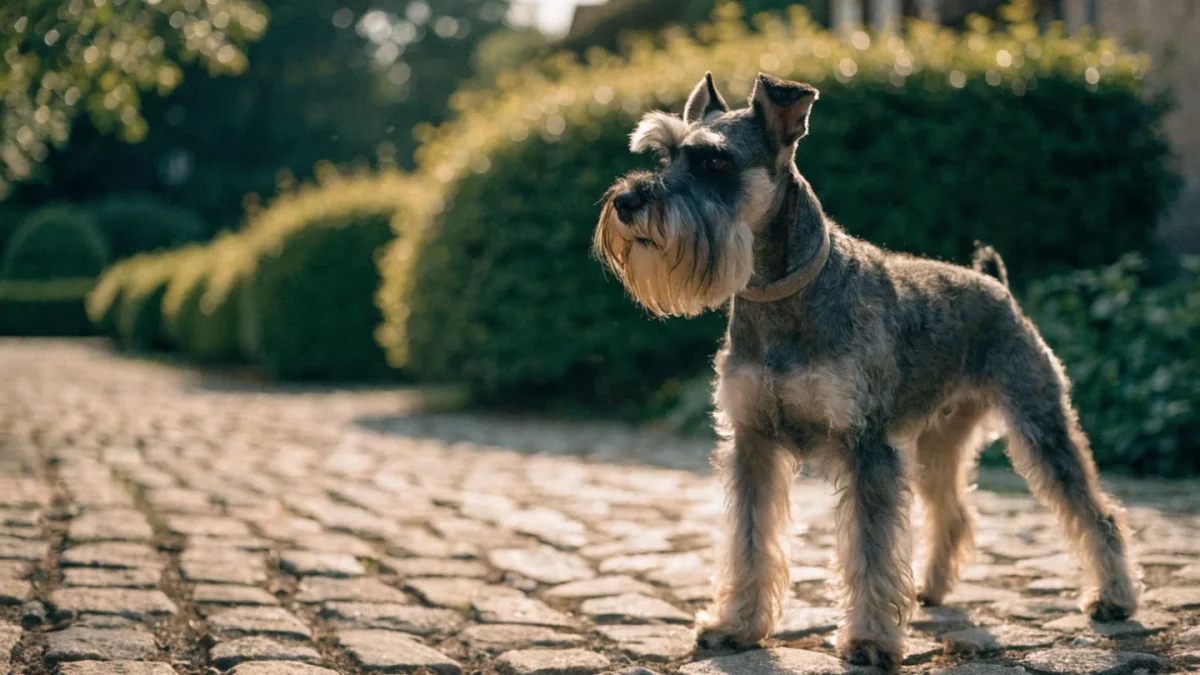
The miniature schnauzer was never supposed to exist. In the 1880s, German farmers needed a smaller version of the standard schnauzer — a dog compact enough to work in tight barn spaces and cheap enough to feed on a farmhand's budget, but still tough enough to kill rats. So they crossed their standard schnauzers with affenpinschers and possibly miniature poodles, and within two decades they had a new breed that would eventually become the most popular schnauzer variety worldwide by a factor of roughly ten to one.
That origin story matters because it explains nearly everything about the miniature schnauzer breed guide essentials: why the breed is so relentlessly alert, why it has opinions about everything that moves, and why a 6 kg dog carries itself with the confidence of something three times its size. The miniature schnauzer is a working ratter that ended up in apartments, and its behavioral wiring never got the memo.
This guide covers origins, temperament, health, grooming, exercise, nutrition, and honest lifestyle fit. If you've been told miniature schnauzers are "easy small dogs," I'd like to correct that before you make a fifteen-year commitment.
Origins and History
The German Farm Dog Foundation
The standard schnauzer — the original — has been documented in German art and records since at least the 15th century. Lucas Cranach the Elder included unmistakable schnauzer-type dogs in paintings dated 1501. These were versatile farm dogs: ratters, guard dogs, and livestock drivers rolled into one wiry-coated package.
By the mid-19th century, German breeders were deliberately miniaturizing the standard schnauzer to create a more efficient barnyard ratter. The standard schnauzer stands 45 to 50 cm at the shoulder — effective, but too large for work inside grain stores, chicken coops, and tight agricultural buildings where rats nested. Smaller dogs could follow rodents into spaces the standard couldn't reach.
The breeding program combined standard schnauzers with affenpinschers — another small German breed with a wiry coat and strong prey drive. Some historical sources suggest miniature poodle crosses were involved as well, though documentation from this period is incomplete and the claim remains debated among breed historians. The goal wasn't companionship. It was a purpose-built pest control tool with the schnauzer's alertness, courage, and weather-resistant coat in a package under 36 cm tall.
Recognition and Spread
The first recorded miniature schnauzer appeared in a German studbook in 1888. The breed was exhibited as a distinct variety at dog shows beginning in 1899. The Pinscher-Schnauzer Klub in Germany, founded in 1895, managed breed standards for all three schnauzer sizes.
Miniature schnauzers arrived in the United States in 1924 when four dogs were imported from Germany. The breed gained momentum quickly. By the mid-20th century, it had separated dramatically from its German farm-dog roots to become one of the most popular companion breeds in North America. The shift from working ratter to household companion happened within roughly 50 years — fast, by breed-development standards.
Today, the miniature schnauzer consistently ranks among the 20 most registered breeds in many countries. It belongs to the Terrier Group in some registrations and the Utility or Companion group in others — a classification disagreement that reflects the breed's dual identity as both a working terrier and a companion dog.
Physical Characteristics
Size and Build
Males stand 33 to 36 cm at the shoulder. Females are slightly smaller, typically 30 to 34 cm. Weight ranges from 5 to 9 kg for both sexes, with most well-conditioned adults falling between 6 and 8 kg. The body is nearly square — the length from breastbone to buttock approximately equals the height at the withers.
The build is sturdy for the size. This is not a fragile toy breed. The bone is moderate, the chest is reasonably deep, and the overall impression is a compact, solid dog. Miniature schnauzers are surprisingly heavy when you pick them up — denser than they look.
The Distinctive Head
The head is what makes the breed instantly recognizable. Rectangular and elongated, with a flat skull, strong muzzle, and the breed's signature furnishings: prominent bushy eyebrows that arch over dark, deep-set eyes, a thick mustache, and a full beard. Those furnishings aren't cosmetic accidents — they developed as protection for the face during ratting work, shielding the eyes and muzzle from bites.
The ears are set high and may be naturally folded (V-shaped, dropping forward) or cropped erect depending on regional regulations and traditions. Ear cropping is banned in many countries and increasingly uncommon even where still legal.
Coat
The double coat consists of a wiry, harsh outer coat and a dense, soft undercoat. The texture of a properly maintained miniature schnauzer coat feels almost bristly — stiff and close-lying, not fluffy or silky. This coat was designed for outdoor work in German winters and provides decent weather resistance.
Recognized coat colors vary by registry but generally include salt and pepper, black and silver, solid black, and white. Salt and pepper is by far the most common — it's the color most people picture when they think of the breed. The banding pattern on individual hairs creates the characteristic grizzled appearance.
The coat sheds very little. This is one of the breed's most significant practical advantages and a major reason for its popularity in households where shedding is a concern. However, "low-shedding" does not mean "low-maintenance." The grooming demands are substantial — more on that below.
Temperament and Behavior
If the Labrador Retriever is the friend who gets along with everyone at the party, the miniature schnauzer is the friend who gets along with everyone but also has strong opinions about the music, the food, and who should not have been invited. These are dogs with personality in abundance — alert, vocal, opinionated, and deeply engaged with everything happening in their environment.
What Most People Get Wrong About This Breed
The most common misconception is that miniature schnauzers are calm, quiet small dogs suited to passive lifestyles. They are not. This is a terrier temperament in a companion-sized package. Miniature schnauzers are reactive, alert to environmental changes, and vocal about things they find interesting, suspicious, or simply noteworthy — which is most things.
The second misconception is that their small size means small exercise and stimulation needs. A bored miniature schnauzer is a destructive, barky, anxious miniature schnauzer. The breed's intelligence demands engagement. They learn fast, which means they learn bad habits exactly as quickly as good ones.
Social Dynamics
Miniature schnauzers bond intensely with their families. They're affectionate, often to the point of following their person from room to room, and they don't handle long periods of isolation well. Separation anxiety is a real concern in the breed — not universal, but common enough to plan for.
With strangers, the typical miniature schnauzer is reserved and watchful. They warm up once they've assessed the situation, but the initial response is usually vigilance rather than enthusiasm. This makes them surprisingly effective alert dogs — they will absolutely tell you when someone is at the door. And when someone walks past the door. And when a leaf moves in the yard.
With other dogs, temperament varies considerably by individual. Some miniature schnauzers are sociable and playful. Others are selective or assertive, particularly intact males. Early socialization makes a significant difference. The breed's terrier heritage means they don't always back down from confrontation, even with much larger dogs — a trait that can create dangerous situations if not managed.
With children, miniature schnauzers are generally good when raised together. They're sturdy enough to handle moderate play and patient with familiar kids. However, they may not tolerate rough handling from unfamiliar children, and their reactivity means sudden movements and loud noises from small children can trigger barking.
Prey Drive
The ratting heritage shows up in a persistent prey drive toward small animals. Squirrels, rabbits, mice, and sometimes cats will trigger chase instincts. This is hardwired behavior, not a training failure. If you have pet rodents, birds, or similar small animals, management and separation are essential — you cannot train out centuries of selective breeding.
Vocal Nature
Miniature schnauzers bark. A lot. They bark at doorbells, visitors, passing dogs, unusual sounds, and sometimes at nothing identifiable. This vocal tendency is one of the most common reasons owners seek behavioral help and one of the most frequent complaints in apartment living. It's manageable with consistent work, but it never fully disappears. If barking is something you cannot tolerate, this breed is a poor choice.
Health Profile
Miniature schnauzers are generally robust dogs with a solid lifespan, but the breed carries several specific health predispositions that prospective owners need to understand.
Lifespan
The average miniature schnauzer lives 12 to 15 years, with many individuals reaching 14 or beyond with appropriate care. This is notably longer than the average for dogs of similar size and significantly longer than most breeds in the terrier group. The breed's longevity is one of its genuine strengths.
Pancreatitis
Miniature schnauzers have a well-documented predisposition to pancreatitis — inflammation of the pancreas — linked to the breed's tendency toward hyperlipidemia (elevated blood fat levels). Studies have identified miniature schnauzers as having three to five times the risk of pancreatitis compared to mixed-breed dogs, with multiple veterinary publications confirming the breed's predisposition linked to its tendency toward hyperlipidemia. This condition can range from mild to life-threatening and is directly influenced by diet. High-fat foods are a significant trigger.
This predisposition to hyperlipidemia is one of the breed's most important health considerations. Routine blood panels should include lipid levels, and dietary fat content needs monitoring throughout the dog's life.
Urinary Stones
The breed has an elevated incidence of calcium oxalate and struvite urinary stones. Miniature schnauzers are among the breeds most commonly affected by urolithiasis. Adequate water intake, appropriate diet, and regular veterinary monitoring reduce risk but don't eliminate it. Symptoms include frequent urination, straining, blood in urine, and signs of discomfort.
Eye Conditions
Several eye conditions appear at higher rates in the breed:
- Cataracts: Both juvenile and senile forms occur. Juvenile cataracts can appear in dogs as young as six months. Genetic testing can identify some forms.
- Progressive retinal atrophy (PRA): A group of inherited diseases causing gradual vision loss. DNA testing is available for the type most common in miniature schnauzers.
- Retinal dysplasia: Abnormal development of the retina, ranging from mild folds to complete retinal detachment.
Mycobacterium avium Complex (MAC) Infection
Miniature schnauzers have a documented breed-specific susceptibility to MAC, a type of bacterial infection that most dogs' immune systems handle without issue. In miniature schnauzers, an immune deficiency allows these normally harmless bacteria to cause serious systemic disease. This is rare but worth knowing about, especially because early detection improves outcomes.
Other Health Concerns
- Comedone syndrome (Schnauzer bumps): A skin condition unique to the breed causing blackheads and crusty bumps along the back. Not dangerous but requires management.
- Liver shunts (portosystemic shunts): Congenital abnormalities of blood vessels around the liver. More common in miniature schnauzers than most breeds.
- Dental disease: The small jaw creates crowding that accelerates tartar buildup and periodontal disease. Regular dental care is essential.
- Von Willebrand's disease: A blood clotting disorder. Type 1, the mildest form, occurs in the breed. DNA testing identifies carriers.
Grooming Requirements
Grooming a miniature schnauzer is not optional, and it's not simple. The wiry double coat requires specific maintenance techniques that differ significantly from most other breeds.
Hand-Stripping vs. Clipping
The traditional grooming method for miniature schnauzers is hand-stripping — manually pulling out dead outer coat hairs to allow new growth. This preserves the coat's correct wiry texture, color vibrancy, and weather resistance. It's labor-intensive, requiring skill and patience, and typically done every four to six months.
Most pet miniature schnauzers are clipped instead, which is faster and less expensive. However, repeated clipping gradually changes the coat texture — it becomes softer, duller in color, and loses some of its weather-resistant quality. This is a cosmetic and functional trade-off that most pet owners find acceptable.
Regardless of method, professional grooming every six to eight weeks is standard. Between professional sessions, the beard, legs, and body coat need regular home maintenance.
The Beard and Furnishings
The breed's facial furnishings — eyebrows, mustache, and beard — require daily attention. The beard gets wet during drinking and traps food debris. Without regular cleaning and combing, it mats, stains, and develops odor. A quick wipe after meals and a thorough comb-through daily keeps the furnishings in condition. Many owners find that a small towel near the water bowl becomes a permanent fixture.
The leg furnishings mat easily, especially in the armpits and behind the elbows. Regular combing with a steel comb prevents matting. Once mats set in wiry furnishing hair, they're difficult to remove without cutting.
Routine Maintenance
- Brushing: Two to three times per week minimum for the body coat. Daily for furnishings.
- Bathing: Every three to four weeks, using shampoo appropriate for wiry coats. Overbathing softens the coat.
- Ear cleaning: Weekly. The ear canal hair should be plucked or trimmed regularly to maintain airflow — schnauzer ears are prone to infections when hair blocks the canal.
- Nail trimming: Every two to three weeks. Dark nails are standard in the breed, making it harder to identify the quick.
- Dental care: Several times per week. The breed's dental crowding demands consistent attention.
Exercise and Activity Needs
Miniature schnauzers need 45 to 60 minutes of daily exercise — more than most people expect from a small breed. These are active, athletic dogs that maintain their energy well into middle age and beyond.
Activity Types
The breed excels at activities that combine physical exertion with mental engagement. Fetch, interactive play, structured walks with sniffing opportunities, and puzzle-based activities all work well. Miniature schnauzers are strong candidates for organized canine sports — agility, rally obedience, and earthdog trials tap directly into the breed's natural drive and intelligence.
Walks should include genuine exploratory time. A miniature schnauzer on a strictly controlled, no-sniffing walk is a frustrated miniature schnauzer. Their prey drive and environmental awareness mean they want to investigate — let them, within reason.
What Happens Without Enough Exercise
An under-exercised miniature schnauzer escalates quickly. Excessive barking, destructive chewing, digging, attention-seeking behaviors, and hyperreactivity to stimuli all increase dramatically when the breed doesn't get adequate physical and mental outlet. The connection between exercise deficit and problem behavior in this breed is about as direct as it gets.
Nutrition Fundamentals
Feeding a miniature schnauzer requires more thought than feeding most breeds, specifically because of the hyperlipidemia and pancreatitis risks discussed in the health section.
Dietary Approach
Low-to-moderate fat diets are generally recommended for the breed. This is not a universal requirement — individual dogs vary — but as a population, miniature schnauzers benefit from dietary fat monitoring more than most breeds. Table scraps, high-fat treats, and rich food should be avoided as a matter of routine prevention.
An average adult miniature schnauzer at healthy weight needs approximately 400 to 600 calories per day depending on activity level, age, and metabolism. Measured meals (two per day for adults) are strongly preferable to free-feeding, both for weight management and for monitoring intake.
Weight Management
The breed's compact build means small weight gains are proportionally significant. An extra kilogram on a 7 kg dog is the equivalent of roughly 10 kg on a 70 kg person. Monitor body condition regularly — you should feel ribs easily without pressing, see a defined waist from above, and observe an abdominal tuck from the side.
Living Situation Compatibility
Miniature schnauzers adapt well to various living situations, including apartments, provided their exercise and stimulation needs are met. Their small size and minimal shedding make them practical indoor dogs.
The primary compatibility concern is noise. The breed's vocal nature can create conflict in shared-wall living situations. If you live in an apartment building with thin walls and noise-sensitive neighbors, a miniature schnauzer's alert barking may become a significant problem.
Climate
The wiry double coat provides reasonable protection in cool weather. In extreme cold, the breed's small size means heat loss is relatively fast — short-haired schnauzer clips in winter may necessitate a coat for outdoor time. In hot weather, the breed handles heat better than many double-coated breeds, but exercise should still be adjusted during peak temperatures.
Multi-Pet Households
The prey drive toward small animals is the primary concern. Miniature schnauzers can coexist well with cats when raised together, but the introduction process needs to be careful and supervised. Small caged pets — hamsters, gerbils, birds — should be permanently secured and kept in separate spaces. The ratter instinct is not something socialization overrides.
With other dogs, compatibility depends heavily on individual temperament, sex combinations, and socialization history. Many miniature schnauzers live happily in multi-dog homes. Others, particularly same-sex pairs, may develop conflict.
The Right Owner for This Breed
A miniature schnauzer is the right dog for you if:
- You want an engaged, interactive companion that participates in household life with opinions and enthusiasm
- You can commit to professional grooming every six to eight weeks and daily facial-hair maintenance
- You're comfortable with — or can manage — a vocal breed that barks at stimuli
- You provide 45 to 60 minutes of daily exercise combining physical and mental activity
- You're home enough that the dog isn't isolated for long stretches
- You can monitor dietary fat intake and maintain regular veterinary blood panels
- You appreciate a dog with a strong personality rather than a passive, easygoing temperament
A miniature schnauzer is the wrong dog for you if:
- You want a quiet, low-energy small dog that lounges most of the day
- Barking is something you genuinely cannot tolerate
- You have small free-roaming pets like hamsters, birds, or rabbits
- You travel frequently and the dog would be left with sitters for long periods
- Grooming maintenance feels like an unreasonable ongoing commitment
- You want a dog that's instantly friendly with every person and animal it encounters
The miniature schnauzer gives you a lot of dog in a small frame. That's either exactly what you want or a source of constant surprise. Knowing which category you fall into before you bring one home is the difference between fifteen years of genuine partnership and fifteen years of mutual frustration.
Frequently Asked Questions
Do miniature schnauzers shed?
Miniature schnauzers shed very little compared to most breeds. The wiry double coat holds dead hair rather than dropping it, which is why regular grooming — either hand-stripping or clipping — is necessary to remove that dead coat manually. People with dog-related allergies often tolerate miniature schnauzers better than heavy-shedding breeds, but no dog breed is truly allergen-free. The reduced shedding is a significant practical advantage for keeping a clean home.
How long do miniature schnauzers live?
The average lifespan is 12 to 15 years, with many healthy individuals reaching 14 or beyond. This puts the miniature schnauzer among the longer-lived breeds, even compared to other dogs of similar size. Longevity depends on genetics, diet (particularly managing the breed's hyperlipidemia tendency), regular veterinary care, dental health, and maintaining appropriate weight throughout the dog's life.
Are miniature schnauzers good apartment dogs?
They can be, with caveats. Their small size and minimal shedding are apartment-friendly qualities. The primary challenge is barking — miniature schnauzers are alert dogs that vocalize at environmental stimuli, which creates problems in shared-wall living. If you live in an apartment, consistent work on bark management and adequate daily exercise to reduce reactivity are essential. A bored, under-exercised miniature schnauzer in an apartment is a noise complaint waiting to happen.
What is the difference between miniature, standard, and giant schnauzers?
The three schnauzer breeds share a common ancestor — the standard schnauzer — but they are distinct breeds, not size varieties of a single breed. The miniature (30 to 36 cm) was bred down for ratting work, the standard (45 to 50 cm) is the original farm and guard dog, and the giant (60 to 70 cm) was bred up for cattle driving and guarding. Temperaments differ: miniatures tend to be more vocal and reactive, standards are more balanced and versatile, and giants are more reserved with stronger guarding instincts. Health profiles also differ significantly across the three breeds.
Why does my miniature schnauzer bark so much?
Barking is a breed characteristic, not a behavioral defect. Miniature schnauzers were bred as alert farm dogs, and they retain that vigilance. They bark at strangers, unusual sounds, environmental changes, other animals, and sometimes at things only they can detect. While consistent training can reduce barking and teach a "quiet" cue, expecting a silent miniature schnauzer is unrealistic. Adequate exercise and mental stimulation reduce excessive barking by lowering overall arousal levels, but the breed will always be more vocal than average.