

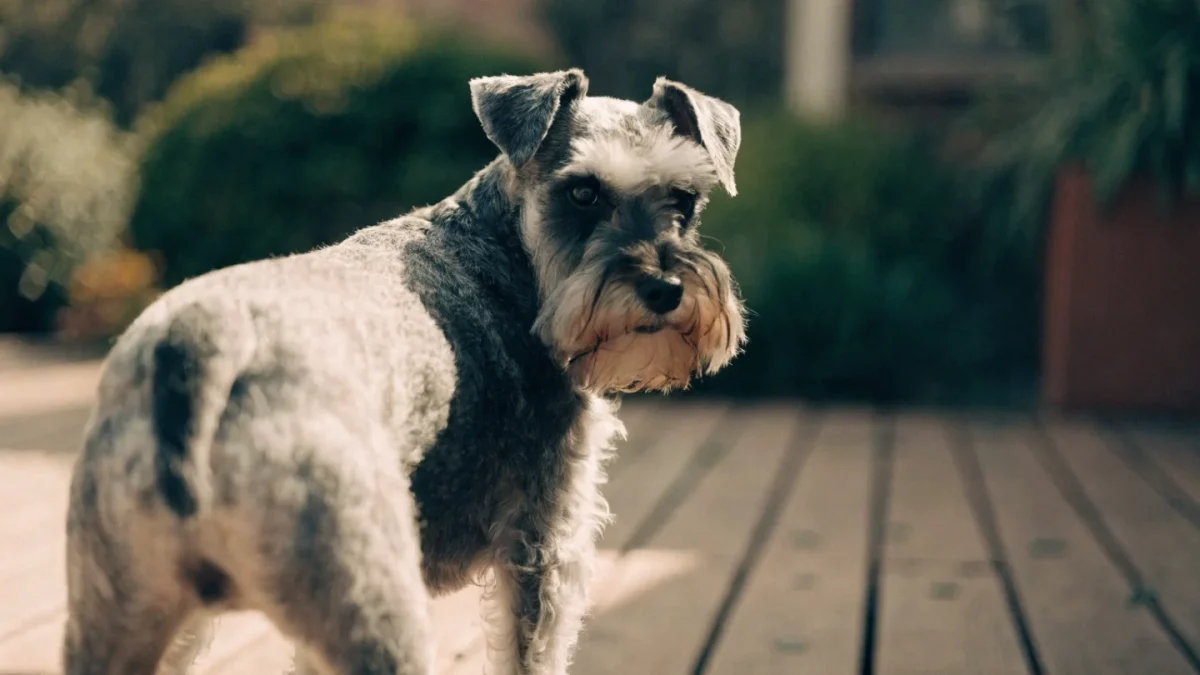
I met my first miniature schnauzer at a regional show outside Columbus — a salt-and-pepper male named Otto who spent most of the morning at the end of his leash, monitoring the show grounds with the sustained attention of an air traffic controller. Every handler, every dog, every cart that rattled past got evaluated. Then he turned around, put his front paws on my knees, looked directly at me, and began what I can only describe as a conversation. His owner laughed. "He does that with everyone," she said. "He wants you to know he's noticed you. For more, see Miniature Schnauzer."
That encounter stuck because it was so immediately legible: this dog was entirely invested in what was happening around it. Not anxious, not aggressive — just intensely present and convinced that its attention and opinions were relevant. That's miniature schnauzer temperament personality in miniature. The breed did not shed its working identity when it moved from German farm to city apartment. It just found new things to manage.
The Alert System That Never Switches Off
Every miniature schnauzer owner discovers this trait within the first week: the dog notices everything. A delivery truck three houses away. A neighbor closing a car door. A bird landing on the fence. A shift in wind that carries a new scent. Each of these events gets processed, evaluated, and — in the miniature schnauzer's operating logic — reported.
This alertness is not anxiety, though it can shade into anxiety if not managed. It's the bred-in vigilance of a farm dog whose job included sounding the alarm for anything unusual. Standard schnauzers guarded German farms for centuries, and the miniature inherited that watchdog wiring even as the job description changed to couch companion. The hardware is still running the old software.
The practical consequence is barking. Miniature schnauzers bark with purpose and persistence. They have a range of vocalizations — a sharp alert bark, a lower warning tone, an excited rapid-fire sequence during play, and a sustained protest bark when they feel ignored. Some owners describe their miniature schnauzer as "narrating" the day's events. It's an accurate description.
Bonding Intensity
Where many small breeds spread their affection broadly, the miniature schnauzer tends to concentrate its attachment. Most bond strongly to one or two people in the household and orient their attention and loyalty around those individuals. They're affectionate with the whole family, but there's usually a clear hierarchy of preference.
This bonding intensity has a shadow side: separation difficulty. The breed does not handle isolation gracefully. A miniature schnauzer left alone for extended periods may bark continuously, destroy household items, refuse food, or develop repetitive behaviors. This isn't manipulation — it's genuine distress from a breed whose social wiring demands proximity to its people.
The trait varies by individual. Some miniature schnauzers manage moderate alone time without issue, especially with gradual conditioning and environmental enrichment. Others struggle significantly from puppyhood. If your lifestyle involves regular 8- to 10-hour absences with no one home, this breed will likely develop problems.
Intelligence and Problem-Solving
Miniature schnauzers are smart in a particular way — not the eager-to-please intelligence of a retriever, but the independent, evaluative intelligence of a terrier. They learn commands quickly. They also assess whether following those commands serves their interests at any given moment. For more, see History of the Miniature Schnauzer: German Farm Dogs Scaled Down.
This creates a temperament that's simultaneously highly trainable and occasionally defiant. A miniature schnauzer that knows "come" perfectly well may choose to ignore it because the squirrel it spotted is more interesting than whatever you're offering. This isn't stubbornness in the sense of inability — it's stubbornness in the sense of prioritization. The dog understood the command. It made a different choice.
Training a miniature schnauzer successfully requires making compliance more rewarding than the alternatives. They respond well to food rewards, play, and genuine enthusiasm from their handler. They respond poorly to repetition without variation — the breed gets bored with drills and starts freelancing.
With Other Dogs
The miniature schnauzer's social dynamics with other dogs are less predictable than many breeds. Some are gregarious and playful. Others are reserved or confrontational. A common pattern is a dog that's selectively social — friendly with familiar dogs, cautious or assertive with unfamiliar ones.
The breed has a documented tendency to escalate interactions with dogs much larger than itself. Whether this stems from confidence, perceived threat, or simple lack of size awareness is debatable, but the behavior pattern is consistent enough to be a breed characteristic. A 7 kg miniature schnauzer that picks a fight with a 35 kg dog is a veterinary emergency waiting to happen. Off-leash dog parks require careful evaluation of your individual dog's social style.
Same-sex pairs sometimes develop rivalry, particularly between intact males. This isn't universal, but it's common enough that multi-dog households should plan introductions carefully and monitor dynamics ongoing.
With Children
Miniature schnauzers generally do well with children in their own household. They're robust enough for moderate play — unlike many toy breeds, they don't break easily — and they often develop strong bonds with kids who interact with them regularly. The breed's playful energy matches well with school-age children who can participate in games and activities.
The caution is around toddlers and unfamiliar children. Miniature schnauzers are reactive to sudden movements and loud sounds, and young children produce both in abundance. A startled miniature schnauzer may snap or bark defensively. Supervision is necessary, and children should learn that the dog's personal space — especially during rest, eating, or chewing — needs respecting.
The Prey Drive Question
Beneath the companion exterior, the ratting instinct runs deep. Miniature schnauzers react to small, fast-moving animals with focused intensity. Squirrels, rabbits, chipmunks, mice — anything that triggers the chase-catch sequence will override recall, manners, and common sense simultaneously.
Indoors, this translates to alertness toward small caged pets and a tendency to stalk, fixate, and attempt to access them. Coexistence with pet rodents, birds, or ferrets requires physical separation. The prey drive is not a behavioral issue to be corrected — it's core breed function, written into generations of selection. Expecting a miniature schnauzer to peacefully coexist with a loose hamster is expecting it to suppress what it was specifically created to do.
With cats, outcomes vary. Many miniature schnauzers raised with cats from puppyhood develop genuine companionship. But the introduction matters, the individual dog's drive level matters, and the cat's confidence matters. A running cat activates the chase sequence in almost any miniature schnauzer, socialized or not.
The Comparison No One Asks For
People choosing between small companion breeds often compare miniature schnauzers with breeds like the shih tzu, cavalier King Charles spaniel, or bichon frise. These are fundamentally different dogs wearing a similar size tag.
The miniature schnauzer is a terrier at heart — driven, reactive, and opinionated. The cavalier is a spaniel — gentle, people-soft, and adaptable. The shih tzu is a palace companion breed — independent but not driven, stubborn but not reactive. Choosing a miniature schnauzer because you want "a small dog" without accounting for the terrier temperament is how people end up surprised and overwhelmed.
If you want a small dog that alerts you to everything, accompanies you everywhere, challenges you mentally, and fills your home with personality and volume — the miniature schnauzer temperament delivers that in spades. If you want quiet, easygoing, and predictable, look elsewhere with no apology needed. Breed fit isn't about better or worse. It's about match.