
The first time I introduced nose work to a reactive border collie mix that had failed at agility, I wasn't sure it would take. She was too stressed in class environments, too focused on other dogs, too easily overwhelmed.
She found her first hide in forty seconds. Then another in thirty. She didn't look at the other dog in the room once. She was too busy working.
That's the thing about nose work. It's not just enrichment — it's a state-changer. A dog hunting a hide is a dog that is completely in their own world, running on instinct, doing what dogs evolved to do.
Why Nose Work Works for Every Dog
A dog's nose is estimated to be 10,000 to 100,000 times more sensitive than a human's, depending on the breed — a range confirmed by researchers at PBS NOVA and supported by olfactory receptor counts: dogs have 125 to 300 million olfactory receptor cells compared to approximately 6 million in humans (Canine Olfaction: Physiology, Behavior, and Possibilities for Practical Applications, PMC 2021). Scent detection isn't a trained behavior so much as it's an innate capability given a job.
This makes nose work accessible to:
- High-energy dogs that can't settle (it burns mental fuel fast)
- Anxious dogs (sniffing activates the parasympathetic nervous system — it's self-calming)
- Senior dogs with physical limitations (low-impact, high cognitive engagement)
- Reactive dogs (the search behavior competes with reactivity)
- Puppies (appropriate scent games from early age)
- Dogs that aren't very food or toy motivated in other contexts (sniffing is usually intrinsically rewarding)
Why sniffing matters for dogs goes deeper than entertainment — it's a fundamental behavioral need.
Phase 1: Building Search Drive with Food Hides
Before introducing a formal target odor, build the dog's confidence as a searcher using food.
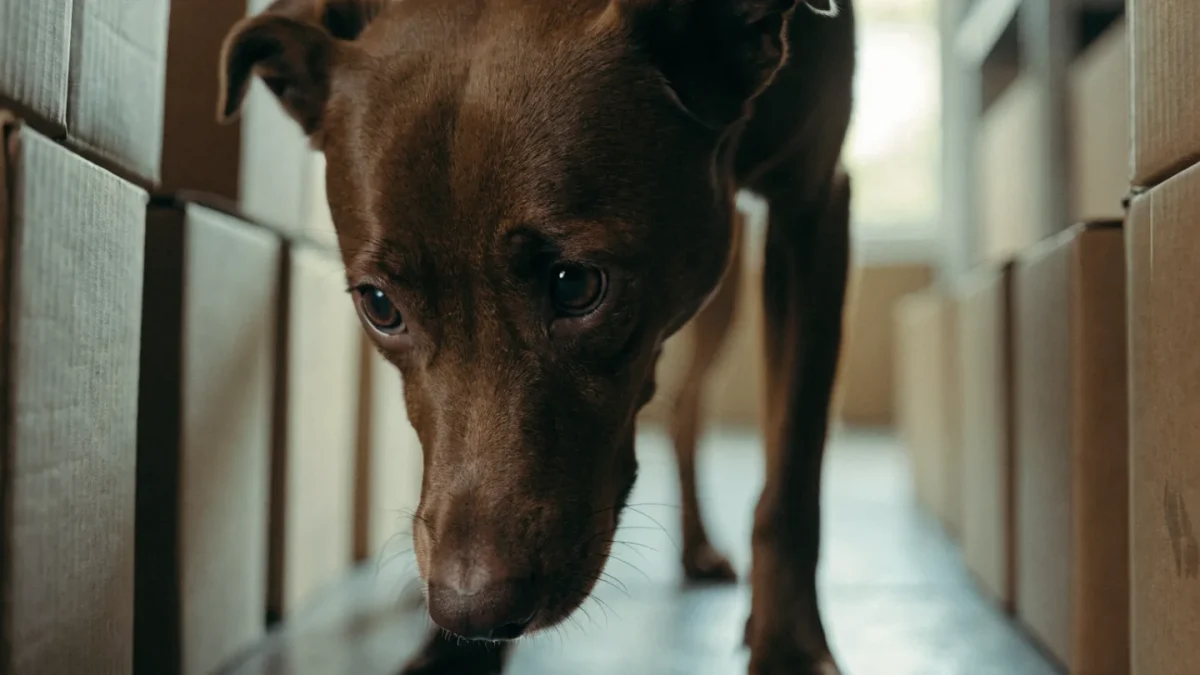
Equipment: 5-10 identical small containers — cardboard boxes, tin cans with lids, plastic boxes. Use the same type each session initially.
Session 1:
- Place 5 boxes in a line on the floor
- Put a small piece of high-value food in ONE box
- Bring your dog in on leash and let them investigate
- The moment their nose goes into or around the correct box: mark (click or "yes") and drop additional treats into the box
- Remove the dog, reload, repeat 5 times
The dog isn't being told to search — they're discovering that sniffing the boxes produces rewards. Within a few sessions, most dogs are actively and enthusiastically searching every box.
Session 2-5:
- Increase the number of boxes (up to 12-15)
- Make the hide less obvious — close the box lid with a crack, or put the food under a folded cloth inside the box
- Start varying which box has the hide so there's no pattern
Phase 2: Introducing a Target Odor
This is where nose work becomes a formal scent sport. The target odors used in organized nose work, as specified by the National Association of Canine Scent Work (NACSW), are three essential oils — Sweet Birch (Betula lenta), Aniseed (Pimpinella anisum), and Clove Bud (Eugenia caryophyllata) — chosen because they're distinct and not common in everyday environments.
Pairing the odor with food:
- Place a few drops of birch oil on a Q-tip
- Put the Q-tip in a small tin or vented container
- Put that container inside the box with the food initially
- Over 10-15 sessions, the dog learns: odor predicts food
Transitioning off food in the box:
- Gradually remove the food from the box, keeping only the odor vessel
- The dog alerts on the odor and you reward from your hand when they indicate
- This is called a "trained final response" — the dog pauses, stares at, paws, or sits at the hide and you pay them there
Phase 3: Expanding Search Areas
Once the dog is finding a single odor hide reliably in a box array, move to:
Interior searches: Hide the odor in various locations within a room — inside furniture, under items, at different heights. The dog learns to search systematically.
Exterior searches: Outdoor areas add weather (wind, humidity), different surface odors, and unpredictable hide placement. More challenging, and most dogs love it.
Vehicle searches: Searching a car's exterior and wheel wells. A natural area for dogs to work given the complexity of smells.
Container searches: A formalized box array, usually in a competition context.
Reading Your Dog During a Search
Dogs communicate their search through body language. Learning to read it makes you a better nose work handler.
Change of behavior (COB): A shift in how the dog moves — head snap, change in body tension, sudden focus in one direction. This is the dog hitting odor. Follow it.
Head up vs. head down: Head up often means the odor is floating (in air, coming from above). Head down means it's near the ground. Follow the nose.
Looping and circling: The dog is working a scent cone — getting closer, losing it, circling back. Don't interrupt this. Let them work.
Freeze or stare: Some dogs stop moving and stare at the hide location. This is their alert. Reward immediately.
Building confidence in anxious dogs through searching is one of nose work's most consistent benefits — the searching state is incompatible with panic.
Getting Competitive
Formal nose work organizations offer titling trials where dogs progress through levels of increasing complexity. It's a non-threatening sport for most dogs because they work one at a time — no direct competition, no other dogs in the search area. Many handlers find it deeply satisfying because it's entirely your dog's skill being displayed, not athleticism or handler precision.
FAQ
Do I need any special equipment to start nose work at home?
No special equipment required to begin. Cardboard boxes and kibble are enough to build search drive. You'll eventually want a target odor kit if you plan to pursue formal nose work, but that comes after the foundational work.
My dog doesn't seem interested in the boxes. What do I do?
Try adding more food value — real meat vs. kibble. Make sure the hide is accessible (don't start with a completely closed container). Check that your dog isn't too full — work before meals. Some dogs take a few sessions to understand the game. Give it 4-5 sessions before deciding it's not working.
What's the difference between nose work and tracking?
Tracking follows a scent trail across ground — usually human scent left on a path. Nose work involves finding a specific target odor hidden somewhere in a defined area. Tracking is outdoor and linear; nose work works indoors and outdoors and uses an odor the dog is trained to recognize specifically.